
From Planck’s reluctant energy quanta to Schrödinger’s cat, Dirac’s antimatter, Bell’s theorem and Feynman’s dream of the quantum computer, the hundred-year arc that remade physics.
The story of quantum thought is the story of how physics learned to live with a world that refuses to behave. In a single century, from Max Planck’s reluctant guess in 1900 to the quantum computers being built today, the subject moved from a desperate fix for a problem about hot objects to a complete and astonishingly accurate description of nature. Along the way it overturned almost every assumption people held about reality, causality and what it means to know something.
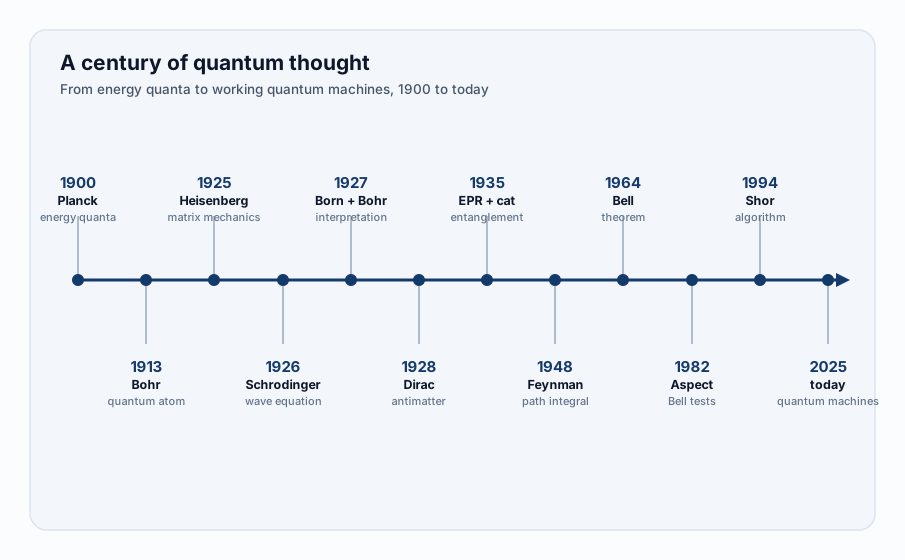
This is a tour of that century of quantum thought, told through the people who shaped it. It runs from Planck and Einstein through Bohr, Heisenberg and Schrödinger, past Dirac and the famous cat, through Feynman’s reinvention of the whole framework, and on to John Bell and the experiments that settled the deepest argument in physics. The thread that connects them is a single stubborn question about how the quantum world can be both real and strange at once.
Where quantum thought began
Quantum thought began with an act of desperation. In 1900 Max Planck was trying to explain why hot objects glow the way they do, a problem that classical physics got embarrassingly wrong. He found that the only formula that worked required energy to come in discrete lumps, or quanta, rather than flowing smoothly, and he proposed it almost apologetically as a mathematical trick.
Five years later Albert Einstein took the idea seriously and made it physical. He argued that light itself arrives in packets of energy, later called photons, and used the notion to explain the photoelectric effect, the work that would win him the Nobel Prize. Between them, Planck and Einstein had cracked open a new physics, even if neither man was entirely comfortable with what lay behind it.
It took more than a decade for the quantum idea to be accepted rather than merely tolerated. Planck himself spent years hoping his constant was a temporary device that better physics would eventually remove. The reluctance is worth remembering, because the founders were rarely comfortable revolutionaries, more often careful conservatives dragged forward by their own equations.
Bohr builds the quantum atom
In 1913 Niels Bohr brought the quantum into the heart of matter. He proposed that the electrons in an atom can only occupy certain fixed orbits, and that they jump between them by absorbing or emitting precise amounts of energy. The model explained the sharp spectral lines that atoms emit, lines that classical physics could not account for at all.
Bohr’s atom was a strange hybrid, half classical and half quantum, and it raised as many questions as it answered. Yet it set the pattern that would dominate the next two decades, in which bold physical pictures were pinned down by ever more powerful mathematics. Bohr himself would become the great interpreter of the theory, the figure around whom much of the argument turned.
Two roads to the new mechanics
By the mid 1920s the patchwork of rules needed a proper theory, and two arrived almost at once. In 1925 Werner Heisenberg, working only from what could actually be measured, built a framework now called matrix mechanics that dispensed with any picture of the electron’s path. A year later Erwin Schrödinger, inspired by Louis de Broglie’s startling claim that particles behave like waves, wrote down a wave equation that captured the same physics in a far more familiar mathematical language.
At first the two approaches looked utterly different, and their authors were not always polite about each other’s work. It soon emerged that they were mathematically equivalent, two descriptions of the same underlying reality. The wave function at the centre of Schrödinger’s equation would become the central object of quantum thought, even though nobody yet agreed on what it actually represented.
Schrödinger’s cat and the meaning of superposition
The question of what the wave function means produced the most famous thought experiment in science. Erwin Schrödinger imagined a cat in a sealed box whose life depends on a single radioactive atom, so that until someone looks, the quantum rules appear to describe the cat as both alive and dead at once. He intended the scenario as a criticism, a way of showing how absurd it was to take the mathematics too literally.
The puzzle behind the cat is superposition, the principle that a quantum system can exist in a blend of possibilities until it is measured. Max Born supplied the crucial rule that the wave function gives only the probability of each outcome, not a definite prediction, and Bohr and his circle folded this into what became the Copenhagen interpretation. For decades that reading was treated as the official voice of quantum thought, even as a minority kept insisting the story was incomplete.
Heisenberg and the limits of knowing
In 1927 Heisenberg drew out one of the deepest consequences of the new mechanics. His uncertainty principle states that certain pairs of properties, such as a particle’s position and its momentum, can never both be known precisely at the same time. The more sharply you pin down one, the more the other blurs, and this is not a limit of our instruments but a feature of nature itself.
The principle demolished the classical dream of a clockwork universe in which, given enough information, everything could be predicted in advance. It meant that chance was woven into the fabric of reality at the smallest scales. Einstein never accepted this comfortably, and his discomfort would soon drive him to design the argument that, decades later, would be turned into a decisive experimental test.
Einstein and Bohr take the argument public
The clash between the new physics and old intuitions came to a head at the Solvay conferences of the late 1920s. There Albert Einstein and Niels Bohr conducted a famous series of debates, with Einstein inventing ingenious thought experiments to expose flaws in the theory and Bohr patiently showing that each one held together. Einstein’s complaint was never that the mathematics failed but that it left far too much to chance.
Those exchanges sharpened quantum thought rather than settling it, forcing its defenders to state exactly what the theory did and did not claim. Einstein’s conviction that God does not play dice never wavered, yet he could not find the flaw he was certain existed. The argument he began would wait nearly forty years for the tools to resolve it.
Dirac unifies quantum theory and relativity
Paul Dirac gave quantum theory its mathematical elegance and its first great prediction. In 1928 he wrote an equation that combined quantum mechanics with Einstein’s special relativity, describing the electron in a way that automatically accounted for its spin. The equation was so tightly constructed that it seemed to demand something extra from the world.
That something was antimatter. Dirac’s equation implied the existence of a particle identical to the electron but with the opposite charge, and the positron was duly discovered a few years later. It was a stunning demonstration that pure quantum thought, pushed hard enough, could predict entirely new pieces of the universe before anyone had seen them.
Dirac was famous for believing that mathematical beauty is a reliable guide to physical truth. He pursued equations that were elegant and trusted that nature would follow, an instinct that the discovery of antimatter spectacularly rewarded. That faith in the power of clean mathematics runs like a current through the rest of the century.
Feynman’s dream of a quantum machine
A generation later Richard Feynman rebuilt the foundations once more. His path integral formulation reimagined a quantum particle as exploring every possible route between two points at once, a picture that made the strangeness feel almost natural and handed physicists powerful new tools. His work on quantum electrodynamics, the quantum theory of light and matter, became the most precisely tested theory in all of science.
Feynman also supplied the dream in the title of this story. In 1981 he pointed out that simulating quantum systems on ordinary computers is hopelessly inefficient, and suggested building machines that are themselves quantum mechanical. That single idea turned a century of quantum thought toward a practical goal, the quantum computer, and launched the field that now fills laboratories around the world.
Bell and the reality of entanglement
The deepest argument in quantum thought was finally settled not by philosophy but by experiment. In 1935 Einstein, with Boris Podolsky and Nathan Rosen, described pairs of particles so strongly linked that measuring one seems to affect the other instantly, and argued that this proved the theory incomplete. The effect, entanglement, sat at the centre of the dispute for thirty years.
In 1964 John Bell turned the argument into mathematics, deriving an inequality that any sensible theory of local hidden variables would have to obey. Experiments by Alain Aspect and others, refined over decades, showed that nature violates Bell’s inequality exactly as quantum mechanics predicts. The 2022 Nobel Prize recognised this work, confirming that entanglement is real and that the universe is stranger than Einstein was willing to accept.
From quantum thought to quantum machines
A hundred years on, quantum thought has escaped the seminar room and become an industry. The superposition that troubled Schrödinger and the entanglement that troubled Einstein are now treated as resources, the raw material of qubits and quantum algorithms. Machines from companies and laboratories worldwide manipulate these fragile states deliberately to perform calculations no classical computer can match.
The present moment is sometimes called the noisy intermediate scale era, a stage where machines are powerful enough to be interesting but still fragile and error prone. Much of the current effort goes into quantum error correction, the painstaking task of protecting delicate quantum states long enough to compute with them. The same superposition and entanglement that puzzled the founders are now engineering problems to be solved.
The arc from Planck’s hot objects to today’s quantum processors is one of the great intellectual journeys of modern science. Each generation found the theory stranger than the last and yet more useful, and the questions raised by the cat and by Bell remain alive in the design of real devices. Feynman’s dream is now being built, and the century of quantum thought that produced it is far from finished.
Frequently asked questions
What is meant by a century of quantum thought?
What is Schrödinger’s cat?
What was Feynman’s dream?
Who proved that quantum entanglement is real?
Why does quantum thought still matter today?




See today’s quantum computing news on Quantum Zeitgeist for the latest breakthroughs in qubits, hardware, algorithms, and industry deals.