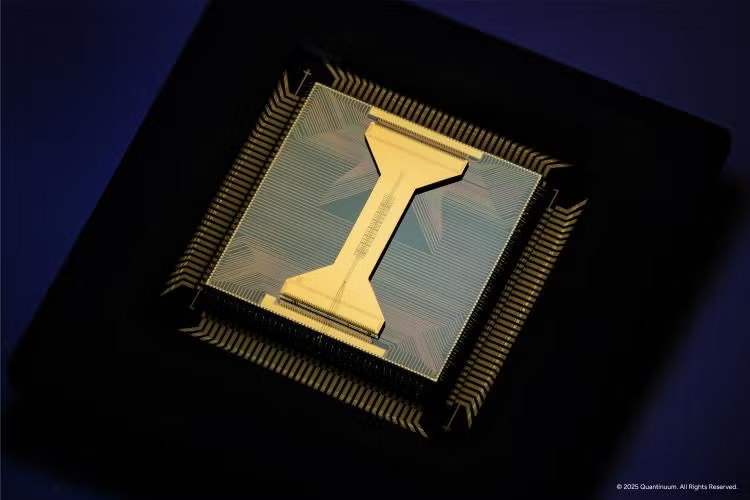
A team of theoretical physicists from the University of Colorado Boulder and Quantinuum has developed a quantum game demonstrating the capabilities of small-scale quantum computers. Tested on Quantinuum’s H1 Quantum Computer, the game involves arranging entangled qubits into a topological phase to achieve quantum pseudo-telepathy with a success rate exceeding 95%. This study highlights the potential for today’s quantum devices to perform tasks beyond classical strategies while maintaining robustness and scalability.
Researchers from Colorado have developed a new quantum game that demonstrates the potential of quantum computers. Using the Quantinuum H1 device, they arranged ytterbium ions in a grid to create a topological phase of matter, showcasing how quantum systems can maintain robust entanglement despite disturbances.
The game achieved quantum pseudotelepathy with a success rate exceeding 95%, where players used entangled particles to coordinate answers without direct communication. This phenomenon highlights the ability of quantum computers to perform tasks beyond classical capabilities, even in challenging conditions.
While this achievement doesn’t immediately solve real-world problems, it underscores the scalability and resilience of current quantum technologies. The study provides evidence that quantum devices can maintain performance despite added complexity, pointing towards future advancements in practical applications.
Why Quantum Computing Matters
Quantum computing leverages principles like superposition and entanglement to perform calculations far beyond the reach of classical computers. This new game exemplifies how these principles can be harnessed for practical applications, offering insights into the potential of quantum systems.
The use of ytterbium ions as qubits is particularly promising due to their stability and precision. By arranging them in a grid, researchers were able to create a topological phase of matter, which ensures that entanglement remains robust against local disturbances.
This experiment not only advances our understanding of quantum mechanics but also brings us closer to realizing scalable quantum devices capable of solving complex problems in fields like cryptography, optimization, and materials science.
Implications for the Future
The success of this quantum game has significant implications for the development of practical quantum technologies. By achieving a 95% success rate under real-world noise conditions, researchers have demonstrated that topological phases can be effectively utilized to maintain entanglement in large-scale systems.
While challenges remain, such as understanding the factors contributing to the remaining 5% failure rate, this work provides a foundation for overcoming current limitations. It highlights the importance of topology in quantum computing and offers promising avenues for advancing error correction techniques.
As quantum technologies continue to evolve, experiments like this will play a crucial role in bridging the gap between theoretical concepts and practical applications, paving the way for a new era of computational power.
More information
External Link: Click Here For More