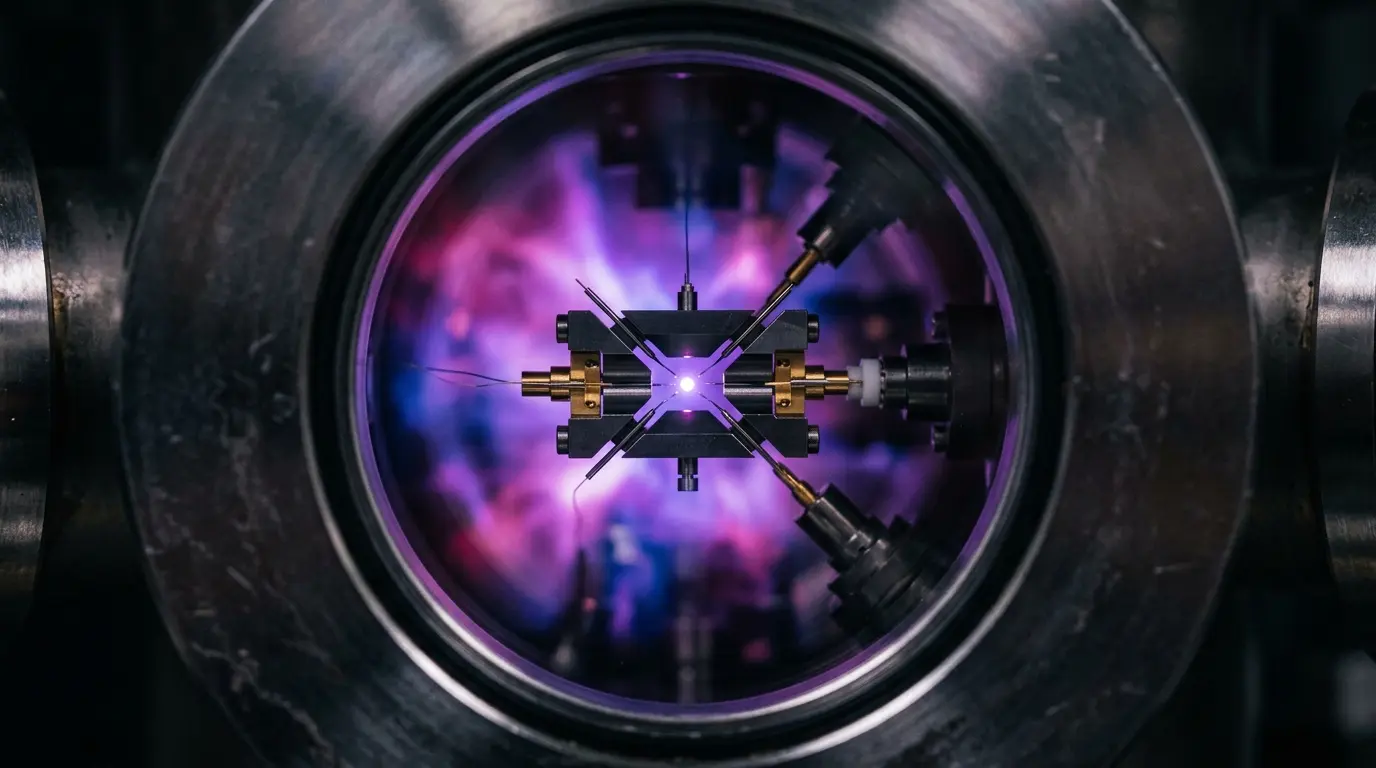
A collimated flux of three times ten to the power of ten strontium atoms per second per centimetre squared is now achievable with a new experimental setup. Ultracold strontium atom production occurs within a total vacuum system length of forty centimetres; this was accomplished by removing Zeeman coils, used to manipulate atomic states, and simplifying laser requirements. This compact design has already operated continuously for over one year, demonstrating its strong reliability.
An engineered method streamlines ultracold strontium atom production; these are key for developing technologies like precise atomic clocks and quantum computers. The apparatus achieves this with a vacuum system only forty centimetres long, sharply reducing size and complexity compared to earlier models. Its design incorporates a simplified laser setup alongside an oven consuming minimal power, enabling continuous operation exceeding one year and proving its reliability for future experiments.
Brossel have unveiled an experimental setup dramatically simplifying ultracold strontium atom production; these atoms are key building blocks for technologies ranging from ultra-precise clocks to quantum computers. Their new apparatus achieves this with a vacuum system just forty centimetres long, a significant reduction compared to previous designs, by removing bulky components like Zeeman coils and streamlining the laser requirements. A key innovation lies within their ‘Zeeman slower’, which acts like a magnetic “funnel”, gently slowing down fast-moving atoms using magnetism, similar to how a catcher handles a baseball.
This compact design also boasts low power consumption, its oven operates on only fourteen watts at 460°C, and has demonstrated over one year of continuous operation proving reliability. But can such a streamlined approach maintain performance during complex experiments requiring precise control.
Compact Design Enables Yearlong Ultracold Strontium Atom Source Operation
An atomic flux of 3x 10^10 strontium atoms per second per square centimetre has been achieved, surpassing previous apparatuses with larger footprints. This density allows continuous operation beyond one year, previously unattainable due to engineering constraints in maintaining stable ultracold atom production over extended periods. Measuring just forty centimetres from oven to science cell, the compact design eliminates bulky Zeeman coils by employing a coil-free magnetic “funnel” that gently decelerates atoms.
The simplified laser architecture further reduces complexity and cost, removing expensive components like tapered amplifiers or secondary harmonic generation systems, a major advancement enabling broader access to research with ultracold strontium. Sustained performance exceeding one year is now demonstrated; this stems from an oven consuming only fourteen Watts at four hundred and sixty degrees Celsius which generates a collimated atomic flux reaching three times ten to the power of ten atoms per second per square centimeter.
Characterisation revealed a transverse velocity of seven metres per second plus or minus two, alongside a divergence angle of 1.2 degrees, results consistent with design expectations. Further analysis showed loading rates varied depending on temperature, transitioning around four hundred and fifty degrees Celsius where vapour means free path matched nozzle dimensions; these findings suggest optimisation strategies for maximising atom capture efficiency through thermal control.
Compact Design Sharply Lowers Barriers To Ultracold Atom Research
A streamlined apparatus tackles the longstanding challenge of building accessible ultracold atom experiments, traditionally demanding substantial laboratory space and engineering expertise to manage complex vacuum systems alongside intricate laser setups. Maintaining performance under demanding conditions is key to achieving new science with this simplified design, but long-term temperature stability remains an open question. Even acknowledging that further investigation into long-term temperature stability is needed, this compact design represents strong progress for ultracold atom research.
This system will enable more researchers to explore quantum phenomena without needing extensive infrastructure or specialist support; broadening participation in this exciting field is vital. Innovations like a coil-free ‘Zeeman slower’ lower practical barriers by using magnetism to decelerate atoms without bulky electromagnets, benefiting those lacking resources or expertise in building complex systems. Achieving all of this within a vacuum system forty centimetres long represents a considerable engineering feat given the traditional demands of such experiments and empowers scientists to explore quantum physics, supporting innovation within this rapidly evolving field; future work could focus on integrating automated control systems for even greater ease of use.
This research demonstrated a compact apparatus capable of producing ultracold strontium atoms with a collimated flux of 3x 10^10 atoms per second per square centimeter. The simplified design, including a low-power oven operating at 460°C and a coil-free Zeeman slower, achieves comparable performance to larger setups in only forty centimeters of length. This reduction in size and complexity lowers the barriers to entry for researchers interested in exploring quantum phenomena, potentially broadening participation in this field. The authors note that future work may focus on integrating automated control systems into the device.
👉 More information
🗞 A compact ultracold strontium experiment
✍️ Mathieu Bertrand, Torben Pöpplau, Romain Long and Jakob Reichel (ENS-Université PSL); Lucas Béguin
🧠 ArXiv: https://arxiv.org/abs/2610.29540



See today’s quantum computing news on Quantum Zeitgeist for the latest breakthroughs in qubits, hardware, algorithms, and industry deals.