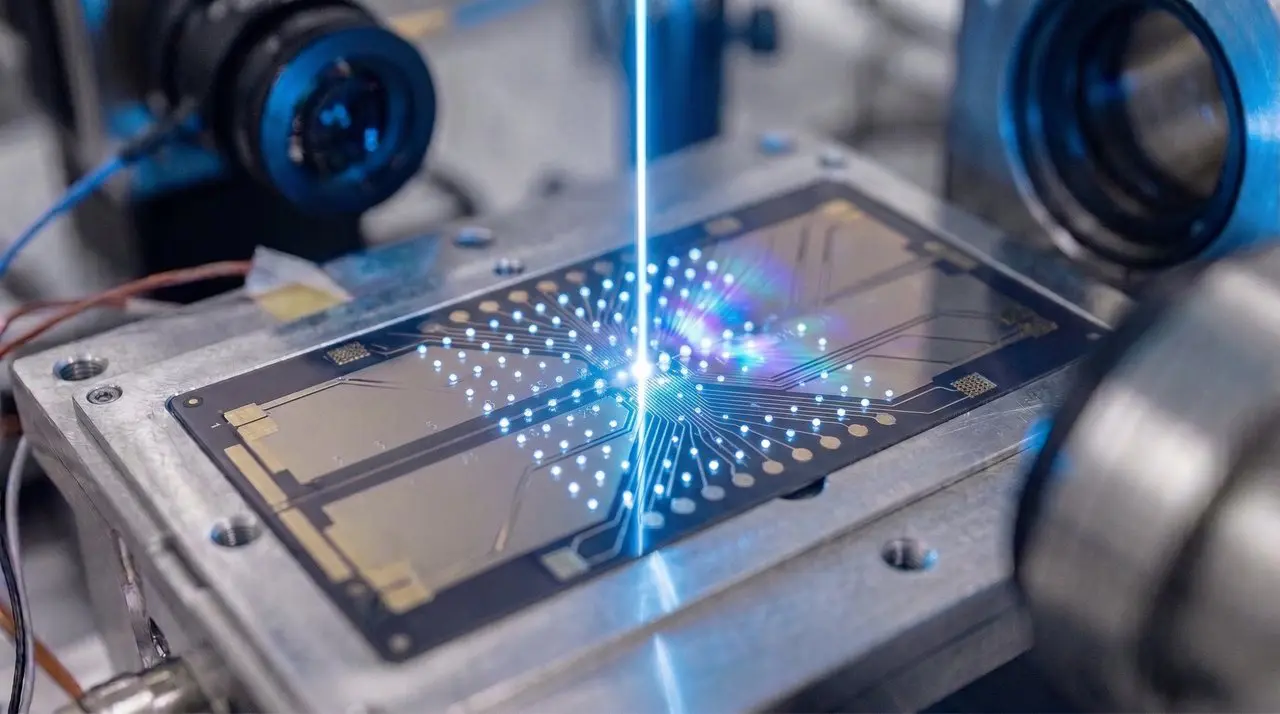
Coherently driven impurities represent a new means to investigate quantum many-body dynamics through precise local control. Probing signatures of the Anderson orthogonality catastrophe, a phenomenon where perturbing a Fermi sea induces a large scale response, revealed a power-law relationship between Rabi frequency and drive strength in an ultracold lithium-caesium mixture. The Anderson Orthogonality Catastrophe, a fundamental effect in quantum physics, has now been observed within a more complex system than previously achieved.
Studying ultracold atoms verified theoretical predictions concerning how disturbances impact large collections of electrons; this strengthens understanding of materials exhibiting unusual quantum properties. A new method for examining these intricate behaviours is introduced by utilising precisely controlled atomic ‘impurities’ within an ultracold gas to act as probes. Observation of the Anderson Orthogonality Catastrophe, a fundamental quantum effect, occurred within an ultracold atomic system more complex than previously examined.
By coherently driving ‘impurities’ within a gas of lithium and caesium atoms, researchers probed how disturbances impact large collections of electrons, validating theoretical predictions about materials with unusual properties. A Fermi polaron can be imagined as dropping a pebble into a still pond: the resulting heavier wave represents excitations moving through a sea of particles created by interactions between the impurity and its surroundings.
The team observed that the rate at which these impurities oscillate, known as the Rabi frequency, decreases predictably with increasing drive strength, mirroring expectations from theories surrounding AOC; however, understanding precisely why damping occurs remains an open question for further investigation.
Observation of persistent Anderson orthogonality catastrophe in driven Fermi polarons
A Rabi frequency of 7.62 ±0.02kHz was measured at Universität Heidelberg, surpassing limitations imposed by thermal effects and infinite mass approximations. This breakthrough allows quantitative agreement between finite temperature simulations and experimental data, demonstrating that signatures of the Anderson Orthogonality Catastrophe persist even under realistic conditions, something previously unattainable. Coherently driving heavy Fermi polarons within an ultracold lithium-caesium mixture revealed a power-law relationship between impurity oscillation rate and drive strength; exponents aligned with theoretical predictions derived from AOC theory.
The modelling accurately reproduced this scaling behaviour, confirming detectable AOC signals outside idealised laboratory settings despite inherent system complexities. Subsequent work at Universität Heidelberg corroborated these initial findings, showing Rabi oscillations’ damping provides insight into polaron dephasing, specifically, a nonmonotonic relationship between drive strength and damping matched current models. Analysis also confirmed consistent alignment of the power-law exponent governing oscillation rate across varying interaction strengths, directly linking experimental results to Anderson Orthogonality Catastrophe theory. Measurements of the quasiparticle residue ‘Z’, quantifying wavefunction overlap, were possible within weak driving regimes.
Heavy Fermi polaron dynamics reveal insights into Anderson orthogonality catastrophe
Universität Heidelberg’s research has opened new avenues for understanding how disturbances ripple through quantum systems; this is vital as physicists seek control over delicate states in materials exhibiting exotic properties. Although successful demonstration of qualitative agreement existed between observations and existing theories regarding damping, a measure of energy loss by these ‘impurities’, fully quantifying that process remains a challenge.
These findings from Universität Heidelberg are significant because they demonstrate coherent control can be used to investigate complex quantum behaviour within many-body systems. Establishing observation of the Anderson Orthogonality Catastrophe within an ultracold atomic gas provides a novel platform for investigating fundamental quantum interactions, building upon prior work establishing coherently driven impurities as tools for probing many-body dynamics with local control.
Researchers observed a power law relationship between the oscillation rate of heavy Fermi polarons and drive strength in an ultracold 6Li-133Cs mixture, consistent with predictions made by Anderson orthogonality catastrophe theory. This demonstrates that signatures of this phenomenon can be detected even outside idealised conditions, offering new ways to study how disturbances propagate through complex quantum systems. Finite-temperature simulations matched experimental results, suggesting these observations are robust despite system complexities. The damping of oscillations also provided insight into polaron dephasing, aligning with current theoretical models.
👉 More information
🗞 Anderson orthogonality scaling in the Rabi-driven heavy Fermi polaron
✍️ Michael Rautenberg, Tobias Krom, Eugen Dizer, Olivier Bleu, Eleonora Lippi, Tilman Enss, Manfred Salmhofer, Lauriane Chomaz and Matthias Weidemüller
🧠 ArXiv: https://arxiv.org/abs/2609.09129


See today’s quantum computing news on Quantum Zeitgeist for the latest breakthroughs in qubits, hardware, algorithms, and industry deals.