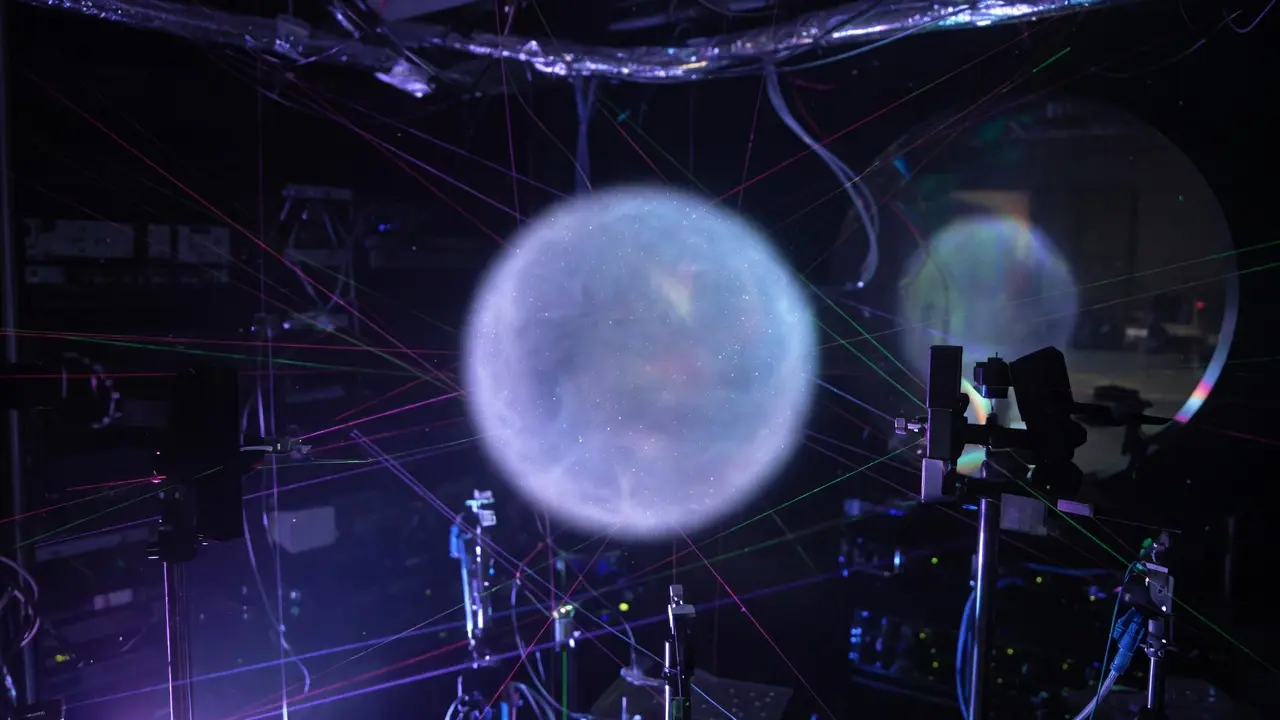
Trapped ions offer a promising platform for quantum technologies but are susceptible to disruption from stray electric fields; these cause excess micromotion which limits control of experiments. Existing methods to detect and correct this issue lack compatibility with advanced sensing techniques requiring precisely controlled, ground-state cooled motional modes. Trapped ions represent a key technology for future quantum devices; however, stray electrical fields cause unwanted movement which reduces experimental control.
A new method of stabilising these ions works alongside advanced sensing techniques, a sharp improvement on previous approaches that interfered with them. This technique converts ion displacement into measurable motion, enabling more precise micromotion compensation and opening doors to increasingly complex experiments utilising unique quantum states. Researchers at The University of Tokyo has developed the new technique for stabilising trapped ions against disruption caused by stray electric fields.
These unwanted fields induce excess micromotion, imagine gently balancing an object; any tiny wobble or vibration is like this “micromotion”, affecting experimental precision. Previous methods of correcting this issue often interfered with advanced sensing techniques that rely on incredibly still ions achieved through ground-state cooling; similar to how lasers slow down atoms, this process reduces the natural vibrations (motion) of an ion to its lowest possible energy level. The team’s approach converts ion displacement into measurable motion and detects it via the qubit itself, enabling more precise compensation than previously possible.
Precise Micromotion Compensation Enables Advanced Quantum Control
Optimal compensation fields were determined with a statistical uncertainty of 8mV/m, a sharp improvement over prior micromotion detection methods that typically lacked this precision and could not resolve displacements below approximately 10mV/m. The breakthrough enables precise control unattainable before because of limitations mitigating stray electric fields, the primary source of unwanted ion movement disrupting quantum experiments.
Converting ion displacement into detectable qubit signals via ground-state cooled motion bypassed constraints inherent in fluorescence or position monitoring techniques used previously. Naturally compatible with advanced sensing protocols employing complex motional states like Fock, squeezed, or Schrödinger-cat states, the new technique opens avenues for enhanced sensitivity and fidelity in trapped-ion quantum devices.
Precise Ion Control Enables Complex Quantum States Despite Scalability Concerns
This technique offers a path toward more precise control over trapped ions, essential for building increasingly complex quantum devices, but scaling the approach presents an immediate challenge as no detail is provided on its performance with multiple qubits confined within a single trap. Existing methods relied upon monitoring fluorescence or ion positions; demonstrably incompatible with advanced sensing protocols, they offered simplicity in multi-ion systems.
Even acknowledging that this technique hasn’t yet been demonstrated with multiple qubits working together, a key step for practical quantum computers, the advance remains significant because it provides a fundamentally new way to control ions without interfering with delicate quantum states needed for advanced calculations.
By directly linking unwanted displacement to measurable changes in qubit state, this method establishes a new standard for ion trap control and bypasses limitations inherent in previous techniques reliant on fluorescence or position monitoring which are incompatible with advanced quantum sensing protocols. This compatibility unlocks access to complex motional states, such as Fock, squeezed, and Schrödinger-cat configurations previously inaccessible due to micromotion interference, offering potential gains in sensitivity and fidelity across diverse applications from atomic clocks to computing architectures.
This research demonstrated a technique for compensating for disruptive ion movement by converting the displacement into detectable signals within the qubit itself, achieving uncertainty of 8mV/m in determining optimal compensation fields. It addresses a limitation of prior methods that interfered with sensitive quantum states used in enhanced sensing protocols. This approach offers an alternative means of controlling ions without disrupting delicate quantum information.
👉 More information
🗞 Mode-Selective Micromotion Compensation via Coherent Excitation of a Ground-State-Cooled Motional Mode
✍️ Tetsu Kinase, Ippei Nakamura and Atsushi Noguchi (The University of Tokyo)
🧠 ArXiv: https://arxiv.org/abs/2610.30614

See today’s quantum computing news on Quantum Zeitgeist for the latest breakthroughs in qubits, hardware, algorithms, and industry deals.