
Researchers at Tohoku University, in collaboration with the National Institute for Materials Science and the University of Tokyo, have integrated charge sensing, high-frequency reflectometry, and a few-electron double quantum dot within a single zinc oxide device. This achievement addresses a key challenge in semiconductor quantum computing, enabling faster detection of electron charge states in zinc oxide, an emerging material offering both a low nuclear spin environment and potential for optical coupling.
“For quantum computing, technologies that enable rapid readout of quantum states are essential,” says Associate Professor Tomohiro Otsuka of the Advanced Institute for Materials Research, Tohoku University. “By demonstrating high-frequency reflectometry in zinc oxide, we have established an important measurement technique for high-speed evaluation of quantum states in this unique material.”
High-Frequency Reflectometry Enables Faster Zinc Oxide Qubit Detection
The integrated device fabricated by researchers enabled a critical advancement in zinc oxide quantum dot measurement; high-frequency reflectometry successfully detected changes in electron charge far more rapidly than previously possible. This speed boost stems from integrating a sensor quantum dot (SQD) with a radio-frequency resonant circuit, a configuration that allowed for precise and swift charge sensing. This consolidation of technologies represents a step toward practical quantum devices built from the material.
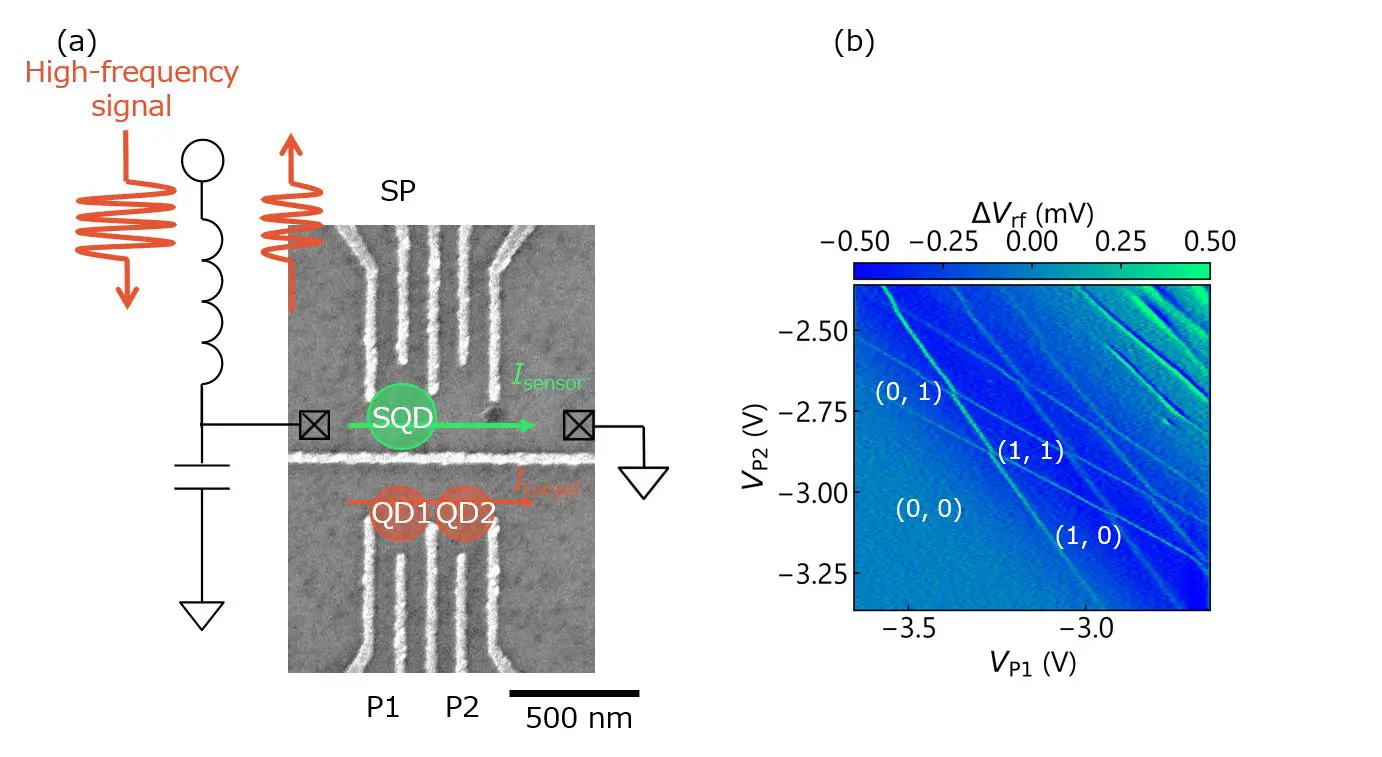
Zinc oxide’s potential as a quantum computing material rests on its specific properties, notably its low nuclear spin environment and direct bandgap, distinguishing it from more commonly studied silicon and gallium arsenide. The low nuclear spin minimizes interference with electron spin states, which is important for maintaining quantum information, while the direct bandgap opens possibilities for optical control and readout of qubits. The ability to probe these spin properties quickly is essential for refining and optimizing qubit performance.
The researchers confirmed the formation of a few-electron double quantum dot within the device, a necessary building block for manipulating and controlling individual electron spins. This double quantum dot configuration, combined with the high-frequency reflectometry, allows for detailed investigation of electron behavior at the quantum level. The team’s work addresses a long-standing challenge in ZnO quantum dot research, the difficulty of rapidly and accurately determining the charge state of electrons.
“This achievement bridges a critical experimental gap for zinc oxide quantum devices,” Otsuka added. The next phase of research will focus on demonstrating electron spin readout and manipulation, and measuring key parameters like spin relaxation and coherence times, all facilitated by this newly established high-speed measurement platform.
This achievement bridges a critical experimental gap for zinc oxide quantum devices.
Tomohiro Otsuka, Associate Professor of the Advanced Institute for Materials Research (WPI-AIMR), Tohoku University
Source: https://www.tohoku.ac.jp/en/press/advancing_quantum_computing_with_zinc_oxide_quantum_dots.html




See today’s quantum computing news on Quantum Zeitgeist for the latest breakthroughs in qubits, hardware, algorithms, and industry deals.