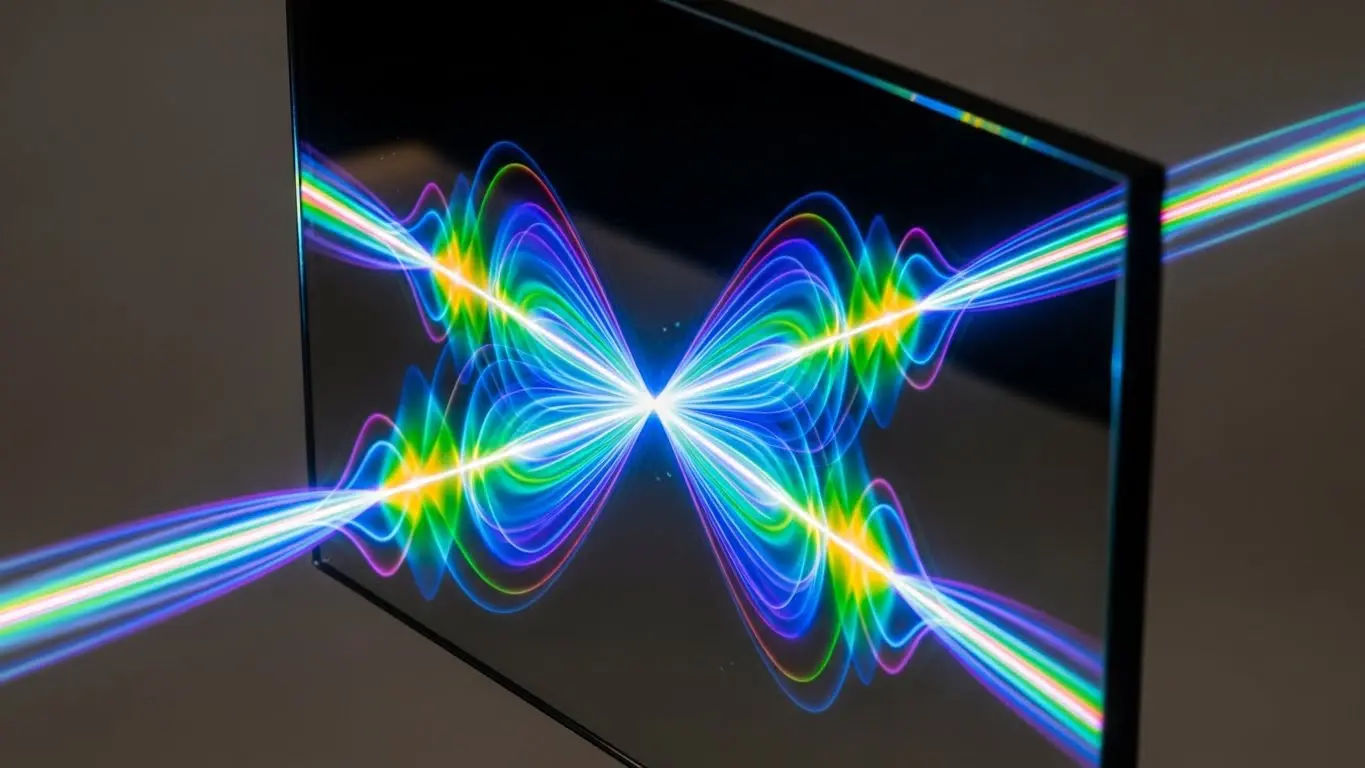
This is the 2026 reference guide to temporal reflection. Below you will find a complete, structured tour of the effect, covering theory, applications, and current research. Each section treats the phenomenon as a serious subject with concrete examples and references.
In a 2025 landmark experiment, researchers manipulated ‘temporal boundaries’ to make signals retrace their own paths through time. We are no longer just engineering space, we are engineering the clock itself. For decades, the unidirectional flow of time has been a cornerstone of our understanding of the universe. Waves, whether light, sound, or quantum mechanical, propagate forward, carrying energy and information into the future. But recent breakthroughs, culminating in a demonstration at the National Institute of Standards and Technology (NIST), suggest this isn’t a fundamental law, but rather a property of the materials through which these waves travel. This isn’t time travel in the science fiction sense; it’s a controlled reversal of wave propagation, achieved by creating what physicists are calling a ‘time interface’, a material whose properties change instantaneously, forcing waves to effectively move backwards. The implications are profound. Imagine a world where signal loss in communication networks is a thing of the past, where errors in quantum computations are automatically corrected, or where the very nature of data storage is revolutionized. This isn’t about altering the past, but about controlling the direction of information flow at a fundamental level. The 2025 experiment didn’t send a message back in time, but it did demonstrate the ability to make a wave appear to originate from its destination, a feat previously considered impossible without violating causality. This manipulation relies on a precise orchestration of material properties, creating a boundary where the conventional rules of wave physics break down. This isn’t merely a theoretical curiosity. The ability to manipulate temporal boundaries has immediate applications in areas like signal processing, data security, and potentially, the development of more robust quantum technologies. The NIST team, building on earlier work in metamaterials and non-reciprocal devices, has effectively created a ‘temporal mirror’, not one that reflects light, but one that reflects its direction in time. This achievement marks a significant departure from traditional wave manipulation techniques, opening up a new frontier in physics and engineering. The core of this technology lies in the precise control of a material’s response to incoming waves, a response that is not static, but dynamically changes in real-time.The Ghostly Echo: Defining Temporal Reflection
The concept of ‘the phenomenon’ is central to understanding the time interface. Unlike a conventional mirror which reflects spatial position, a temporal reflector reverses the direction of wave propagation in time. This doesn’t mean reversing the flow of time itself, but rather altering the phase and velocity of the wave such that it appears to originate from a point in the future. To visualize this, imagine a pulse of light. Normally, it travels from a source to a detector. With this time-domain reversal, the pulse appears to emerge from the detector and travel back to the source, even though the energy is still flowing forward in the conventional sense. This is achieved by manipulating the material’s refractive index, its ability to bend light, in a way that creates a ‘temporal gradient’. This gradient isn’t a physical slope, but a change in the material’s properties over time. The NIST team achieved this by utilizing a specially engineered metamaterial, a composite structure designed to exhibit properties not found in nature. This metamaterial contains microscopic resonators that respond to incoming electromagnetic waves. By rapidly switching the state of these resonators, they created a time-varying refractive index, effectively ‘flipping’ the direction of the wave. The key is the speed of this switching; it must be faster than the wavelength of the wave being manipulated. This requires incredibly precise control over the material’s properties and a deep understanding of wave dynamics.Building the Temporal Boundary: Metamaterials and Beyond
The creation of a functional time interface relies heavily on the development of advanced metamaterials. These artificial materials are constructed from repeating unit cells, smaller than the wavelength of the electromagnetic radiation they are designed to interact with. By carefully designing the shape, size, and arrangement of these unit cells, scientists can tailor the material’s electromagnetic properties, including its refractive index and permeability. The NIST team’s metamaterial consists of an array of tiny split-ring resonators, which act like miniature antennas. These resonators are connected to a fast-switching circuit that allows them to be rapidly turned on and off. When an electromagnetic wave encounters the metamaterial, it induces a current in the resonators. By controlling the switching speed of the circuit, the researchers can manipulate the phase of the wave, effectively reversing its direction in time. However, metamaterials are not the only path to this effect. Researchers are also exploring alternative approaches, such as using nonlinear optical materials and exploiting the properties of quantum systems. Nonlinear materials exhibit a change in their refractive index with the intensity of the incoming light, allowing for the creation of time-varying refractive indices. Quantum systems, such as superconducting qubits, offer the potential for even faster switching speeds and more precise control over wave propagation.The Causality Question: Avoiding Temporal Paradoxes
One of the most immediate concerns surrounding the time-mirror effect is the potential for causality violations. If waves can travel backwards in time, could this lead to paradoxes, such as the classic ‘grandfather paradox’? The answer, according to physicists, is a resounding no. The time interface doesn’t allow for true time travel; it only reverses the direction of wave propagation. The energy still flows forward in time, and the laws of physics remain intact. The reversed wave is not a signal from the future, but rather a reflection of the incoming wave, albeit one that appears to originate from the detector. This is analogous to a conventional mirror. When you look at your reflection, you see an image of yourself, but that image doesn’t actually exist in the mirror. It’s a virtual image created by the reflection of light. Similarly, the reversed wave is a virtual wave, a mathematical construct that doesn’t violate causality. The key is that the time interface is a passive device; it doesn’t amplify or create energy. It simply redirects existing energy. Furthermore, the this temporal-mirror process is not perfect. There is always some loss of signal, which prevents the creation of a self-sustaining loop that could lead to a paradox.Beyond Communication: Applications in Quantum Computing
While the initial focus of the time interface research has been on improving communication systems, the potential applications extend far beyond. One particularly promising area is quantum computing. Quantum computers rely on the manipulation of qubits, quantum bits that can exist in a superposition of states. However, qubits are extremely fragile and susceptible to noise, which can lead to errors in computation. The effect could be used to create a ‘temporal shield’ around qubits, protecting them from external noise and decoherence. By reversing the direction of noise waves, the time interface could effectively cancel out their effects, preserving the quantum state of the qubits for longer periods. This would significantly improve the accuracy and reliability of quantum computations. Furthermore, the phenomenon could be used to implement novel quantum algorithms. By manipulating the temporal order of quantum operations, researchers could potentially unlock new computational capabilities. The ability to control the flow of quantum information in time could revolutionize the field of quantum computing, paving the way for the development of more powerful and efficient quantum computers.The Challenge of Scale: From Lab to Real-World Devices
Despite the significant progress made in recent years, several challenges remain before the time interface can be implemented in real-world devices. One of the biggest hurdles is scalability. The current metamaterial structures are extremely small and difficult to manufacture on a large scale. Creating a time interface that is large enough to cover a significant bandwidth or area requires a massive number of precisely engineered unit cells. This poses a significant manufacturing challenge and increases the cost of production. Another challenge is the energy consumption of the switching circuit. The fast switching speeds required for temporal reflection consume a significant amount of energy, which can limit the practicality of the device. Researchers are exploring alternative materials and designs that can reduce energy consumption without sacrificing performance. Furthermore, the time interface is currently limited to a narrow range of frequencies. Expanding the bandwidth of the device requires more complex metamaterial structures and more sophisticated control algorithms.The Speed Limit: Pushing the Boundaries of Temporal Control
The speed at which the metamaterial’s properties can be switched is a critical factor in determining the effectiveness of the time interface. The switching speed must be faster than the wavelength of the wave being manipulated. This is a significant technical challenge, as it requires incredibly precise control over the material’s properties and a deep understanding of wave dynamics. Current metamaterial structures are limited by the speed of the electronic circuits used to control the resonators. Researchers are exploring alternative approaches, such as using optical switching techniques and exploiting the properties of quantum systems, to overcome this limitation. Optical switching uses light to control the state of the resonators, offering the potential for much faster switching speeds. Quantum systems, such as superconducting qubits, offer the ultimate limit in switching speed, as they operate on the timescale of femtoseconds (quadrillionths of a second). However, these technologies are still in their early stages of development and require significant further research.The Future of Temporal Engineering: A New Era of Wave Control
The development of the time interface marks a paradigm shift in our understanding of wave physics. For the first time, we have demonstrated the ability to control the direction of wave propagation in time, opening up a new frontier in physics and engineering. While significant challenges remain, the potential applications are vast and far-reaching. From improving communication systems and enhancing quantum computing to developing new sensors and imaging technologies, the time interface promises to revolutionize a wide range of fields. The next step is to scale up the technology and develop practical devices that can be used in real-world applications. This will require significant investment in research and development, as well as collaboration between physicists, engineers, and materials scientists. The future of temporal engineering is bright, and we can expect to see even more groundbreaking discoveries in the years to come. The ability to manipulate time, even in a limited sense, is a testament to human ingenuity and our relentless pursuit of knowledge. The manipulation of temporal boundaries is no longer science fiction; it is a rapidly evolving reality.External reference for temporal reflection: Nature Physics paper on temporal reflection of electromagnetic waves.
Temporal reflection 2026 Outlook
Temporal reflection entered 2026 as a confirmed experimental phenomenon after the 2023 CUNY microwave demonstration, though optical-frequency demonstrations remain elusive because changing the refractive index fast enough at optical frequencies is technically demanding. Several research groups (CUNY, Harvard, Imperial College London) are pursuing optical-frequency demonstrations using epsilon-near-zero materials and ultrafast pump-probe schemes. The Nature Physics paper on the 2023 temporal reflection microwave demonstration is the foundational experimental reference.Why The Effect Exists
Temporal reflection arises because Maxwell’s equations treat time and space symmetrically: a sudden change in the spatial profile of a medium reflects waves spatially, and a sudden change in the temporal profile of a medium reflects waves temporally. The temporal reflection produces a backward-propagating wave with reversed time evolution but preserved spatial structure. The phenomenon is a clean consequence of the wave equation under abrupt parameter changes and was theoretically predicted in 1958 by Morgenthaler.Why It Took 65 Years To Demonstrate
Temporal reflection took six decades to demonstrate experimentally because changing the refractive index of a material faster than the wave period is technically demanding. The 2023 CUNY work used a metasurface with switchable elements driven at radio frequencies, which is feasible because microwave wavelengths are long. Optical-frequency demonstrations require switching speeds in the femtosecond range, which is at the edge of current ultrafast laser capabilities. Epsilon-near-zero materials are the leading candidate platform.What Comes Next
By 2030 the field expects optical-frequency demonstrations of Temporal reflection, practical applications in time-reversed antennas for radar and wireless, and integration with metasurfaces for holographic imaging through scattering media. Quantum-optical extensions using time-reversed quantum states could enable new entanglement-distribution protocols. The combination of Temporal reflection with classical and quantum metasurface engineering is one of the most active areas in modern wave physics.Temporal reflection FAQ
What is Temporal reflection?
Temporal reflection is a wave phenomenon in which a wave reverses its direction of propagation when the medium it travels through abruptly changes properties. Unlike conventional reflection at a spatial interface, Temporal reflection occurs at a temporal interface (a sudden change in the medium throughout space) and produces a backward-propagating wave with reversed time evolution but preserved spatial structure. The effect was predicted by Morgenthaler in 1958 and first cleanly demonstrated in microwaves by Andrea Alu’s group at CUNY in 2023.
How is Temporal reflection different from a regular mirror?
A regular mirror is a spatial interface: the medium changes at a particular location, reflecting waves that hit it. Temporal reflection is a temporal interface: the medium changes throughout space at a particular instant, reflecting waves in time. The two are dual to each other in Maxwell’s equations. Practically, a regular mirror reverses the spatial direction of propagation while preserving time order; Temporal reflection reverses the time order while preserving the spatial structure of the wave.
When was Temporal reflection first demonstrated?
Temporal reflection was theoretically predicted by Morgenthaler in 1958, but the first clean experimental demonstration was published by Andrea Alu’s group at CUNY in Nature Physics in March 2023. The experiment used a metasurface of switchable elements driven at radio frequencies to create a sudden change in effective refractive index, producing a measurable backward-propagating wave. Optical-frequency demonstrations remain technically challenging and are a current focus of multiple research groups.
What are the applications of Temporal reflection?
Proposed applications of Temporal reflection include time-reversed antennas for radar and wireless communication, holographic imaging through scattering media, novel optical components that operate without spatial mirrors, and quantum-optical devices that exploit time-reversed quantum states for new entanglement-distribution protocols. The combination of Temporal reflection with metasurface engineering is also opening new design spaces for metamaterials. As of 2026 most applications remain at the proof-of-principle stage; commercial deployment would require optical-frequency demonstrations and engineering maturity.



See today’s quantum computing news on Quantum Zeitgeist for the latest breakthroughs in qubits, hardware, algorithms, and industry deals.