Zapata Quantum’s Scientific Advisory Board comprises leading researchers and technologists focused on advancing the development of scalable, fault-tolerant quantum computing. This board guides efforts to overcome limitations in current quantum systems and achieve reliable quantum computation. The advisory group’s expertise is directed toward the transition to quantum systems capable of addressing complex computational challenges. Their collective work aims to establish the foundations for practical applications of quantum technology and unlock its potential across various scientific and industrial fields.
Zapata Quantum’s Scientific Advisory Board
Zapata Quantum’s Scientific Advisory Board is composed of leading researchers and technologists. The group’s focus centers on advancing the field toward scalable, fault-tolerant quantum computing. This suggests a dedication to overcoming current limitations in quantum technology, specifically addressing challenges related to building larger and more reliable quantum systems.
Ultimately, the purpose of Zapata Quantum’s Scientific Advisory Board is to guide the transition to more powerful quantum computing. Focusing on scalability and fault tolerance highlights the critical areas needing improvement for quantum computers to become truly impactful tools. The board’s expertise is intended to shape the future direction of this rapidly evolving field.
The new Scientific Advisory Board appointments further solidify the Company’s scientific foundation and will help guide Zapata’s long-term technical direction.
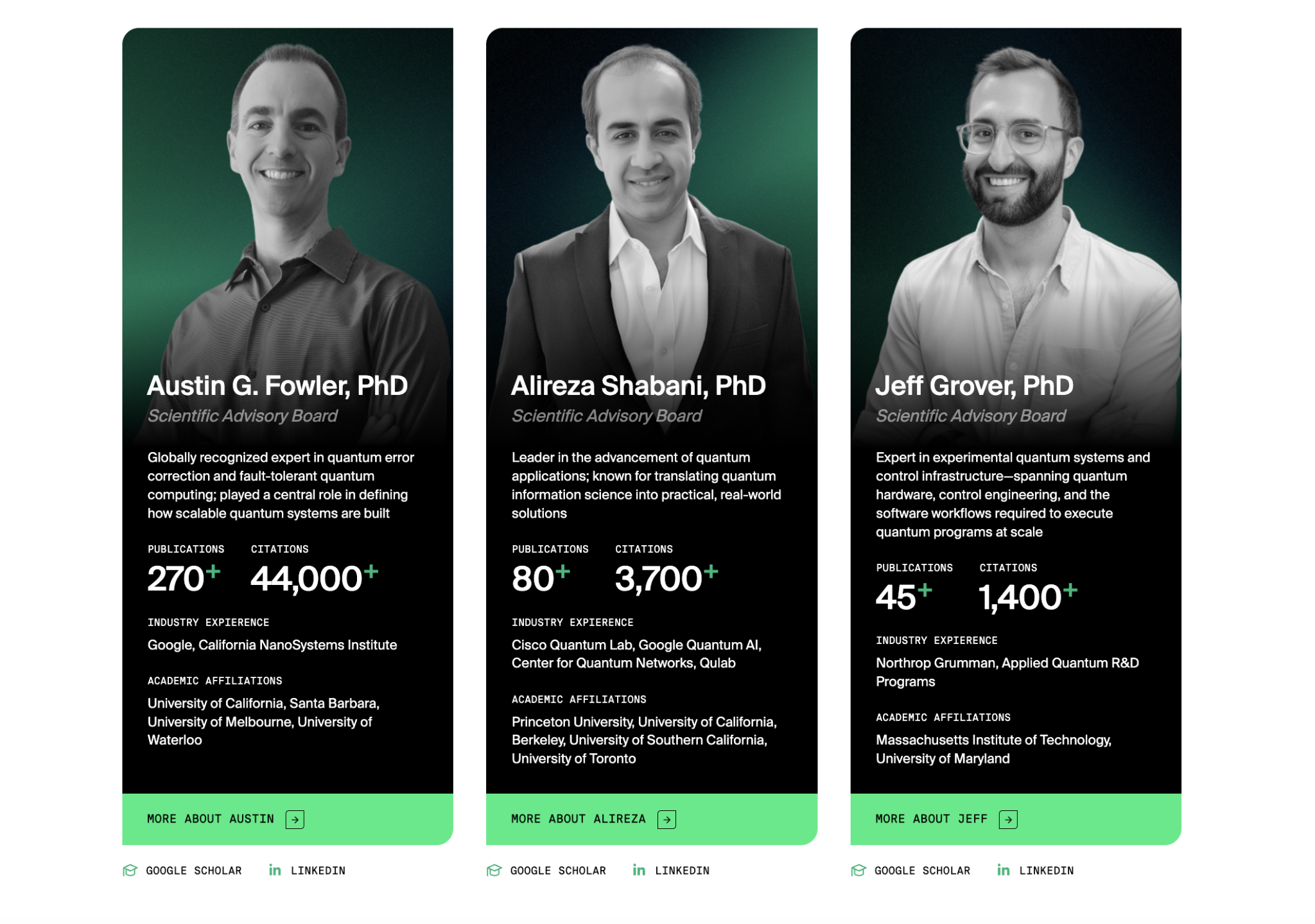
- Dr. Alireza Shabani is a leading figure in the advancement of quantum applications, recognized for translating quantum information science into practical, real-world impact. He founded Cisco Quantum Lab, where he led application-driven research at the intersection of quantum information and enterprise deployment. He is also the founder of a quantum-focused startup applying quantum computing and AI to drug discovery and chemical science. His background spans academia, entrepreneurship, and industrial research, including postdoctoral research at Princeton University and UC Berkeley, and prior research roles at Google Quantum AI.
- Dr. Austin G. Fowler is a globally recognized authority in quantum computing and a leading figure in the development of quantum error correction and fault-tolerant quantum architectures. His pioneering work on surface code quantum error correction helped establish the theoretical foundation for scalable, fault-tolerant quantum computers. He previously served as a research scientist at Google Quantum AI, where he was a co-author of Google’s landmark 2019 Nature paper demonstrating quantum supremacy. He also founded and continues to lead TQEC (Topological Quantum Error Correction), an influential open-source project focused on the systematic construction and compilation of error-corrected quantum circuits.
- Dr. Jeff Grover is a principal research scientist in MIT’s Engineering Quantum Systems (EQuS) Group, where his work focuses on experimental quantum systems, control infrastructure, and multi-qubit calibration. His expertise spans the critical interface between quantum hardware and the software and operational workflows required to run quantum applications reliably. Dr. Grover brings a systems-level perspective that grounds algorithms and use cases in the real performance, stability, and constraints of quantum hardware, helping ensure that application ambition is aligned with what today’s systems can deliver, and how they must evolve to support scalable, deployable applications in the future.
Achieving true fault tolerance requires rigorous control over quantum decoherence, the primary obstacle where environmental noise causes qubits to lose their fragile quantum information. Leading research focuses on implementing sophisticated Quantum Error Correction (QEC) codes, such as the surface code mentioned by Dr. Fowler. These methods do not merely correct individual bit flips but encode logical qubits across many physical qubits, allowing the system to detect and mitigate correlated errors inherent in large-scale processors.
The realization of these architectures depends heavily on the physical realization of the qubit itself. Current hardware candidates span various modalities, including superconducting circuits, trapped ions, and photonic systems. Each platform presents unique trade-offs regarding coherence times, gate fidelity, and connectivity. For instance, trapped ion qubits offer exceptional gate precision, while superconducting circuits benefit from robust engineering and integration with existing semiconductor manufacturing techniques.
From a computational perspective, quantum advantage is measured not just by qubit count, but by effective qubit connectivity and algorithm suitability. Algorithms like Variational Quantum Eigensolver (VQE) and Quantum Approximate Optimization Algorithm (QAOA) utilize near-term, intermediate-scale quantum (NISQ) devices. The successful implementation of these requires sophisticated quantum compilation techniques to map logical circuits onto the physical constraints of the underlying hardware topology.
Zapata Quantum’s Scientific Advisory Board brings together leading researchers and technologists shaping the transition to scalable, fault-tolerant quantum computing.


See today’s quantum computing news on Quantum Zeitgeist for the latest breakthroughs in qubits, hardware, algorithms, and industry deals.