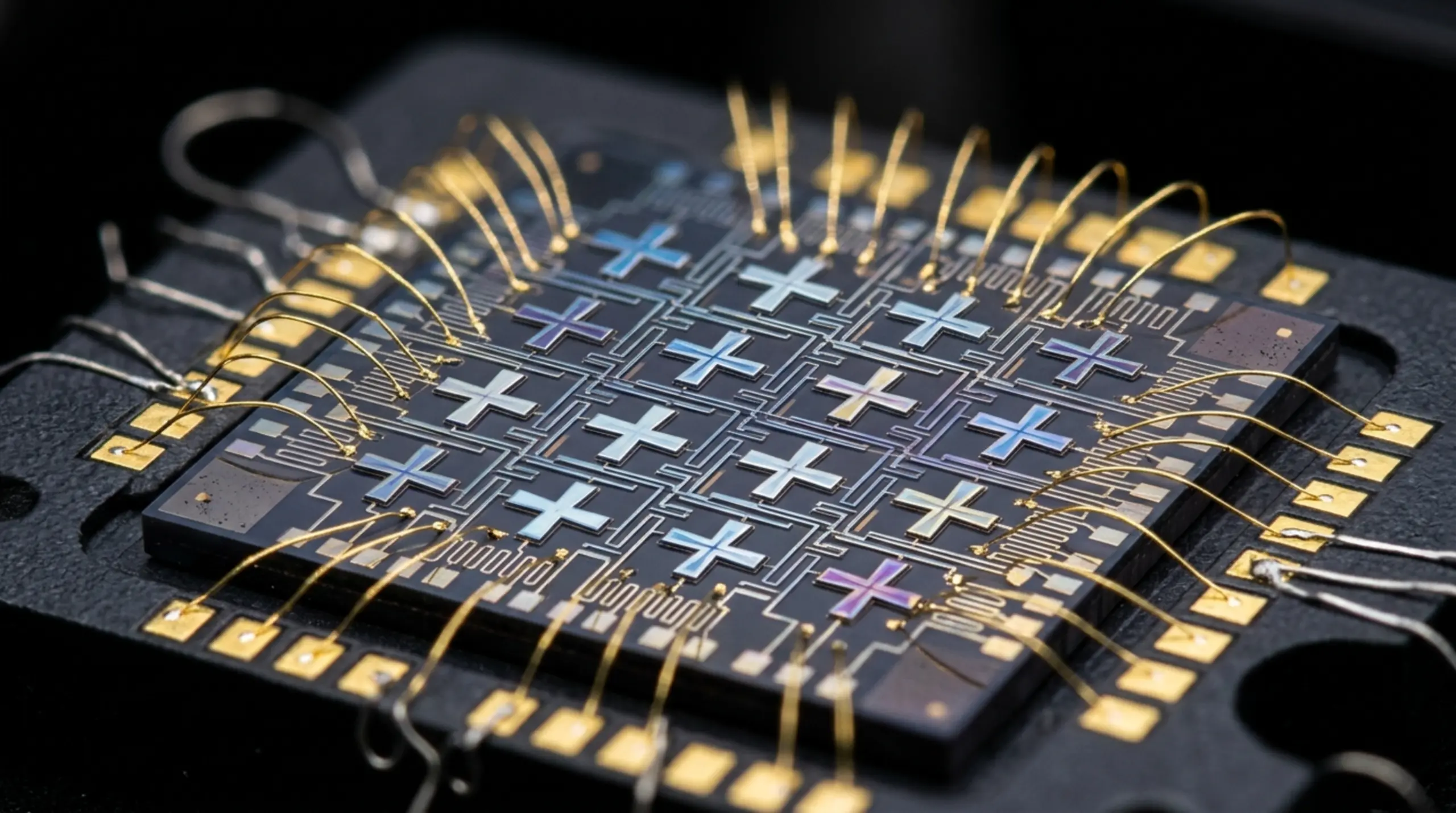
Researchers at Tencent Quantum Laboratory have proposed a double-transmon coupler (DTC) architecture that uses shared control lines to reduce wiring complexity in superconducting quantum processors. The team’s work addresses a significant bottleneck for scalability; integrating single-transmon coupler (STC) schemes currently increases the number of control lines needed for operation.
This new DTC architecture efficiently suppresses undesirable static ZZ coupling while maintaining accurate control over two-qubit gate operations, demonstrated by the preparation of Bell and three-qubit GHZ states with fidelity exceeding 99% and 96%, respectively. This multiplexed approach offers potential to minimize wiring overhead in two-dimensional qubit arrays, greatly enhancing the scalability of superconducting quantum processors.
Double-Transmon Coupler Scheme Reduces Wiring Complexity
The Tencent Quantum Laboratory has demonstrated a double-transmon coupler (DTC) scheme capable of preparing three-qubit GHZ states with a fidelity exceeding 96%, a result enabled by a reduction in the number of control lines needed to operate the qubits. This new architecture addresses a core challenge in scaling superconducting quantum processors, where the increasing complexity of wiring has become a significant impediment to building larger, more powerful systems.
The team’s approach uses shared coupler control lines, a departure from previous single-transmon coupler (STC) designs that required dedicated lines for each coupling interaction. Experimental verification involved implementing both a fast coupler Z-control-based CZ gate and a parametric iSWAP gate, demonstrating the versatility of the DTC architecture.
This suppression of crosstalk is confirmed by random-barrier (RB) measurements, which show consistent fidelities between 99.86% and 99.92% for qubits undergoing simultaneous and isolated testing. The data confirm that the residual ZZ coupling between neighboring qubits is effectively suppressed, even during qubit frequency adjustments, without the need for additional flux pulses on the couplers. The multiplexed DTC scheme’s compatibility with two-dimensional square-lattice qubit architectures further enhances its potential for scalability.
The researchers envision two approaches to line sharing, including a central qubit using four adjacent couplers controlled by a single shared line. This intrinsic selectivity of parametric gates allows for the sharing of coupler Z control lines among a larger number of DTCs, streamlining the physical layout of the processor. The ability to create a three-qubit GHZ state, a benchmark for entanglement generation, highlights the practical applicability of this multiplexing approach in complex systems.
The team’s work builds on previous DTC designs, which demonstrated superior control over coupling strengths and high-fidelity CZ gate implementation in two-qubit systems. However, scaling those earlier designs to multi-qubit configurations presented ongoing challenges. The current implementation presents a robust control-line multiplexed DTC scheme that achieves an optimal balance between simplification of control lines and enhanced coupling precision. Simply reducing wiring at the expense of control accuracy would negate the benefits of the new architecture.
The researchers prepared Bell states on qubit pairs and using the CZ gates, further validating the entangling capability of the system. The results demonstrate that the multiplexed DTC scheme is naturally compatible with the two-dimensional square-lattice qubit architecture, a common layout for superconducting quantum processors. The potential impact of this work extends to practical implementation of surface codes and other quantum error correction protocols.
Static ZZ Coupling Suppression via Multiplexed DTC Architecture
Experimental verification confirms the new double-transmon coupler (DTC) architecture maintains accurate two-qubit gate operations while actively suppressing static ZZ coupling, a critical impediment to scaling superconducting quantum processors. Unlike previous designs, this multiplexed configuration sustains low ZZ coupling, below 100 kHz, across a broader range of qubit detuning, facilitating practical control-line multiplexing for larger systems.
The extended suppression window is a key advantage, as the standard single-transmon coupler (STC) scheme confines this low coupling to a narrow operating region, limiting its adaptability. Systematic analysis, both theoretical and experimental, demonstrates the feasibility of performing parallel single-qubit gate operations within this DTC architecture.
This consistency is achieved through a practical configuration supporting both single-qubit gate implementation and scalable CZ gate operation. The team implemented CZ gates on qubit pairs Q1-Q2 and Q2-Q3, assessing the impact of ZZ coupling from spectator qubits to quantify the robustness of these multiplexed gate operations. The DTC architecture’s compatibility with control-line multiplexing is particularly beneficial for multi-qubit systems requiring simultaneous frequency tuning, a common need in advanced quantum algorithms.
To validate the scheme’s applicability in practical quantum circuits, they prepared Bell states on Q1-Q2 and Q2-Q3, achieving fidelity exceeding 99% and a three-qubit GHZ state with 96% fidelity. These results demonstrate the ability to create complex entangled states essential for quantum computation and simulation. Further investigation into ZZ coupling characteristics revealed that the DTC’s performance is relatively insensitive to modest variations in qubit frequency.
This insensitivity, stemming from the approximate equality of inter-qubit coupling strengths, enables real-time modulation of the effective coupling during circuit execution, significantly reducing the control overhead in scalable architectures. The experimental setup involved a superconducting quantum processor featuring five frequency-tunable transmon qubits arranged in a one-dimensional chain, with the three qubits on the right, Q1, Q2, and Q3, serving as the multiplexed unit. Quantifying ZZ crosstalk during CZ gate operations involved designating Q3 as a spectator qubit while performing RB sequences on Q1-Q2, and preparing Q3 sequentially in the |0⟩, |1⟩ and + |1⟩) states.
By minimizing the influence of spectator qubits on adjacent CZ gate operations, the DTC architecture demonstrates a promising path towards scalability. This capability is key for building larger, more complex quantum processors capable of tackling increasingly challenging computational problems. The ability to maintain high fidelity while reducing wiring complexity positions the DTC architecture as a strong candidate for future scalable quantum computing systems.
Scalability Challenges of Single-Transmon vs. Double-Transmon Couplers
The implementation of a multiplexed control-line scheme using a double-transmon coupler (DTC) architecture demonstrably minimizes residual ZZ coupling during qubit frequency adjustments, a critical factor previously limiting the scalability of superconducting quantum processors. The Tencent Quantum Laboratory team verified this suppression even as qubits shifted frequencies, a common requirement for complex quantum operations. The team’s work moves beyond simply suppressing crosstalk; it demonstrates a method for sharing control lines among multiple DTCs, directly addressing the bottleneck created by increasing qubit counts.
The team validated the DTC’s performance by preparing Bell states on qubit pairs Q1-Q2 and Q2-Q3 using controlled-Z (CZ) gates, achieving high-fidelity entanglement. Further testing involved generating a three-qubit Greenberger-Horne-Zeilinger (GHZ) state, a more complex entangled state, with a measured fidelity of 96.0%.
They demonstrated the effective implementation of a diabatic CZ gate when two DTCs share a single line, and used the intrinsic selectivity of parametric gates to extend this sharing capability. The ability to maintain high fidelity during these frequency adjustments is particularly noteworthy, as it circumvents a common source of error in superconducting quantum systems. The researchers highlight that this suppression of spectator qubit influence on adjacent CZ gate operations is a key indicator of the architecture’s scalability.
The team’s findings position the multiplexed DTC architecture as a promising candidate for scalable multiplexed architectures in large-scale quantum computing. The work at Tencent Quantum Laboratory builds on previous efforts to address control line overhead, including frequency-division multiplexing and the use of fixed-frequency qubits.
However, the DTC approach offers a unique combination of reduced wiring complexity and maintained control precision, potentially overcoming limitations of earlier designs. The team’s focus on parametric gate implementations further expands the versatility of the architecture. The preparation of Bell states and three-qubit GHZ states further validates the scalability of this approach, demonstrating its ability to support complex quantum operations with high fidelity.
Theoretical Model of Multiplexed DTC Unit and Hamiltonian
Incorporating a multiplexed unit comprised of three transmon qubits coupled via two double-transmon couplers (DTCs), the design of a superconducting quantum processor has been validated by experimental results. The extended suppression window allows for practical implementation of multiplexed control lines within DTC architectures, a critical step toward scaling quantum systems. The team demonstrated this capability by arranging the frequencies of three qubits in a Λ-type configuration, mitigating leakage effects associated with shared control lines.
Specifically, the frequency detuning between qubits and was set to -90 MHz, while that between and was 400 MHz. Experimental verification involved assessing ZZ suppression using simultaneous randomized benchmarking (RB) on qubits , and . Results indicate consistent fidelities, : 99.91(1)%; : 99.90(1)%; : 99.86(1)%, across simultaneous RB and isolated RB, confirming effective suppression of ZZ crosstalk within the multiplexed DTC scheme.
Despite residual ZZ interactions remaining near suppression points, remaining below 100 kHz, the team anticipates further improvements through enhanced cryogenic magnetic shielding and fabrication processes. The study details that the regime where ZZ coupling remains below 10 kHz is confined to a narrow crossing region for STC configurations, while the DTC sustains this low ZZ coupling over a substantially broader range.
Data supporting the findings, as well as the code used for simulations, are available from the corresponding authors, Z.X.Z., Y.C.Z., and S.Y.Z., upon request. The team’s work demonstrates a pathway toward reducing wiring complexity in two-dimensional qubit arrays, a significant hurdle in building larger, more powerful quantum processors.
The code used for simulations is also available from the same researchers, furthering the potential for independent verification and expansion of this promising new architecture. The team, comprised of Tianqi Cai, Chitong Chen, Kunliang Bu, Sainan Huai, Xiaopei Yang, Zhiwen Zong, Yuan Li and the aforementioned corresponding authors, all affiliated with Tencent Quantum Laboratory in Shenzhen, China, have laid the groundwork for a more scalable and efficient approach to superconducting quantum computing.



See today’s quantum computing news on Quantum Zeitgeist for the latest breakthroughs in qubits, hardware, algorithms, and industry deals.