Researchers at the University of Pennsylvania have demonstrated a method for maintaining high-fidelity control of silicon spin qubits for ten days without recalibration. The team replaced standard control pulses with two new designs, BIR-4 and CORPSE, which prove resilient to the drift that typically requires quantum processors to be retuned every few hours.
CORPSE pulses, when fully calibrated, achieve 99.97% fidelity per gate, matching the performance of traditional pulses, while also tolerating a frequency offset of ±0.9 MHz. This advance mitigates a key bottleneck in scaling quantum-dot-based quantum processors by reducing the need for constant tuning.
Silicon Spin Qubits and the Need for Recalibration
Silicon spin qubits maintained a consistent rotation angle of 0.3 degrees over ten days without frequent recalibration, according to work from the University of Pennsylvania. This achievement addresses a critical obstacle to building larger quantum processors, where the cumulative effect of constant tuning can limit scalability. The research team, based in the Department of Electrical and Systems Engineering and the Department of Computer and Information Science, demonstrated that newly designed control pulses significantly reduce the need for this ongoing adjustment.
The standard approach to manipulating spin qubits relies on precisely tuned microwave pulses, but these calibrations are susceptible to drift from device noise and fluctuations in control instrumentation. Each control axis, amplitude and frequency, requires regular measurement and correction, typically every few hours, to maintain high-fidelity operations. The University of Pennsylvania team replaced conventional square control pulses with two alternative designs, BIR-4 and CORPSE, to combat this drift.
These pulses were tested on a silicon quantum-dot device, and their performance was benchmarked against deliberate miscalibration scenarios. The team employed gate-set tomography, tracking errors over the ten-day period without any recalibration to assess long-term stability. The researchers found that BIR-4 maintained 99% Clifford fidelity even with a factor of two change in drive power, indicating resilience to variations in the energy applied to the qubit.
Even more impressively, CORPSE sustained similar fidelity across a frequency offset of ±0.9 MHz, a substantial tolerance for drift. “The progress of spin qubits over the past decade, from proof-of-principle demonstrations to fully tuned processors with fault-tolerant control fidelities, has rested on frequent recalibration of these two control axes,” the authors write, highlighting the significance of reducing this dependency.
The stability of BIR-4 was further demonstrated by its ability to hold its rotation angle to within 0.3 degrees throughout the ten-day experiment, even while experiencing a 1.3 MHz frequency jump.
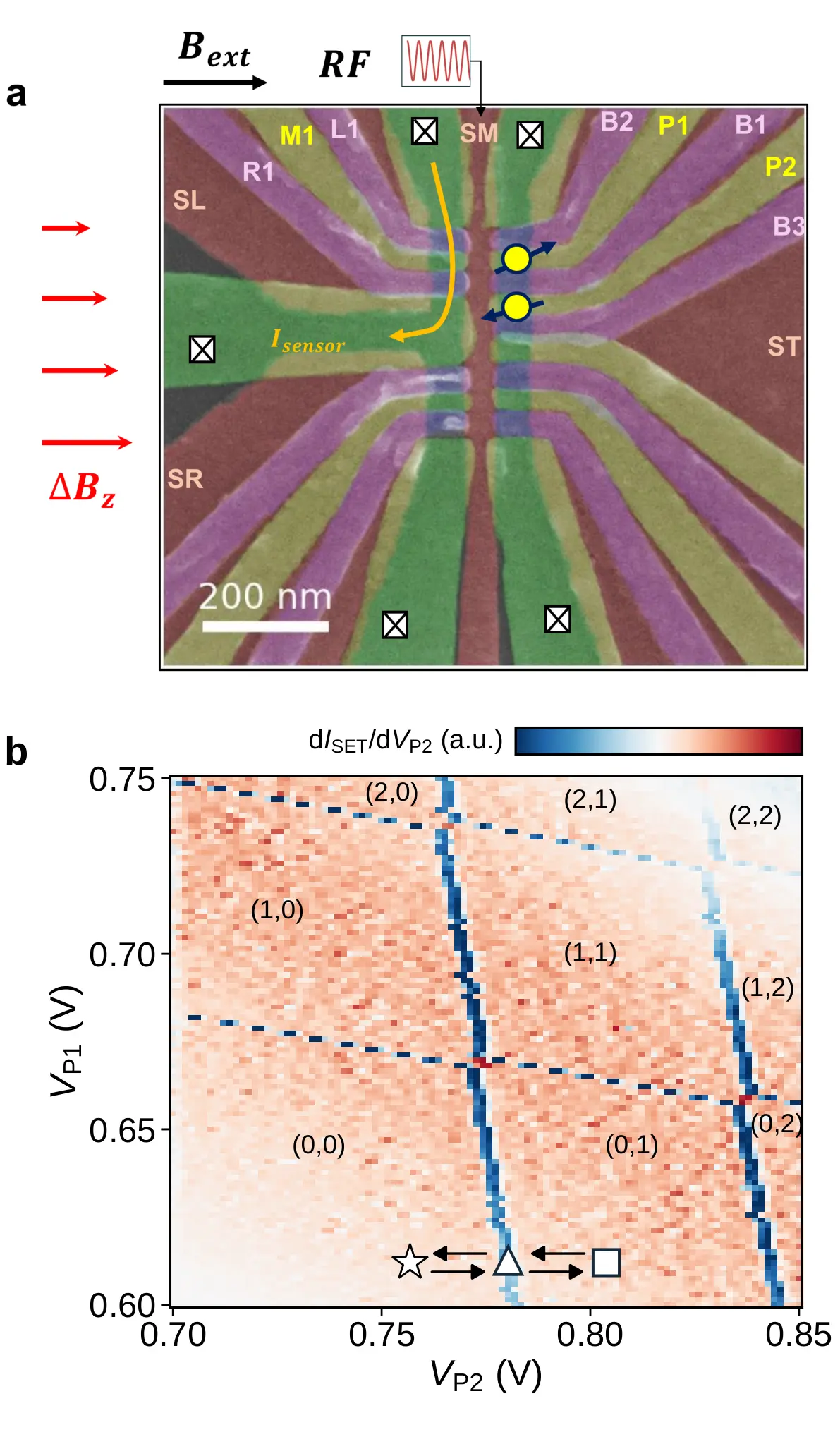
A false-color scanning electron micrograph of a device nominally identical to the one measured shows that BIR-4 holds its rotation angle to 0.3 degrees throughout, including across a 1.3 MHz frequency jump, demonstrating resilience to a common source of qubit instability.
Factors like power delivery variations across multiple qubits, off-resonant drive causing Stark shifts and heating-induced Zeeman frequency shifts all contribute to calibration drift. The ability to maintain stable control over extended periods will be essential for realizing the full potential of silicon spin qubits as a viable platform for scalable quantum computing.
Clifford and Single-Gate Fidelity Performance of Pulses
CORPSE pulses maintain similar fidelity to a calibrated square pulse when fully calibrated. This performance demonstrates a path toward stable qubit operation without frequent recalibration, a critical challenge in scaling quantum computing architectures. The work details how these pulses, adiabatic BIR-4 and composite CORPSE, counteract the effects of device drift, specifically variations in frequency and power.
Benchmarking against deliberate miscalibration revealed that the CORPSE pulse family maintains fidelity across a ± 0.9 MHz offset. The design of these pulses addresses distinct calibration vulnerabilities, with BIR-4 proving resilient to changes in drive power, maintaining 99% Clifford fidelity over a factor of two variation. The team compiled single-qubit Cliffords into primitive gate sets to assess performance, noting that the CORPSE pulses required 2.17 primitives per Clifford, while the square and BIR-4 pulses averaged 1.875.
Ten-Day Drift Tracking with Gate-Set Tomography
This extended monitoring, conducted on a quantum-dot device, demonstrates a significant improvement over systems requiring tuning every few hours and addresses a key obstacle to scaling quantum processors. The experimental setup involved a gate-defined double quantum dot within a Si/SiGe heterostructure, using a cobalt micromagnet and a single-electron-transistor for spin state measurement. An in-plane external field of 0.42 Tesla, combined with the micromagnet’s offset field, established a Larmor frequency, while electron spin resonance drove rotations at a specific Rabi frequency.
With a dephasing time of 12 microseconds and a Hahn-echo coherence time of 25 microseconds, the dominant source of noise was determined to be quasi-static on the timescale of a gate operation. All benchmarking relied on Clifford randomized benchmarking and gate-set tomography, techniques insensitive to errors in state preparation and measurement. The gradient of the external field was accounted for in simulations, acknowledging that frequency drift can partially translate into power drift and create some interdependence between the two calibration axes.
Mitigating Drift for Scalable Quantum-Dot Processors
Silicon spin qubits offer high control fidelities, fast readout and compatibility with state of the art electronics foundries making them a leading candidate for a scaled quantum computer. In the Loss-DiVincenzo architecture, each spin is rotated by a resonant microwave pulse whose amplitude and frequency must be precisely controlled. Both parameters vary from dot to dot and wander in time with charge noise and temperature. This is particularly true for micromagnet-equipped devices that enable fast electric-dipole spin resonance (EDSR), where the field gradient that provides the drive increases their sensitivity to the electron’s position.
Device and readout. The work addresses a critical limitation in scaling quantum processors, the constant need for recalibration that currently hampers progress beyond a few qubits.
The team at the University of Pennsylvania focused on developing control pulses less susceptible to drift in device parameters, specifically exploring the adiabatic BIR-4 and composite CORPSE pulse designs. This approach is particularly relevant as systems expand beyond a few qubits, where meticulous calibration becomes increasingly impractical.
👉 More information
🗞 Mitigating drift in spin-qubit control with calibration-insensitive pulses
✍️ Mridul Pushp, Seong Woo Oh, Vatsal K. Bandaru, Noah D. Johnson and Anthony J. Sigillito (Department of Electrical and Systems Engineering, University of Pennsylvania, Philadelphia, Pennsylvania, USA); Shize Che (Department of Computer and Information Science, University of Pennsylvania, Philadelphia, Pennsylvania, USA); Jonathan Hess
🧠 ArXiv: https://arxiv.org/html/2611.30931v1




See today’s quantum computing news on Quantum Zeitgeist for the latest breakthroughs in qubits, hardware, algorithms, and industry deals.