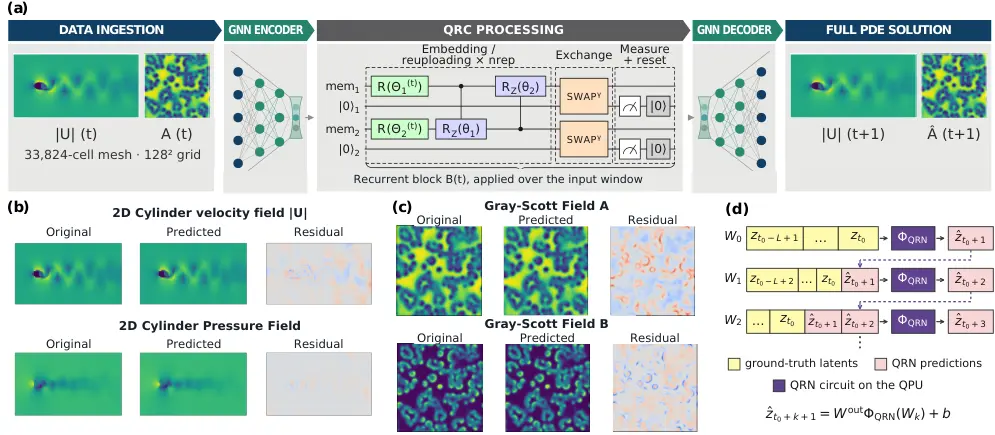
Researchers at QodeX Quantum and collaborating institutions have demonstrated forecasting of complex, high-dimensional equations on quantum hardware using up to 52 qubits on IBM superconducting processors. Their quantum reservoir network achieves a kernel space exceeding 2^(52) dimensions, moving beyond the reach of exact classical simulation. A partial measure-and-reset mechanism extends circuit runtime to approximately 24 times the qubit coherence time, overcoming limitations imposed by qubit lifetimes. This work demonstrates, for the first time, quantum circuits forecasting unstructured mesh problems on highly nonlinear partial differential equations.
Quantum Reservoir Networks Forecast High-Dimensional PDEs
This advance allowed researchers to move beyond the constraints of short qubit lifetimes, which typically restrict the duration of quantum computations. By effectively resetting qubits while preserving essential quantum information, the team achieved sustained operation significantly exceeding standard coherence limits. A dynamic observable reconstruction method and careful design considerations mitigated typical difficulties associated with predicting large scale Partial Differential Equations (PDEs), including challenges with transpilation, exponential shot requirements and hardware noise.
These strategies allowed for high-fidelity prediction on both CUDA-Q simulation and superconducting quantum processors with 26 and 52 qubits. The researchers validated their approach using a roughly 34k-cell unstructured 2D cylinder flow at a Reynolds number of 1000, alongside a nonlinear Gray-Scott reaction-diffusion problem, demonstrating the method’s versatility. Quantum reservoir networks (QRNs) provide a kernel space that expands exponentially with the number of qubits, circumventing the trainability issues often encountered with variational circuits.
This capability unlocks access to dimensions exceeding those achievable with exact classical simulation, reaching up to dimensions in this instance. The QRN’s architecture, unlike traditional variational quantum algorithms, is gradient-free, simplifying the computational process and reducing the risk of optimization challenges.
This approach uses the inherent properties of quantum systems to create a rich, high-dimensional space for data representation and processing. Adding QRN features to a latent-space linear readout reduced one-step and observer prediction error by 21 to 43 percent, with circuits running for up to approximately 28 times the median qubit T1 and up to 24 times the median qubit T2.
The team decoupled geometry and boundary conditions from the quantum model by employing a graph neural network autoencoder to compress PDE fields on an unstructured mesh into a low-dimensional latent state. “The central result is that this large quantum kernel space, run on noisy hardware and with no circuit training, still adds predictive value to the PDE forecast,” the researchers state in their published work.
To the researchers’ knowledge, this work represents the first PDE forecast on an unstructured, body-fitted mesh performed on quantum hardware, and the first closed-loop autoregressive PDE rollout executed on a quantum processor. This achievement marks a step toward using quantum computers for realistic simulations of complex physical phenomena, potentially impacting fields ranging from fluid dynamics to materials science. The method’s ability to handle unstructured meshes is particularly noteworthy, as it allows for the modeling of irregular geometries commonly found in real-world applications.
Gradient-Free QRN Implementation on IBM Superconducting Hardware
This approach enabled forecasting of complex, high-dimensional problems on quantum hardware, circumventing limitations of traditional methods reliant on simplified scenarios or small qubit counts. The architecture employed a three-stage recurrent block acting on memory and readout registers, embedding the latent state through repeated rotations and controlled-R_Z gates. Experiments utilized between 10,000 and 30,000 shots per circuit execution, with detailed parameters available in supplementary materials, and used datasets including a 2D flow simulation generated using OpenFOAM and the Gray-Scott system from The Well dataset on a 128×128 grid.
Recurrent QRC, exploiting partial measurements and resets, has previously demonstrated tunable fading memories unconstrained by qubit lifetimes, but its application was limited to noiseless simulations or systems with fewer than a dozen hardware qubits, and never extended to PDE fields on an unstructured mesh. The current implementation reports an ablation study over differing Pauli weights on both hardware and simulators, with detailed results in supplementary materials, further validating the robustness of the approach.
Qubit Coherence & Runtime Extended via Partial Reset
This advancement directly addresses a fundamental limitation in quantum computing, where the fleeting nature of quantum states has historically constrained the complexity of achievable computations. By decoupling runtime from qubit lifetimes, researchers opened the door to forecasting scenarios previously inaccessible due to decoherence. This method relies on a carefully calibrated exchange of entanglement between memory and readout qubits, followed by measurement and reset of the readout register, creating a controlled amplitude-damping channel on the memory register.
The system’s design intentionally introduces a tunable forgetting mechanism, discarding older inputs at a rate determined by the strength of the entanglement, mirroring the fading memory of classical echo-state networks. This allows the quantum reservoir network to maintain computational relevance far beyond the typical qubit coherence window, theoretically enabling circuits with arbitrary depth. The ability to forecast these complex systems was demonstrated both through CUDA-Q simulation and on superconducting quantum processors containing 26 qubits.
The ability to sustain computation for this duration is important for forecasting problems that require extended simulation horizons. The team implemented a closed-loop autoregressive prediction protocol, allowing the network to forecast from its own predictions, a capability realized on current hardware.
Unstructured Mesh Prediction Validated with Cylinder Flow
The method’s success hinges on mitigating challenges inherent in predicting large-scale partial differential equations, including the complexities of transpilation and the limitations imposed by hardware noise. A key innovation lies in a dynamic observable reconstruction method that addresses the exponential increase in computational cost typically associated with reading out larger quantum registers. This technique selectively retains Pauli observables based on their weight, tailored to the specific prediction task and available computational resources.
This process involves a sliding latent window of fixed length, where each predicted latent state is appended and the oldest state removed to form the input for the next prediction step. The system was tested on both the cylinder flow and a nonlinear Gray-Scott reaction-diffusion problem, with detailed results and implementation specifics available in supplementary materials.
QRN Features Reduce Prediction Error in Autoencoders
Adding quantum reservoir network features to an autoencoder pipeline demonstrably improves prediction accuracy, reducing error by 21 to 43 percent across tested partial differential equation models. A key aspect of this work is the implementation of a closed-loop autoregressive forecasting protocol, enabling the network to predict successive time steps and feed those predictions back as input. The dynamic observable reconstruction method allows for adaptation to varying shot budgets and hardware noise levels, retaining only the most impactful features.
Specifically, retaining all strings through weight K produces features, with the number of nontrivial observables reaching 2^(n_R)-1 when K equals n_R. This careful selection process, combined with the partial measurement resets, enables the system to operate effectively despite the inherent challenges of current quantum hardware. The team tested the system on IBM superconducting hardware, demonstrating a practical application of quantum computing beyond small-scale demonstrations.
Limitations of Existing Quantum PDE Methods
Existing quantum approaches to solving partial differential equations often rely on uniform grids, a simplification that limits their application to real-world scenarios featuring complex geometries. The current work circumvents this restriction, enabling forecasting on unstructured meshes, irregular networks of polyhedrons whose density varies, a feature previously absent in complete quantum demonstrations. While these meshes enhance realism, they also introduce computational challenges that have historically constrained the scale of quantum PDE simulations.
Variational quantum algorithms, a common approach, further restrict progress with their inherent training demands and substantial measurement overheads, often requiring approximately shots per cost evaluation. Consequently, hardware implementations have been confined to linear problems or those with classically evaluated nonlinearities, using at most twenty qubits and a thousand grid points. Data-driven quantum methods, which learn from existing trajectories, have shown promise with turbulent and high-Reynolds-number data, including experimental wake flows and unstructured meshes.
However, even these approaches have faced limitations on quantum hardware, with demonstrations typically employing only 10-15 qubits per circuit. The present circuits achieve a comparable extension of coherence, allowing for deeper circuits and more complex forecasting. This extended operation is achieved without relying on feedback mechanisms that re-inject measurement outcomes, preserving the integrity of the memory register. Dynamic observable reconstruction further mitigates challenges associated with finite measurement samples. By carefully managing the number of shots used to estimate observables, the system avoids scaling issues that can arise in quantum simulations.



See today’s quantum computing news on Quantum Zeitgeist for the latest breakthroughs in qubits, hardware, algorithms, and industry deals.