

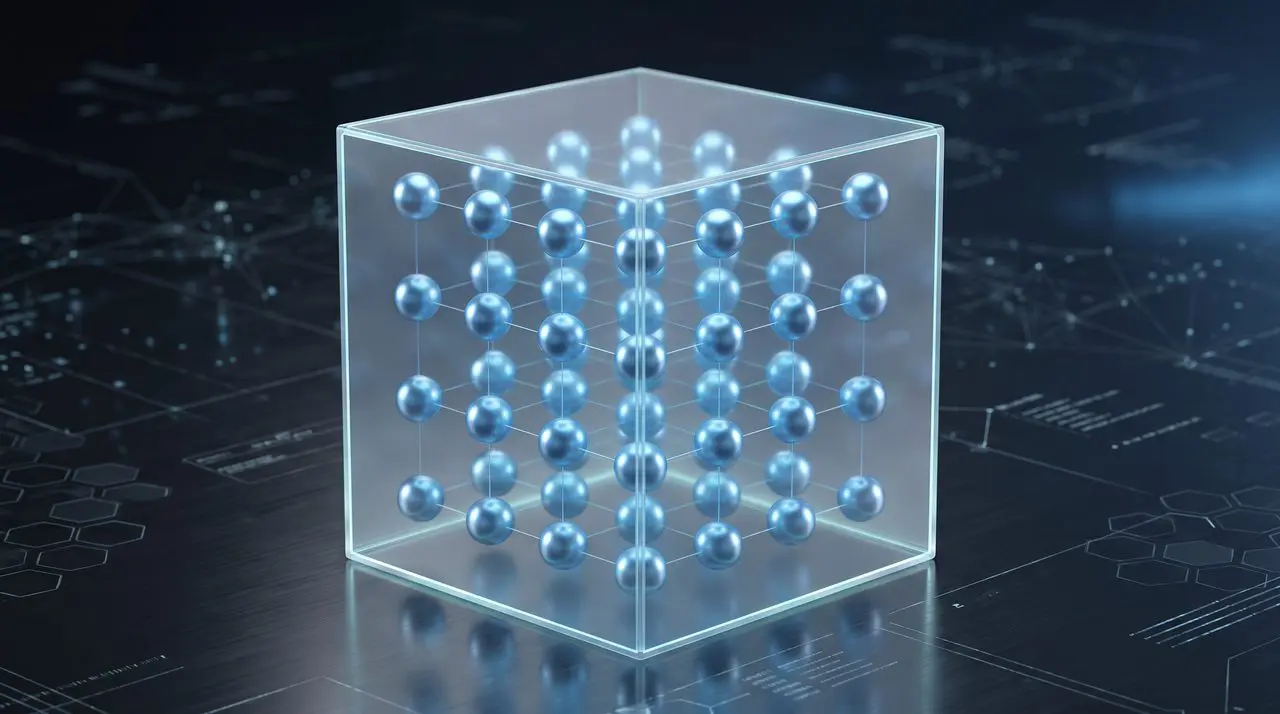
Constructing quantum error correction codes capable of simplifying complex calculations has long been a challenge for physicists. Rui Mao, Weixiao Sun, and Shengyu Zhang at Tencent Quantum Laboratory have now created the first-rate optimal phantom quantum low-density parity-check (qLDPC) code families that achieve maximal logical scaling, where the number of encoded logical qubits grows logarithmically with system size, and an arbitrary fixed distance. New quantum error correction codes expand computational capacity without increasing complexity; these ‘phantom’ codes offer a promising route towards more powerful computers.
These newly designed codes address limitations in previous approaches where scaling up processing power often meant adding significant overheads to calculations. The team demonstrated the first scalable family capable of maintaining performance while simultaneously expanding its ability to process information, a key balance for practical applications. Tencent Quantum Laboratory has developed new quantum error correction codes that promise to expand computing power without adding undue complexity; these ‘phantom’ codes represent a step towards building more effective computers.
These newly designed codes tackle a key limitation in previous methods where increasing processing capability often required significant computational overheads, imagine it as adding extra checks and redundancies into your message so even if some parts are lost or corrupted, you can still reconstruct the original accurately.
The team has created the first scalable family of such codes capable of maintaining performance while simultaneously expanding its ability to process information, measured by what is known as logical dimension, think of this like the number of lanes on a motorway, with more lanes allowing for greater data flow.
Logarithmic Scaling and Computational Limits in Novel Quantum Error Correction Codes
This represents an improvement over prior constructions where increasing qubit numbers led to escalating check weights. Previously, growing the number of encoded qubits necessitated adding significant computational overheads; this has now been overcome. Determining if a given qLDPC code is ‘phantom’, possessing properties allowing simplified gate operations via qubit permutations, is as computationally difficult as solving the Graph Isomorphism problem even with only two logical qubits, establishing fundamental limits on efficient phantom code operation.
These newly designed families achieve maximal logical scaling with any fixed distance, meaning they can protect against errors up to a certain level without requiring unmanageable resource increases. However, these results do not yet demonstrate practical error correction thresholds or scalability beyond relatively small system sizes.
Symmetry exploitation within stabiliser codes enables simplified qubit manipulation
Stabilizer codes, a method for encoding and protecting quantum data using mathematical rules similar to those used in classical cryptography, were carefully manipulated during construction of the new qLDPC structures. The scientists focused on identifying specific symmetries that allowed complex operations, such as logical CNOT gates, simply by rearranging physical qubits involved; this avoids needing extra complicated steps normally required when building such gates. An exhaustive search across potential code structures was demanded, guided by principles of low-density parity-check coding which functions like adding redundancy into a message, so reconstruction remains possible even if parts become corrupted.
These new quantum codes were developed utilising stabiliser techniques employing mathematical rules to protect data during processing and are designed to achieve an efficient balance where the number of logical qubits scales with the logarithm of total qubit count, addressing limitations found in previously known phantom code designs which restricted scalability and hindered resource efficiency.
Phantom qLDPC codes and the computational difficulty of verification
Protecting fragile quantum information from disruption is vital for building stable computers as systems grow in complexity. Tencent Quantum Laboratory scientists have now demonstrated families of ‘phantom’ codes allowing simplified operations via qubit rearrangement; however, proving whether any given code *is* phantom presents a roadblock. Verifying this characteristic is computationally equivalent to solving the Graph Isomorphism problem, even with minimal two-qubit encoding.
Establishing that verifying these ‘phantom’ codes matches the difficulty of solving the Graph Isomorphism problem does not negate their potential value but clarifies a fundamental limitation in designing them efficiently. The team has created the first practical families of quantum low-density parity-check (qLDPC) codes exhibiting ‘phantom’ characteristics and enabling streamlined operation through qubit arrangement rather than increased physical components. This work demonstrates a trade-off between scalability and reliability in error correction, showing maximising encoded logical qubits requires careful consideration of code distance which determines its ability to withstand errors.
The researchers demonstrated new quantum low-density parity-check (qLDPC) codes with ‘phantom properties that simplify operations by rearranging qubits instead of adding more hardware. This work highlights a relationship between scalability and reliability; maintaining a greater number of encoded logical qubits necessitates careful consideration of code distance for error resilience.
👉 More information
🗞 Phantom Codes: Hardness, Rate Optimal qLDPC Constructions, and Distance Limits
✍️ Rui Mao, Weixiao Sun and Shengyu Zhang
🧠 ArXiv: https://arxiv.org/abs/2609.16542


See today’s quantum computing news on Quantum Zeitgeist for the latest breakthroughs in qubits, hardware, algorithms, and industry deals.



