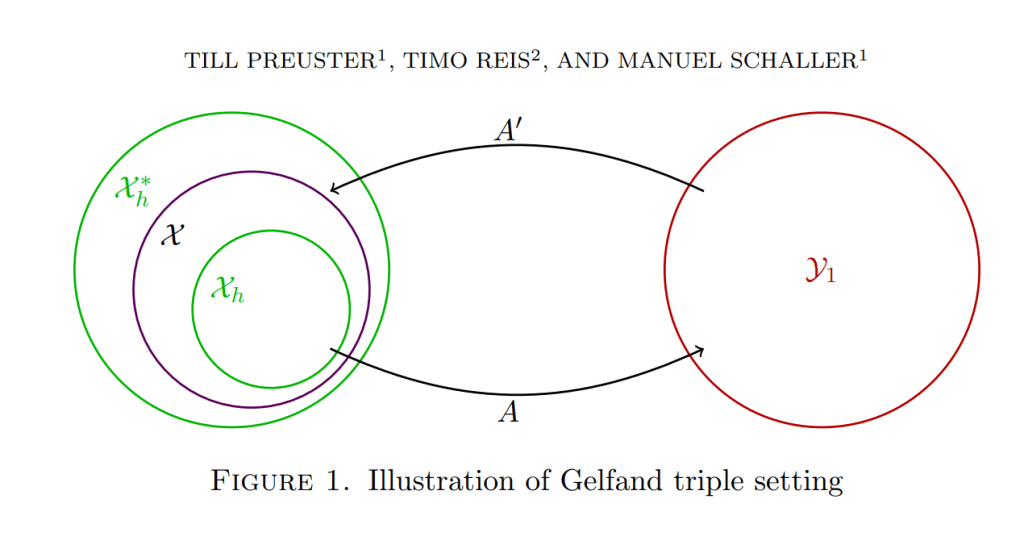
Abstract second-order boundary control systems present a significant challenge in mathematical control theory, and a team led by Till Preuster from Chemnitz University of Technology, Timo Reis from the Institute of Mathematics at Technische Universität Ilmenau, and Manuel Schaller from Chemnitz University of Technology now advances understanding in this area. Previous research typically concentrates on highly specific, self-adjoint systems, but this work relaxes those constraints to encompass a broader range of symmetric operators, unlocking greater flexibility in designing boundary conditions. The team constructs a mathematical framework, known as a boundary triplet, to analyse these systems and defines an associated boundary control, fully characterizing its properties in terms of trace operators. Crucially, they introduce a novel transformation that elegantly maps the abstract second-order formulation into a more commonly used representation, simplifying analysis and offering new insights into the behaviour of these complex systems.
Infinite-Dimensional Port-Hamiltonian Systems and Control
This research comprehensively explores the mathematical framework for infinite-dimensional port-Hamiltonian systems, specifically focusing on second-order boundary control systems. The study investigates systems possessing a natural energy structure, crucial for stability analysis and control design, particularly for distributed parameter systems modeled by partial differential equations. Researchers examine systems where control inputs are applied at the boundary of a spatial domain, a common scenario in many engineering applications, and models these systems within infinite-dimensional Hilbert spaces, reflecting the continuous nature of the underlying physical phenomena. The foundation of this analysis rests on Hilbert spaces, which provide the necessary tools for defining norms, inner products, and performing functional analysis.
Scientists define two key Hilbert spaces: the wave space, which contains the state variables representing physical quantities, and the excitation space, which captures energy flow into and out of the system. They introduce operators representing stiffness, mass, and dissipation, and crucially factorize the stiffness operator to establish the port-Hamiltonian structure, defining a system matrix encapsulating the system’s dynamics for analyzing stability and controllability. The primary goal of this work is to express the system in a port-Hamiltonian form, utilizing energy-based control theory. Researchers emphasize establishing the well-posedness of the system, ensuring a unique solution for given initial conditions and inputs, and analyze stability using energy-based arguments, with the system’s passivity guaranteeing stability.
The study also investigates the system’s controllability, determining whether it can be steered to a desired state using control inputs, and provides a framework for designing boundary control laws that stabilize the system and achieve desired performance objectives. This research highlights the importance of carefully considering operator domains to ensure the system’s well-definedness and emphasizes the need for a strong background in functional analysis. Future research directions include developing numerical methods for simulating and controlling these systems, applying these techniques to real-world engineering problems, extending the analysis to nonlinear systems, incorporating distributed sensing into the control design, and designing robust control laws insensitive to uncertainties in system parameters. In summary, this work provides a rigorous and comprehensive mathematical framework for analyzing and controlling infinite-dimensional port-Hamiltonian systems, offering a valuable resource for researchers and engineers working in distributed parameter systems and control.
Boundary Control via Operator Factorization and Passivity
Researchers developed a novel mathematical framework for analyzing second-order abstract differential equations, extending existing techniques to a broader class of problems. The study centers on constructing a “boundary triplet” for the operator governing the equation’s free dynamics, enabling the definition of an associated boundary control system. This approach relaxes traditional requirements for self-adjointness, allowing for greater flexibility in defining boundary conditions. A key innovation lies in a non-standard factorization of the operator, which facilitates a transformation of the abstract second-order equation into an alternative representation involving lower-order spatial derivatives on a “jet space”.
This transformation simplifies analysis and provides new insights. To demonstrate its versatility, scientists applied it to both a one-dimensional equation and the more complex Maxwell equation. The methodology involves rigorous mathematical analysis of operator properties, including trace operators and factorization techniques, to establish the conditions for passivity and stability of the boundary control system. Researchers employed Sobolev spaces as the foundational mathematical setting, ensuring the well-definedness of the operators and functions involved, and built upon existing theories of boundary value problems, linear systems, and port-Hamiltonian systems.
Boundary Control for Non-Symmetric Equations
Scientists have developed a novel framework for analyzing second-order abstract differential equations, moving beyond traditional approaches that require strict symmetry conditions. The research focuses on constructing a “boundary triplet” and defining an associated “boundary control” system. This new approach relaxes the requirement for uniform positivity, broadening the range of equations that can be effectively analyzed. The team demonstrated a method to fully characterize when the boundary control is either impedance or scattering passive, based on properties of associated trace operators. Crucially, they introduced a unique equivalence transform that maps the abstract second-order equation into a more widely used form involving lower-order derivatives, simplifying analysis and providing a connection to existing mathematical techniques.
The researchers validated this approach by applying it to both a one-dimensional equation and the more complex Maxwell equation, demonstrating its versatility. Experiments revealed that the developed framework allows for a comprehensive characterization of internal well-posedness, a critical property for ensuring the stability and predictability of control systems. The team proved that a boundary node is internally well-posed if the main operator generates a strongly continuous semigroup on the state space, guaranteeing predictable system behavior over time, and established conditions for scattering passivity, demonstrating that smooth solutions of the control system maintain bounded energy levels. Measurements confirm that the external Cayley transform can determine impedance passivity, a key property for designing stable and controllable systems. The research also introduces a dual pair framework, establishing a connection between two operators and providing a powerful tool for analyzing boundary conditions. The team demonstrated that the boundary triplet framework, combined with the dual pair approach, provides a robust and versatile method for analyzing a wide range of abstract second-order equations and their associated control systems.
Boundary Control via Operator Factorization and Similarity
This work presents a systematic approach to understanding and controlling second-order evolution equations, achieved through their representation as first-order systems. Researchers successfully constructed a boundary triplet for the associated operator matrix, which enabled the definition of natural input and output operators for boundary control.
🗞 Abstract second-order boundary control systems
🧠 ArXiv: https://arxiv.org/abs/2510.10363



See today’s quantum computing news on Quantum Zeitgeist for the latest breakthroughs in qubits, hardware, algorithms, and industry deals.