

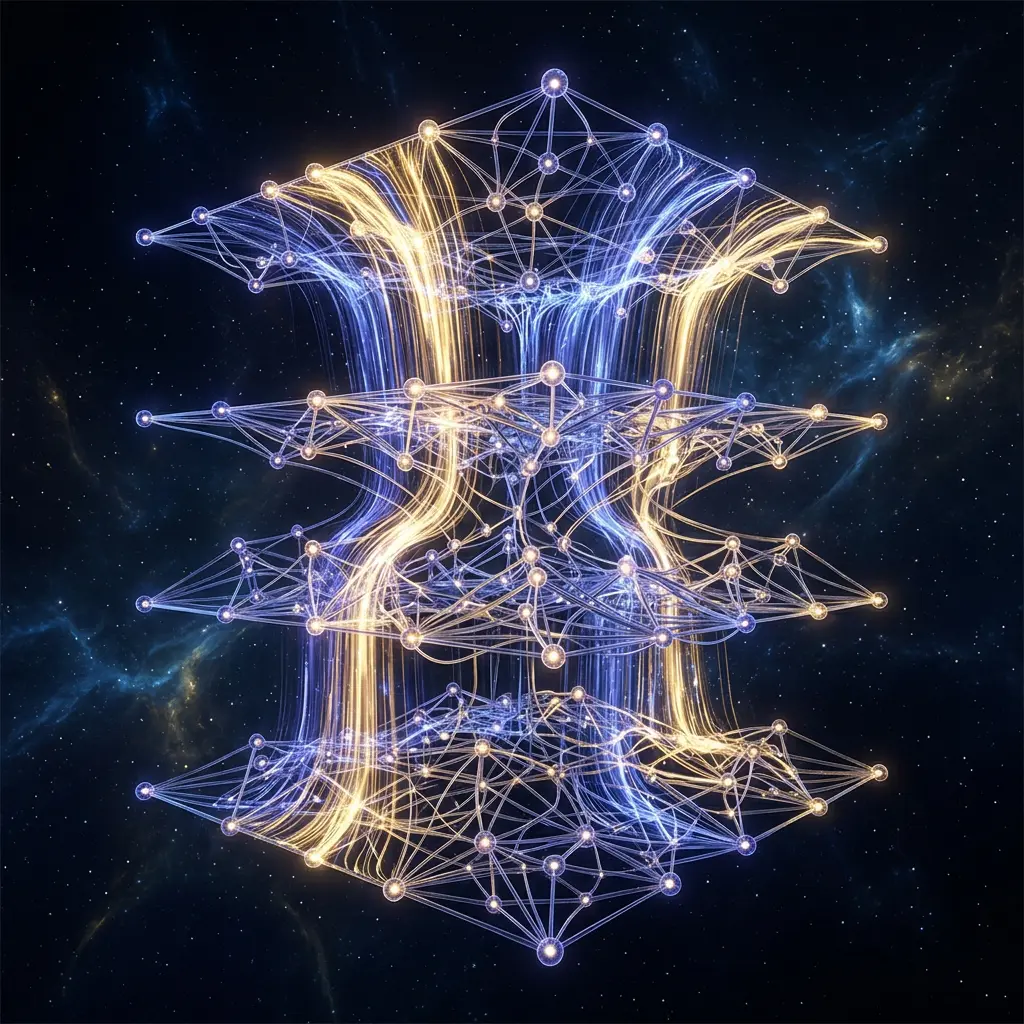
A single H100 graphics processing unit completed a complex calculation for the triangular-lattice Heisenberg antiferromagnet in approximately 10 hours, thanks to a new algorithm developed by Yining Zhang and Philippe Corboz from University of Amsterdam. Their work introduces subspace-iteration CTMRG, or SI-CTMRG, which accelerates tensor-network contraction, a computationally intensive task in condensed matter physics. The innovation replaces demanding large-matrix decompositions with operations on smaller matrices, shifting the computational bottleneck to tensor contractions and allowing for significant gains from GPU processing. This results in speedups of up to two orders of magnitude compared to standard CTMRG methods, as the researchers detail in their recent paper.
The innovation centers on replacing computationally expensive large-matrix singular value decompositions (SVDs) with SVDs performed on significantly smaller matrices. This strategic shift reorients the primary computational demand from decomposition to tensor contractions, unlocking substantial gains through GPU acceleration. This advancement promises to broaden the scope of simulations possible with iPEPS, enabling exploration of larger and more intricate quantum materials, yielding speedups of up to two orders of magnitude over standard CTMRG.
This achievement stems from a new method, subspace-iteration CTMRG, or SI-CTMRG, which fundamentally alters the computational bottleneck of these simulations. Achieving these results on a single GPU expands the scope of accessible simulations for complex quantum systems, allowing for more accurate modeling of material properties and quantum phenomena, and potentially accelerating discoveries in condensed matter physics.
👉 More information
🗞 Fast two-dimensional tensor-network contraction via subspace iteration
✍️ Yining Zhang and Philippe Corboz
🧠 ArXiv: https://arxiv.org/abs/2607.15158


See today’s quantum computing news on Quantum Zeitgeist for the latest breakthroughs in qubits, hardware, algorithms, and industry deals.



