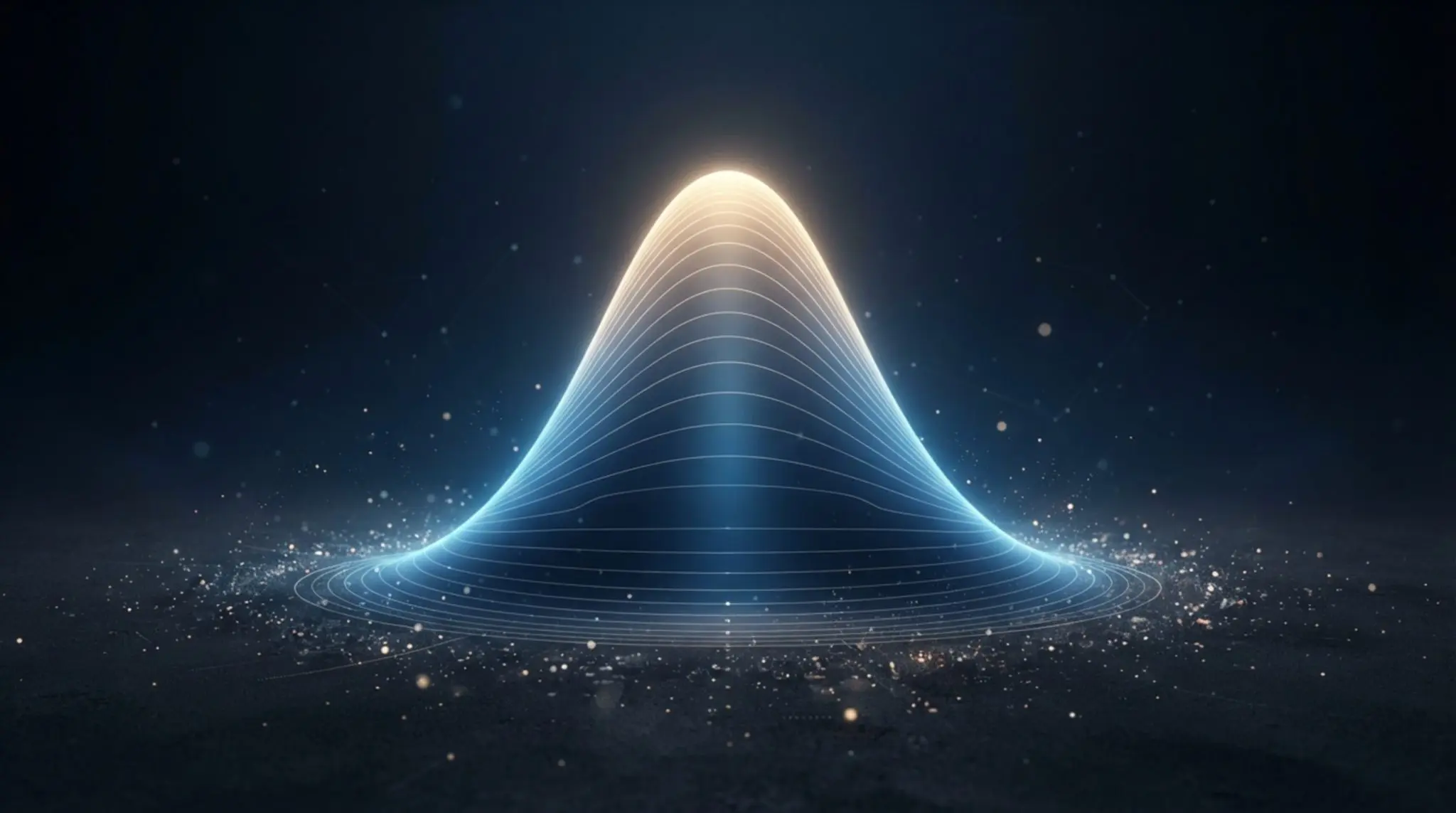
Cosmological-state construction techniques now encompass multiple holographic conformal field theories (CFTs). Gluing together AdS pages, each representing a CFT’s asymptotic boundary, via multiway junction conditions creates associated states through Euclidean evolution with multilinear insertions. The resulting ‘booklet cosmological state’ develops closed universes under specific heavy insertion limits, offering insights into early universe scenarios. Modelling three-page insertions using circular complex Gaussian random tensors yields tripartite Haar states, demonstrating that prescribed codes can be approximately recovered from any two arms with diminishing error as the code dimension decreases relative to the Hilbert space dimension of each page.
Recovery of cosmological information utilising triply-connected holographic boundaries
Error rates dropped to vanishing levels when employing prescribed codes as models extended cosmological-state constructions beyond dual boundaries. Previously, such models limited themselves to just two interconnected holographic conformal field theories (CFTs). This advancement facilitates the recovery of information from any combination of at least three CFT ‘arms’, each representing an asymptotic boundary of an AdS space; error diminishes with smaller code dimensions relative to individual page sizes.
The team employed a “booklet” structure, gluing these CFTs together via multiway junction conditions and modelled cosmology-to-boundary maps using random tensor networks, intricate webs that represent relationships in complex systems. A prescribed code of dimension K can be approximately recovered from only two out of three holographic conformal field theories (CFTs), as error rates decrease when K becomes small compared to the output Hilbert space dimension denoted ‘b’.
Perfect correction for single-arm erasure remains impossible within finite dimensions b, meaning practical application necessitates extremely large system sizes to approach zero error. This allows exploration into how universes might preserve data despite phenomena like black holes or cosmic expansion.
Modelling multiple cosmological boundaries enhances insight into information preservation across hidden regions
Models now successfully extend beyond simplistic dual boundaries, previously limited to describing a universe mirroring our observable cosmos. The breakthrough enables increasingly complex simulations incorporating at least three interconnected ‘pages’, each representing a boundary of theoretical space and offering potential insights into the persistence of information even when portions obscure themselves from view. Some physicists question whether these highly theoretical constructs genuinely reflect physical reality, beyond being useful analytical tools, but acknowledging reasonable scepticism about applying such abstract mathematical models to cosmology is important. Researchers at the University of the Chinese Academy of Sciences linked these CFTs via their established “booklet” structure where interfaces converge, hinting at mechanisms for data preservation; this approach allows investigation of scenarios with more than one hidden region and exploration of its implications on cosmological modelling techniques. It moves past previous two-boundary limitations by incorporating a minimum of three interconnected holographic conformal field theories (CFTs). These mathematical frameworks describe volumes using surface data similar to holograms, offering new avenues for studying complex systems and potentially revealing how they encode information in extreme environments.
The research successfully extended models describing universes beyond dual boundaries to incorporate at least three interconnected holographic conformal field theories. This means the framework can now simulate more complex scenarios where portions of space are obscured from view, allowing researchers to investigate how information might be preserved across these hidden regions.
Using this approach with three ‘pages’, each representing a boundary, scientists demonstrated that a code could be approximately recovered from any two out of three connected theoretical spaces when its dimension is small relative to the system size. The authors suggest further work will focus on understanding limits to perfect correction within finite dimensions.
👉 More information
🗞 A baby universe from a large family: booklet cosmology states and quantum error correction
✍️ Jingshu Dai, Binye Dong and Cheng Peng (Affiliation: University of the Chinese Academy of Sciences)
🧠 ArXiv: https://arxiv.org/abs/2610.02168



See today’s quantum computing news on Quantum Zeitgeist for the latest breakthroughs in qubits, hardware, algorithms, and industry deals.