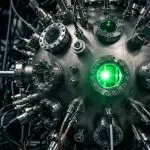
Rice University researchers are proposing a new dark matter detector design, the Semiconductor Quantum Well Axion Radiometer Experiment (SQWARE), that could resonate with as much as 85% of the universe, the portion thought to be comprised of elusive dark matter. Unlike existing technologies requiring complex mechanical tuning, SQWARE utilizes stacks of ultrathin semiconductor layers to trap electrons, relying instead on magnetic fields to probe a wider range of axion masses, hypothetical particles considered leading candidates for dark matter. “We are proposing a well-studied material from condensed matter physics for a new application—axion detection,” said Jaanita Mehrani, a doctoral student in Rice’s Applied Physics Graduate Program and first author on the study. The detector aims to convert axions into detectable photons by exploiting a unique plasma effect within the semiconductor material, potentially enhancing the signal and bringing researchers closer to understanding this fundamental component of the cosmos.
Semiconductor Quantum Wells Enable Axion-to-Photon Conversion
A novel detector design leveraging semiconductor quantum wells promises to significantly broaden the search for dark matter, potentially revealing the elusive nature of this mysterious substance. Accounting for approximately 85% of the matter in the universe, dark matter remains unidentified, prompting physicists to explore various theoretical candidates like axions. This innovative approach focuses on facilitating the conversion of axions into detectable photons when exposed to a strong magnetic field, a process predicted by current theory.
Within SQWARE, confining electrons in these quantum wells creates a plasma-like state, altering how light propagates through the material; this manipulation is key to enhancing the signal. “What’s happening is this plasma is giving the photons an effective mass, which helps the momentum conservation between the axion and the photon, since in a vacuum, axions have a mass but photons don’t,” Mehrani explained, detailing how the design addresses the inherent momentum mismatch between the two particles. The team has already considered the practicalities of fabrication, evaluating whether the proposed semiconductor structures can be created using current or near-future technology.
Shengxi Huang, associate professor of electrical and computer engineering and materials science and nanoengineering at Rice, emphasized the broader implications of this work, stating, “Advances in semiconductor materials have created opportunities well beyond their original applications.” The researchers are now focused on experimentally verifying the performance of these materials and building prototype devices, hoping to move beyond theoretical modeling and toward actual dark matter detection.
What’s different about this material is that it doesn’t have to use complex mechanical tuning mechanisms, it simply tunes with the magnetic field.
Jaanita Mehrani, a doctoral student in Rice’s Applied Physics Graduate Program
SQWARE Detector Design Targets Challenging Axion Mass Ranges
The search for dark matter continues to drive innovation in detector technology, with current efforts largely focused on identifying weakly interacting massive particles (WIMPs) and, increasingly, axions. While WIMP detectors have yielded no conclusive results to date, a new design from Rice University proposes a new approach to probing axions across a broader mass range than previously accessible. The core of SQWARE lies in its use of multiple quantum wells, stacks of ultrathin semiconductor layers that confine electrons to two-dimensional sheets, a technique leveraging advancements beyond the materials’ initial intended purposes. The detector’s functionality hinges on the unique behavior of electrons within these quantum wells, forming a plasma-like state that alters the propagation of light. The theoretical design has already undergone preliminary evaluation for practical fabrication, with the team assessing the feasibility of constructing the necessary semiconductor structures using current or near-future technology.
This work explores whether those same materials can be adapted to address one of the central questions in particle physics and cosmology.
Shengxi Huang, associate professor of electrical and computer engineering and materials science and nanoengineering at Rice


See today’s quantum computing news on Quantum Zeitgeist for the latest breakthroughs in qubits, hardware, algorithms, and industry deals.