Six and a half years ago, a sketch of the first Superconducting Quantum Materials and Systems Center logo appeared on a board in a Fermilab hallway, deliberately shaped to fit within a superconducting radio-frequency cavity, a technology central to the laboratory’s decades of work. From that initial idea, SQMS has grown into a community of hundreds of people across the United States and around the world, building new experimental capabilities and connecting scientific disciplines.
“We knew it had to fit within the shape of a superconducting radio-frequency cavity,” recalls the founding director, explaining that SQMS was founded on the question of what fundamentally limits quantum system performance and how to push those boundaries. The center, established by the Department of Energy in August 2020, uses Fermilab’s expertise in superconducting materials to explore a novel quantum architecture.
SQMS Origins: From SRF Cavities to Quantum Vision
This seemingly simple act immediately connected the nascent quantum initiative to Fermilab’s long-standing expertise in accelerator technology and superconducting systems. The center’s origins lie in recognizing how decades of work perfecting these cavities, structures capable of storing electromagnetic energy with minimal loss, could be repurposed to dramatically extend quantum information preservation times. This foundational link between established infrastructure and emerging quantum technologies helped secure funding and attract talent.
The Department of Energy’s selection of SQMS as a National Quantum Information Science Research Center in August 2020 catalyzed the transformation of this initial idea into a tangible reality. The center’s researchers quickly began exploring architectures beyond conventional two-level qubits, focusing instead on higher-dimensional quantum systems known as qudits. These qudits use the multiple quantum states available within three-dimensional superconducting cavities, offering the potential for encoding and manipulating quantum information in more complex and powerful ways.
This shift in focus required developing new methods for coupling these cavities to superconducting control devices and connecting them into larger, scalable systems. The evolution of SRF cavity technology within SQMS extends beyond simply preserving quantum information; it has become a fundamentally new application of a well-understood technology. The team has learned to manipulate increasingly complex quantum states within these cavities, a process that demands precise control and characterization.
This work has led to advancements in materials science, surface fabrication, and processing techniques, all building upon Fermilab’s existing capabilities. “Can we build an extraordinary quantum system?” is a question that has driven the center’s research since its inception, and the progress made in cavity-based qudits suggests a promising path forward. The inauguration of the Quantum Garage at the SQMS Center in November 2023 marked a significant milestone, establishing one of the largest quantum research laboratories in the nation.
The center’s collaborators gathered in person for the first time during the SQMS Annual Meeting in 2022. This expansion has been accompanied by a growing network of collaborators. The SQMS community now comprises hundreds of individuals across the United States, showing the rapid growth from its initial core team. This network includes principal investigators from all five national quantum information science research centers, who gathered in Washington D.C. in 2024 for a meeting to coordinate efforts and share findings.
The center also welcomed its DOE Program Manager, Zach Goff-Eldredge, to Fermilab in 2024, signaling continued support and alignment with national quantum initiatives. The scale of this collaboration emphasises the importance of a coordinated approach to advancing quantum technologies. The center’s commitment to hands-on expertise is evident in the work of Machining Specialist Eddie Pieszchala, who fabricates highly customized components used throughout the SQMS Center.
Anna Grassellino and Jim Sauls are pictured standing before a nine-cell SRF cavity, a visual reminder that SQMS isn’t solely focused on abstract concepts but is deeply rooted in established, foundational technologies. “Can we make an extraordinary quantum device?” is a question the team continues to address through both innovation and meticulous craftsmanship.
SQMS Structure: A Multi-Institutional, Collaborative Approach
This deliberate connection wasn’t merely symbolic. It signaled an intent to build upon decades of expertise in cavity technology, rather than starting from scratch, and informed the center’s early visual identity. National laboratories contributed unique facilities and engineering capabilities, while universities provided deep scientific knowledge and a pipeline of students. Industry partners offered fabrication expertise and a focus on scalability. This collaborative network first convened in person at the SQMS Annual Meeting in 2022, establishing a foundation for ongoing knowledge exchange and shared experimentation.
Researchers connected microwave losses in niobium to microscopic structural defects in surface oxides, identifying specific mechanisms that drain energy from quantum systems. Detailed studies of tantalum and niobium oxides revealed why different qubit materials exhibit varying behaviors. The center’s guiding principle, share everything, compare everything, and improve together, transformed isolated expertise into shared capabilities, driving substantial gains in coherence and reproducibility across the collaboration.
SQMS-developed techniques, such as surface encapsulation, have been widely adopted by laboratories worldwide to enhance qubit coherence, demonstrating the broad impact of the center’s innovations. In 2024, Alexander Romanenko and Anna Grassellino visited colleagues at INFN in Italy, exemplifying the center’s commitment to international collaboration and the free exchange of knowledge. This exchange of ideas and techniques extended beyond geographical boundaries, supporting a global network of quantum researchers.
The scale of collaboration became visually apparent in February 2023 with the delivery of new dilution refrigerators to the Quantum Garage, the center’s flagship facility, and the entire team mobilized to prepare the lab for their arrival. This capacity allows for a high throughput of research, accelerating the pace of discovery and innovation. The facility’s activity reflects the center’s commitment to hands-on experimentation and the pursuit of practical quantum solutions.
SQMS actively cultivates connections with other national quantum centers, as evidenced by a principal investigators meeting held in 2024, bringing together representatives from the institutions. This meeting facilitated coordination of efforts and the sharing of findings, strengthening the overall quantum research ecosystem in the United States. The collaborative spirit extended to Quantum Week in 2026, where leaders from all five centers organized a joint booth and panel discussion, further solidifying their collective presence and shared goals.
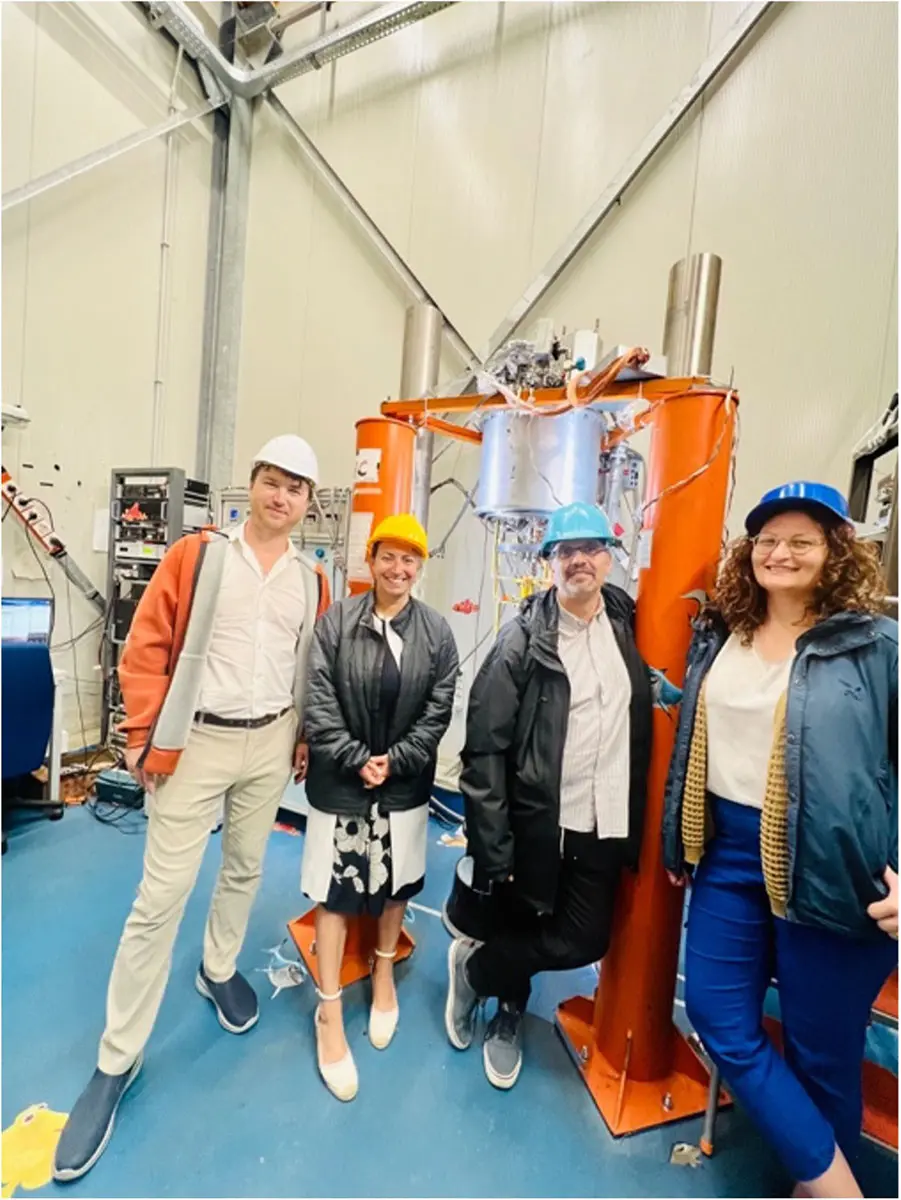
The center’s global reach is further demonstrated by a workshop focused on strengthening collaboration in quantum information science, and a workshop hosted by Northwestern University on connecting experimental findings to theoretical understandings of decoherence in superconducting resonators and qubits. Attendees of “Exploring the Quantum Universe” captured memories of their visit to the Quantum Garage, highlighting the center’s commitment to public outreach and education.
The collaborative presence at events like IEEE Quantum Week, with a booth organized by communications leaders across the five centers and a panel featuring all five center directors demonstrates a unified front in promoting quantum information science.
Quantum Decoherence: Investigating Limits to Information Preservation
That early visualization quickly evolved into a focused investigation of quantum decoherence, the process by which quantum information degrades, and the search for materials and designs that could preserve it for longer durations. The center’s approach to mitigating decoherence uses Fermilab’s decades of experience in building and operating superconducting radio-frequency cavities, technologies originally designed to accelerate particles but now repurposed for quantum applications. Fermilab’s expertise in low-loss electromagnetic energy storage within these cavities provided an unusual, and advantageous, starting point for addressing decoherence.
Quantum information is exceptionally fragile, susceptible to disruption from material imperfections, radiation, magnetic fields and even the nuances of fabrication processes, all of which introduce pathways for information loss. The center’s strategy centers on understanding and minimizing these decoherence mechanisms through both material science and device engineering.
The U.S. Quantum Information Science Summer School provided hands-on lab time focused on qubit measurements and materials characterization, training the next generation of quantum scientists and engineers. This commitment to education and workforce development is integral to the center’s long-term vision. The Superconducting Quantum Materials and Systems Center, led by Fermi National Accelerator Laboratory, involves a network of partner institutions, encompassing national labs, academic institutions and industry collaborators.
The center’s ultimate goal is to engineer multiqubit quantum processor platforms based on qubits and superconducting technologies, opening unprecedented computational opportunities.
SQMS Prototype: 3D SRF Cavities for Multiqudit QPU Development
This impromptu design session focused specifically on fitting a quantum concept within the physical constraints of a superconducting radio-frequency cavity, a technology already central to Fermilab’s decades of expertise. The center’s evolution over the past six and a half years has been driven by a singular question: what fundamentally limits quantum systems, and how can those limitations be overcome through materials science and engineering? SQMS is now actively developing architectures that move beyond traditional two-level qubits, instead using the multiple quantum states inherent in three-dimensional superconducting cavities.
This work builds on the center’s core competency in superconducting radio-frequency technology, adapting a well-established field for the demands of quantum information processing. The installation of these refrigerators, essential for maintaining the millikelvin temperatures required for superconducting operation, marked a critical step in expanding the center’s experimental capacity. Beyond internal experimentation, SQMS has prioritized collaboration and knowledge sharing.
In 2024, a principal investigator meeting was held with representatives from the five national quantum information science research centers. This emphasis on bridging the gap between theory and experiment reflects a broader commitment to accelerating progress in the field. The center’s commitment to encouraging the next generation of quantum scientists is evident in the inaugural U.S. Public engagement also remains a priority, as evidenced by the hundreds of visitors who tour the Quantum Garage each year.
Attendees of events like “Exploring the Quantum Universe” have the opportunity to see the facility firsthand, and some are even fortunate enough to view an open dilution refrigerator. These tours provide a glimpse into the cutting edge of quantum research, encouraging public understanding and enthusiasm for the field. The center’s work, driven by the initial question of fundamental limits, continues to evolve, building on existing expertise and embracing new collaborations to push the boundaries of quantum information science.



See today’s quantum computing news on Quantum Zeitgeist for the latest breakthroughs in qubits, hardware, algorithms, and industry deals.