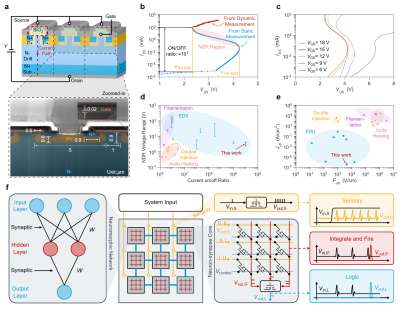
Engineers at HKU have demonstrated the first “brain-like” chip capable of mimicking biological neurons at a frigid 10 millikelvin, a crucial step toward solving the wiring challenges that limit quantum computer scalability. The team, led by Professor Yuhao Zhang and PhD student Xin Yang, harnessed a unique property of Silicon Carbide (SiC) MOSFETs, a stable “S-shape” negative differential resistance, to create energy-efficient circuits operating near absolute zero. This innovative approach offers a potential solution to the excessive heat generated by current quantum control systems, which forces electronics to be positioned remotely from sensitive qubits. “Our work introduces a hardware platform that can be integrated alongside quantum processors,” said Professor Zhang. The resulting circuits are reportedly thousands of times more energy-efficient, with implications extending beyond quantum computing to applications like deep-space exploration.
Silicon Carbide MOSFETs Enable Cryogenic Neuromorphic Circuits
The ability to mimic biological neurons at temperatures approaching absolute zero has been demonstrated using silicon carbide, offering a potential solution to the escalating challenges of scaling quantum computing systems. Researchers at HKU Engineering have successfully created a programmable neuromorphic hardware platform leveraging the unique properties of Silicon Carbide (SiC) MOSFETs, achieving neuron-like “spiking” behavior at 10 millikelvin, a temperature at which conventional silicon-based electronics struggle. This breakthrough addresses a critical issue in quantum systems, where the need to maintain extremely low temperatures for qubits necessitates placing control electronics at a distance, limiting performance and scalability. Professor Yuhao Zhang of the Department of Electrical and Computer Engineering at the University of Hong Kong explains that the team discovered that cooling SiC MOSFETs below 2 Kelvin induces a distinct “S-shape” negative differential resistance (NDR) behavior, driven by electron-donor impact ionization (EDII).
This mechanism, unlike those found in traditional electronics, is inherent to the material itself, ensuring stability and repeatability across manufacturing processes. Xin Yang, a PhD student involved in the research, emphasized the scalability of this approach, stating that it is “a robust and scalable approach.” The use of SiC is particularly advantageous as it is already widely utilized in industries like electric vehicles and power grids, allowing for production on standard 300-millimeter wafers. The demonstrated ability to cascade these artificial neurons into larger networks opens possibilities for complex, localized data processing at cryogenic temperatures, promising improvements in quantum error correction and real-time quantum control. Beyond quantum applications, the robustness of these circuits makes them well-suited for the harsh conditions of deep-space exploration, where electronics must withstand extreme cold on lunar surfaces or in the outer solar system. The findings, published in Nature Communications, detail a pathway towards significantly more energy-efficient circuits, thousands of times more efficient than current options, thereby reducing the thermal burden on the complex cryogenic systems required for advanced computing and space travel.
“Because SiC is already used globally in electric vehicles and power grids, we can leverage existing industrial foundries to manufacture these cryogenic chips on 300-mm wafers”.
Negative Differential Resistance Achieves Energy-Efficient Spiking Behavior
The pursuit of more efficient control systems for quantum computers is increasingly focused on mimicking biological processes; conventional electronics struggle with the extreme cryogenic environments and power demands of qubit manipulation. This breakthrough, detailed in a recent Nature Communications publication, marks the first demonstration of a single transistor replicating this energy-efficient behavior at temperatures as low as 10 millikelvin. This reduction in thermal load addresses a key issue currently limiting the advancement of quantum systems and opens possibilities for more complex and powerful quantum architectures.
“By using the unique carrier dynamics in silicon carbide, we can create circuits that are thousands of times more energy-efficient than conventional electronics, significantly reducing the thermal load on cryogenic systems”.

See today’s quantum computing news on Quantum Zeitgeist for the latest breakthroughs in qubits, hardware, algorithms, and industry deals.