He built the fastest computer in the world, and then he left. He did it again, and left again. By the end Seymour Cray had walked out of two companies carrying his own designs and one carrying his own name, and he died at seventy-one while drawing up a fourth machine for a fourth company.
He is remembered as the patron saint of the supercomputer, which is true and slightly beside the point. The more useful thing about Seymour Cray is that he seemed constitutionally unable to stay anywhere that had started to succeed. Every time the business caught up with the engineering, he moved somewhere smaller and began again.
This account follows him through the audited record rather than the folklore, because the folklore is thick and some of it does not survive checking. Several claims repeated in almost every profile of Seymour Cray are corrected here rather than passed on, and where a famous quotation cannot be sourced, it does not appear.
Before the computers had names
Seymour Cray was born on 28 September 1925 and grew up in Chippewa Falls, Wisconsin, the town he would later drag the supercomputer industry back to. His father was a civil engineer who surveyed dam sites on the Chippewa River and then became the town’s city engineer, doubling as its plumbing, electrical and building inspector. Cray described himself as “one of those nerds before the name was popular”, who spent all his time in the electrical engineering laboratory and not enough time socialising.
He graduated from high school in 1943 and, in his own dry phrase, you know what happened, so he was packed off to the army. He wanted no part of it and ended up in the infantry, which is not where electronics happens. He carried a walkie-talkie in a communication platoon and served in both theatres, arriving in Europe after D-Day, seeing the Battle of the Bulge and walking across Germany to meet the Russians, then shipping to the Pacific, where he pulled wires through jungle in the Philippines and helped round up Japanese stragglers.
Afterwards came a bachelor’s degree in electrical engineering from the University of Minnesota in 1950 and a master’s in applied mathematics the following year. An instructor told him to walk down the street to a firm called Engineering Research Associates, which occupied a wooden former glider factory built for the D-Day landings. He joined in 1950.
What he actually did at Engineering Research Associates
The standard line is that Cray designed the ERA 1103. The oral histories held by the Charles Babbage Institute are more precise and more interesting. James Thornton, who worked alongside him, recalled that Cray did the control system and the flip-flop while Thornton did the basic circuits and the arithmetic, and that Cray was rapidly promoted to project engineer and became the lead. Asked in 1995 what the first machine he did by himself was, Cray answered with the 1103.
Less well known is the Navy Tactical Data System machine, which colleagues remembered as substantially his and as the first big computer the firm built with transistor circuitry. Gordon Bell’s lecture slide calls it Cray’s first computer. It rarely appears in profiles of him at all.
Remington Rand bought the company, then Sperry absorbed it, and the work drifted commercial. Cray gave the clearest possible account of why he left. Looking at an accounting system shortly before his departure, he found his own project filed under miscellaneous and other, and took the point that he was no longer mainstream.
The 1604 and the world supply of reject transistors
At Control Data he built the 1604, which he described as the first computer for that company and as a success in the scientific market because it was the first large scientific machine to be transistorised.
The way he sourced its parts is the best anecdote in his working life and it is on the record from his own mouth. He bought up a Minneapolis retail store’s stock of transistors rejected for use in transistor radios, going back repeatedly until a company representative told him there were none left. He had, as he put it, “exhausted the entire world supply of reject transistors for transistor radios in building my first computer”.
Control Data, and the machine that embarrassed IBM
Almost every account calls Seymour Cray a co-founder of Control Data Corporation, and his own company’s 1994 annual report to the Securities and Exchange Commission says exactly that. Cray disagreed. Asked directly in a Smithsonian interview in May 1995 he said he did not start Control Data and was not part of forming the corporation, only that he was probably the most technical person there at the beginning.
He put $5,000 of his own money in and joined a group that wanted to build point-of-sale machines, insisting instead on large scientific computers. William Norris, who did found the company, remembered him as one of the young men who turned up at the house where prospective employees gathered, and added that he had heard Cray was a very astute engineer and one of the real comers. Two answers earlier in the same session, though, he had said the opposite, that he left with Bill Norris and started Control Data Corporation, and inside the denial itself he refers to the rest of the half dozen or so founding people, counting himself among them. His own account will not settle it.
The machine that made his name was the CDC 6600 of 1964. The Computer History Museum records it running around three million instructions a second, built from roughly 400,000 transistors and more than a hundred miles of wiring. Ten small peripheral processors handled input and output so that the central processor never had to stop and do the housekeeping, which is the idea the whole design turns on.
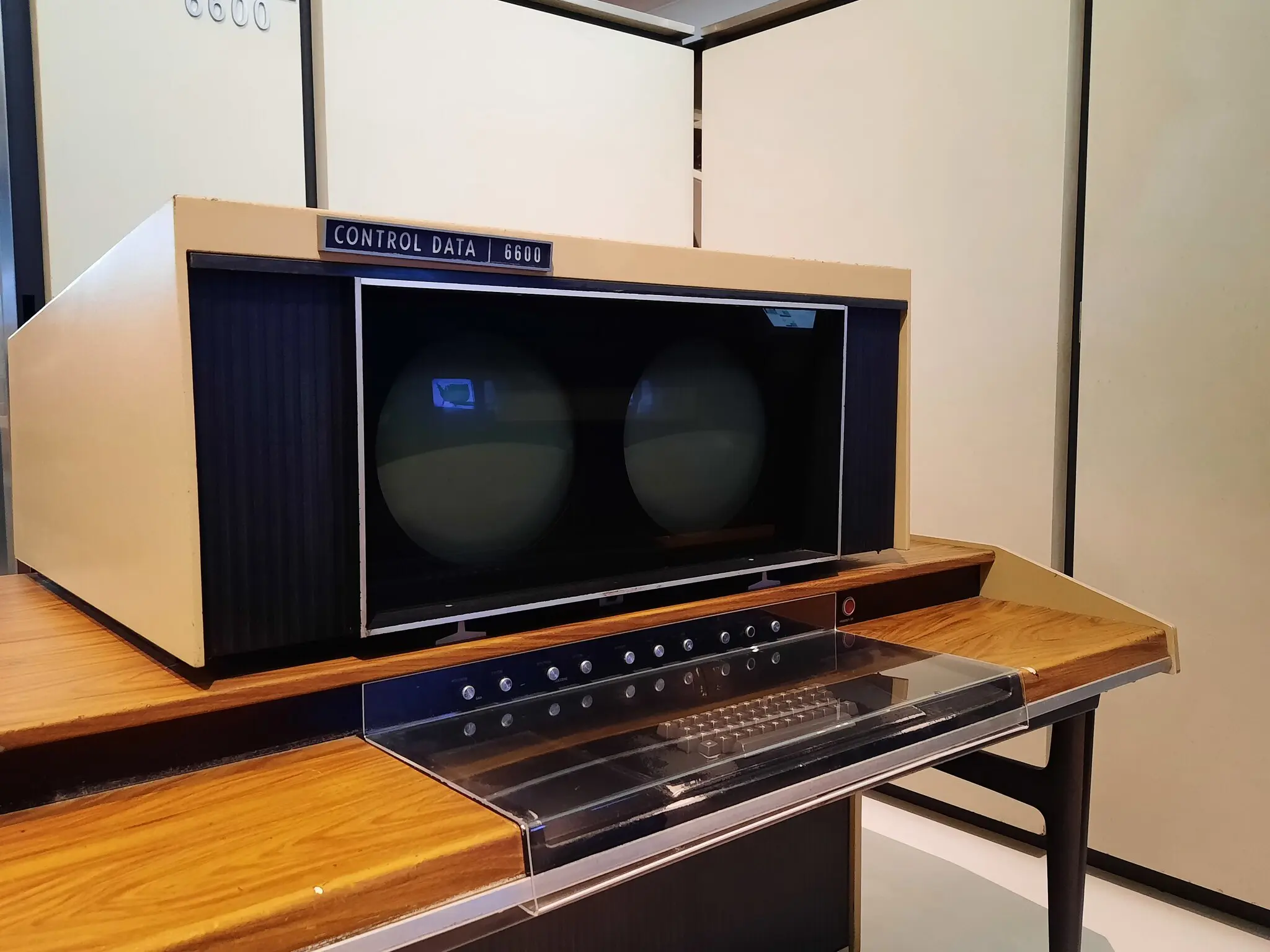
IBM’s reaction is the measure of what he had done. Thomas Watson Jr. wrote an internal memo in August 1963, reproduced years later in a lecture by Gordon Bell, complaining that Control Data had announced the 6600 from a laboratory of only thirty-four people including the janitor, of whom fourteen were engineers and four were programmers, and asking why IBM had lost its industry leadership by letting someone else offer the world’s most powerful computer.
Cray is supposed to have replied that Mr Watson had answered his own question. It is the best line in the story and we could not source it anywhere, so it is offered here as the thing everyone repeats rather than as something he said. The museum records that IBM pre-announced faster System/360 models and then never shipped the machine it had promised. William Norris, Control Data’s president, answered with an antitrust suit, and IBM settled it four years later with cash and a computer services company that the museum puts at more than $600 million between them.
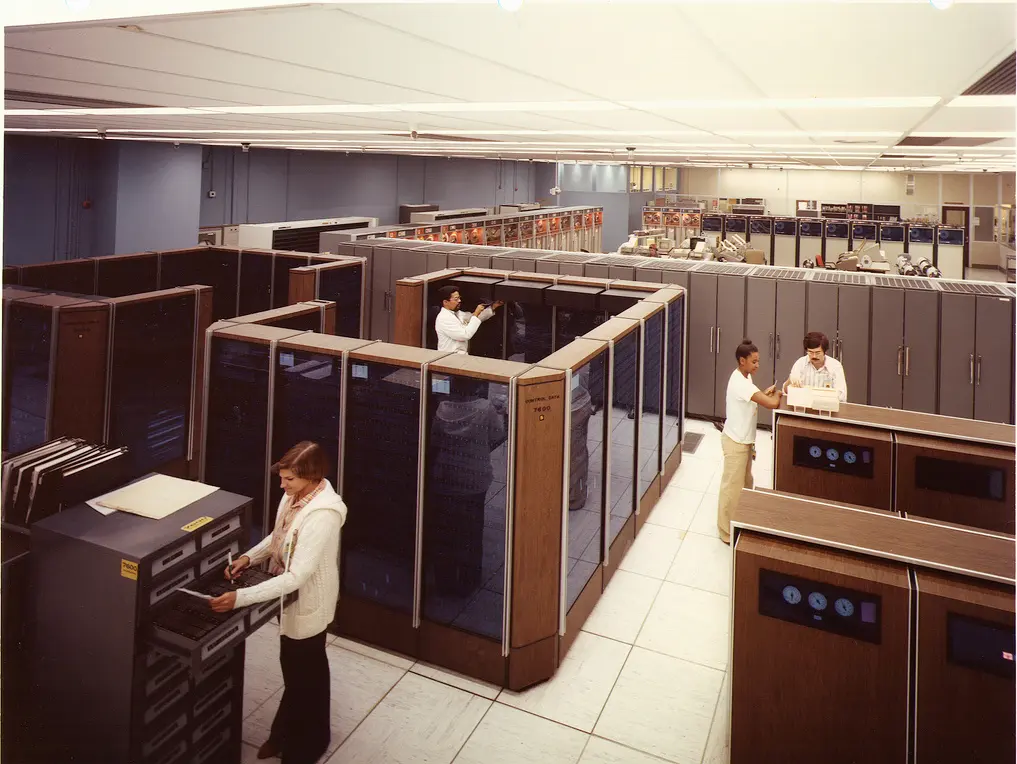
Cray followed it with the CDC 7600 in 1969, which the museum records as the machine that finally surpassed its predecessor. He was, by then, the man Gordon Bell would later call the greatest computer builder he knew of. He left three years later.
Walking out, the first time
Seymour Cray left Control Data and founded Cray Research in 1972. He explained why in a Smithsonian interview in May 1995, and both halves of the story that gets retold come from him.
The first half is distance. As the company grew successful he found himself pulled into marketing and management, so he moved out of town and built a laboratory at Chippewa Falls in Wisconsin, far enough away that most customers would not drive it. He called it “a nice filtering process for the marketing organization”, and reckoned anyone who did make the trip had earned his time.
The second half is money. Being that far from headquarters, he said, the communication dwindled until it was no longer perceived as important, and then financing became the issue. Funding was not available, so it was time to start a new company, and that began Cray Research. Notice what he does not say in that passage. He never names the 8600, the machine the folklore always names, though later in the same session he described it without the label, as an unfinished multiprocessor built from discrete components that was falling behind schedule.
Others did name it. A panel of eighteen Control Data engineers recorded in 1975, three years after the event, discussed the 8600 as exactly that flashpoint, with one participant recalling that they had power on the prototype and were debugging it right up to the moment they were called into the final meeting. Nicholas Lewis’s 2019 doctoral study of Los Alamos computing reconstructs a site visit to Chippewa Falls in May 1972, from a laboratory notebook kept at the laboratory, at which Cray told visiting staff about the new company before it had a name. The design had run into heat and reliability trouble, he wanted to start over, and Control Data proposed waiting about a year for the funds. He left rather than wait.
The Cray-1, and the shape of the thing
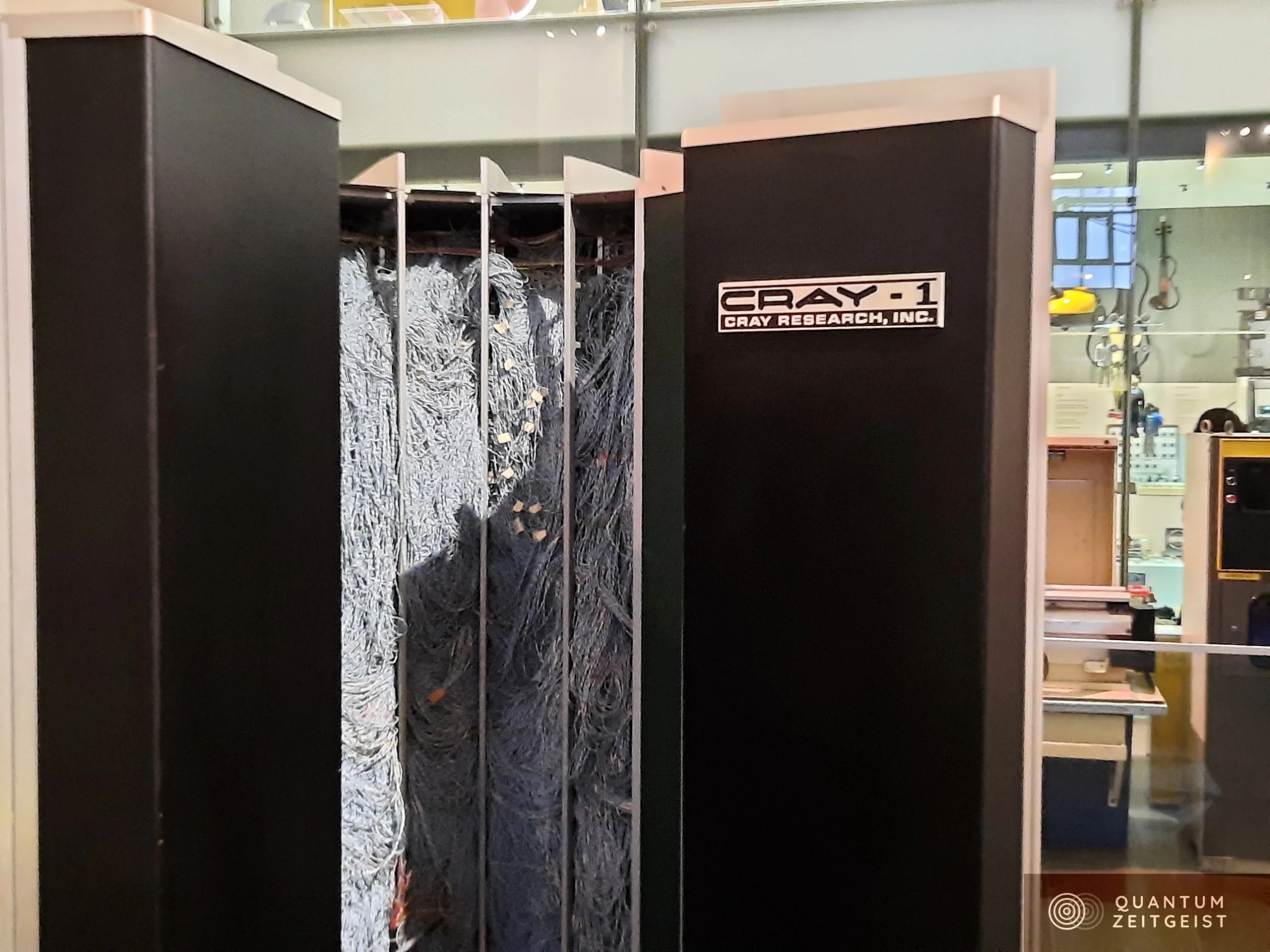
The Cray-1 is the machine most people picture when they picture a supercomputer, and the reason is that it looks like nothing else. Cray Research’s own hardware reference manual describes twenty-four logic chassis arranged two to a column across twelve columns, bent into a 270 degree arc about five feet across and six and a half feet tall.
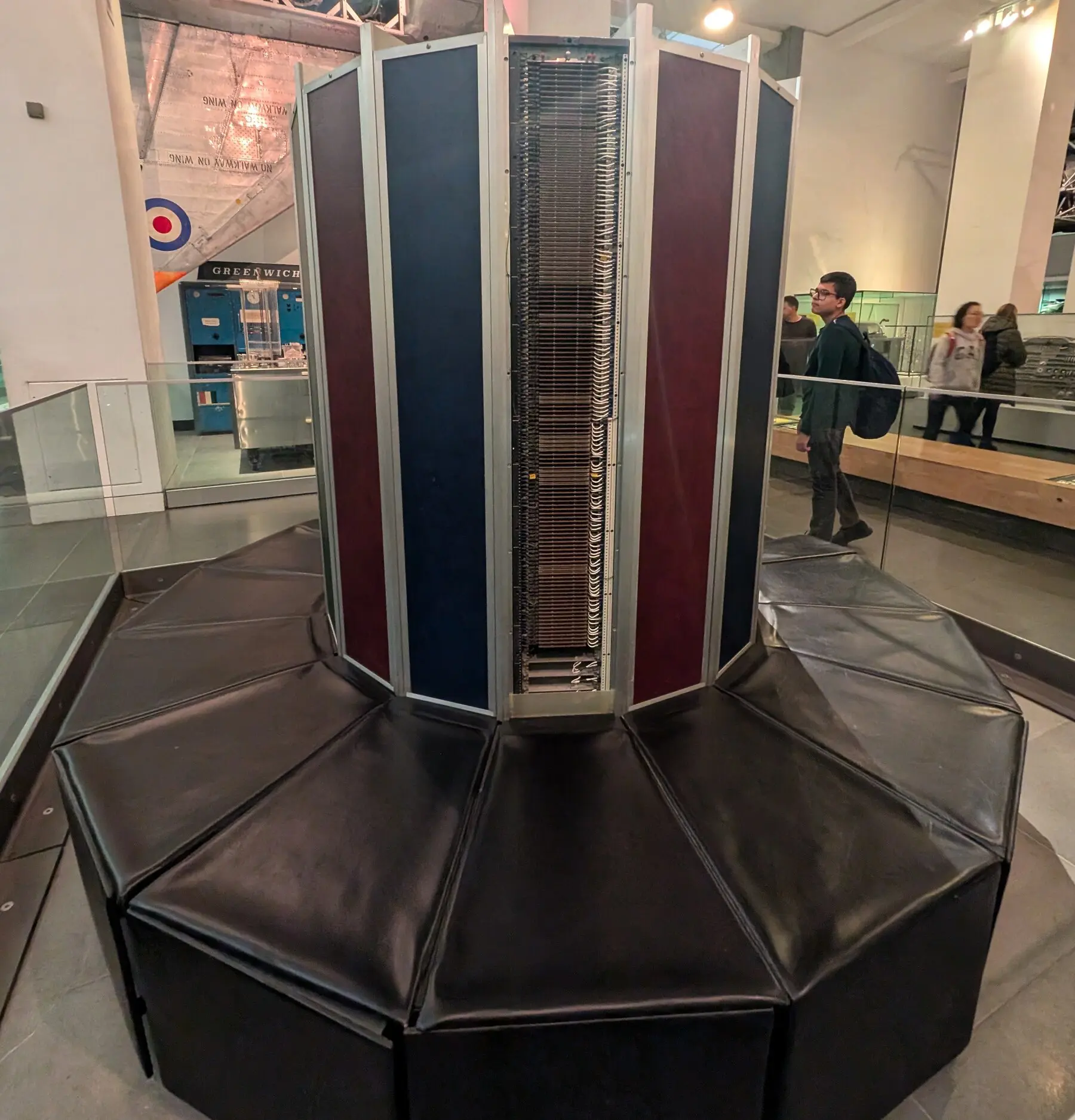
The shape was not styling. Bending the chassis shortens the runs on the inner radius, and the manual places the computation and input-output modules on the eight chassis forming the centre four columns. At a 12.5 nanosecond clock the distance a signal has to travel between two components stops being a detail and becomes a design constraint.
It was not the first vector machine, and Seymour Cray said so himself. Asked about it he called the Cray-1 the second vector machine in the marketplace, the previous one having been done by Control Data, meaning the STAR-100. Almost every profile of him claims the first, and he was more careful about his own record than his admirers have been.
The rest of the specification, from the manual rather than from later summaries, is memory expandable from a quarter of a million to a full million 64-bit words, each word physically 72 bits with eight of them check bits. It weighed 10,500 pounds at maximum memory and drew roughly 118 kilowatts, cooled by Refrigerant-22 piped through the columns rather than by immersion.
Where the famous number comes from
Almost every account of the Cray-1 quotes 160 million floating-point operations per second, and the number appears nowhere in Cray’s own manual. What the manual says is that the add and multiply units are independent and fully segmented, that vector instructions produce one result per clock period, and that chaining lets the machine produce more than one result per clock.
Chain a multiply to an add and you get two results every 12.5 nanoseconds, which is 160 million a second. It is a derived theoretical peak available only to code that vectorises and chains cleanly, and it was never a sustained rate on real work. That gap between the number on the brochure and the number on the floor is the recurring theme of Seymour Cray’s career, and eventually it is what the industry stopped paying for.
Serial number 001 went to Los Alamos in 1976 on loan. The first machine actually sold went to the National Center for Atmospheric Research, and NCAR’s own account is more precise than the version usually printed. The president of its parent body signed an $8.86 million contract on 12 May 1976, and the machine it produced, a Cray-1A carrying serial number 3, was delivered on 11 July 1977.
Serial number 2 was never built. Los Alamos persuaded Cray to add error detection and correction to the design, and the second chassis was cut up for marketing souvenirs. Accounts that describe a first sale to NCAR in the summer of 1976 compress a contract and a delivery fourteen months apart, and quietly drop the serial number that makes the story interesting.
What Seymour Cray actually designed
Precision matters here, because his name was on the building and the assumption is that his hand was on everything inside it. The machines that are genuinely his are the CDC 6600, the CDC 7600, the Cray-1 and the Cray-2, and later the Cray-3 and the unfinished Cray-4 at his own company. That is four generations of fastest-computer-in-the-world across three decades.
The Cray X-MP is not one of them. It is commonly credited to him and it was designed under Steve Chen, while Seymour Cray was working on the Cray-2. The distinction is not pedantry, because the X-MP was another substantial commercial success for Cray Research, and it was built by somebody else while the founder was off pursuing a different idea entirely.
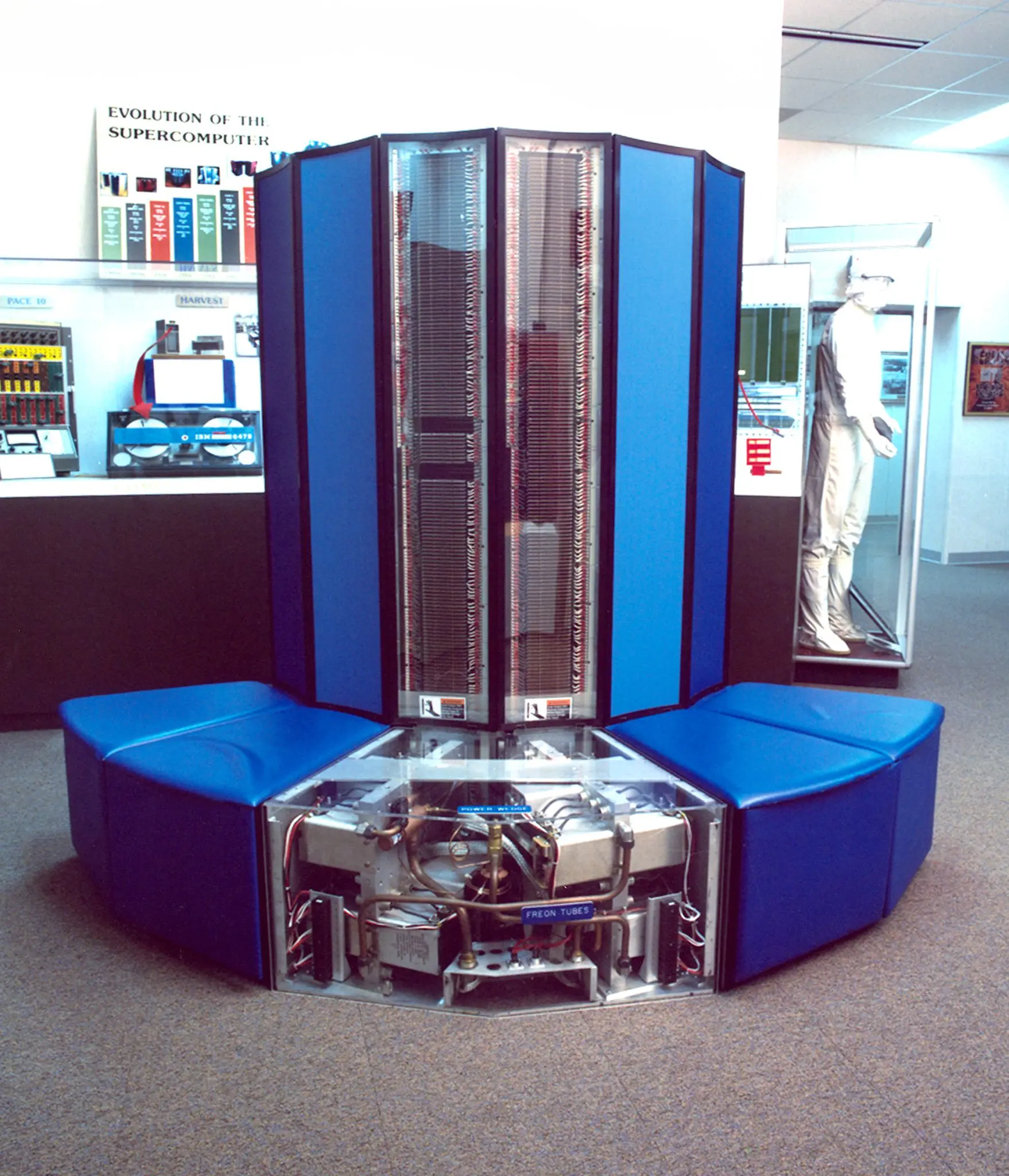
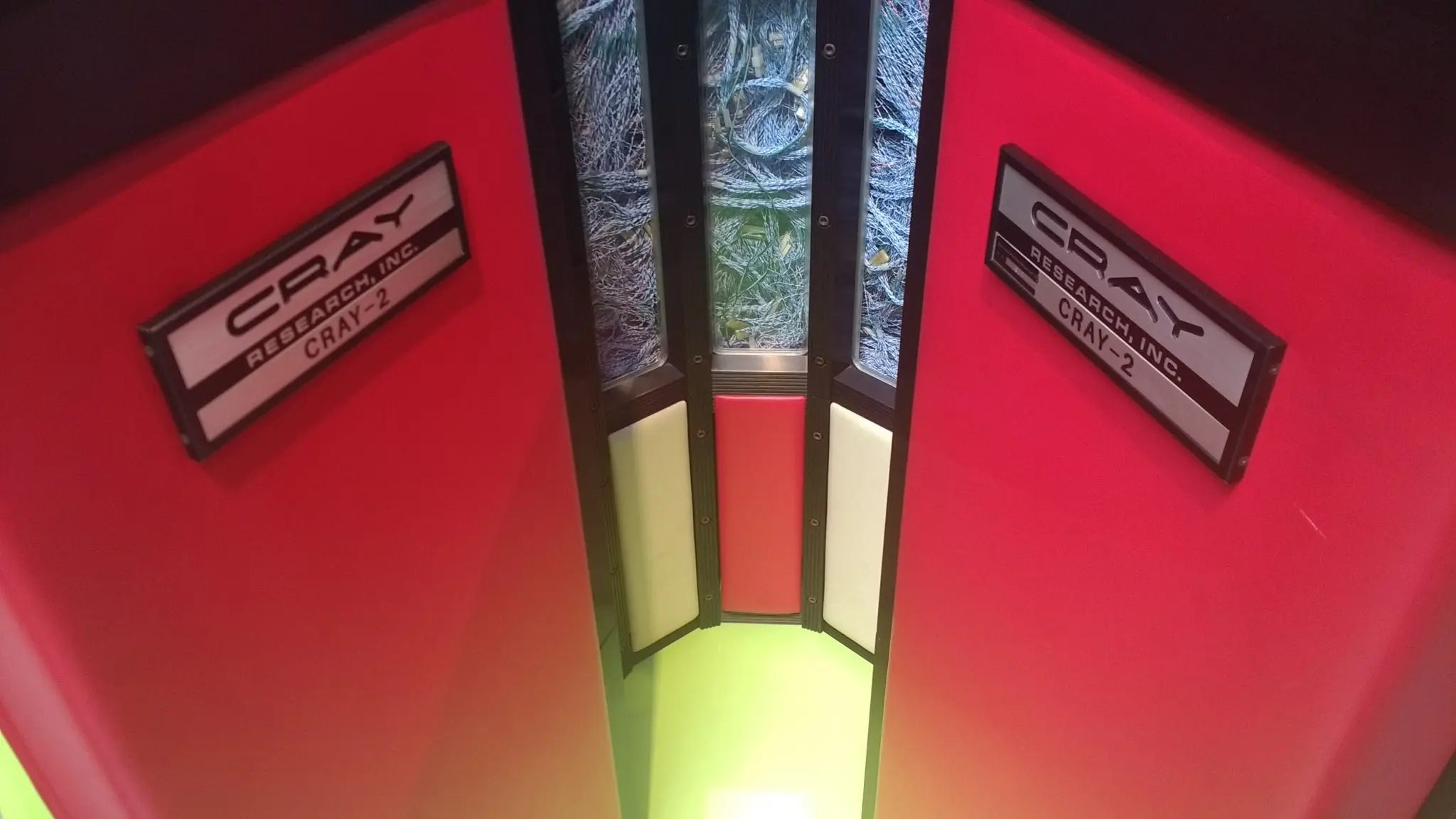
The Cray-2 of 1985 is his, and it is the one where the engineering gets strange. Cray’s functional description manual describes fourteen vertical columns in a 300 degree arc, 45 inches tall and 53 inches across, with an inert fluorocarbon liquid circulating inside the cabinet in direct contact with the integrated circuit packages. The Cray-1 was cooled through pipework; the Cray-2 sat in the coolant.
Its memory is the specification most often mangled. The manual gives 256 or 512 million words of dynamic common memory, or 64 or 128 million words of static memory, and a word on that machine is 64 bits, so 256 million words is two gigabytes. Accounts putting the Cray-2 at 256 megabytes understate it eightfold.
How Seymour Cray actually worked
He worked alone, and said so. Computer design, he thought, was hard to do as a group activity, and “designing by committee is not appropriate for computers”. What a single person had to provide was the architectural overview, meaning the instruction set, the size of the memory and what the memory was made of, after which other people could take portions of the work within those constraints.
Colleagues describe a manager who gave almost no direction. Howard Sachs, who ran hardware development for him in Boulder, remembered Cray asking different people to design sections of a machine, letting them submit their logic equations, and then never speaking to them about it again, so that nobody knew whether their work had been used until the machine was finished. He also personally trained the women who adjusted the lengths of the traces on the circuit boards, so that every trace matched and no signal arrived before another.
He wrote his own documentation. One Control Data engineer recalled that Cray wrote the 7600 CPU manual himself, after the design was complete on paper and long before any hardware existed, and called it unbelievable for anyone who needed to work at that level. He also declined, deliberately, to promise marketing that a machine would ship at all. One colleague thought the effect was useful, because it meant fewer people arriving to offer their input.
Two things everybody says that are not true
The first is that he never used simulation. He was more equivocal than that in 1995, saying that while he did not use his own computers to design other computers, they were used to simulate and to verify, and that a personal computer had by then replaced paper and pencil for him. The team working on his last Control Data machine ran a logic simulator that one engineer called the most valuable tool they had.
The second is the tunnel. The tunnel is real and well documented, described to Time in March 1988 by John Rollwagen, then chairman of Cray Research, as running from below Cray’s house toward the woods, eight feet high and four feet wide, lined with cedar boards. What has drifted is the joke. In the version Cray actually told, he works for three hours, gets stumped, and goes to dig; the elves in the Wisconsin woods see him leave, come into his office and solve the problems while he is out. The widely quoted version has the elves visiting him in the tunnel, which reverses the mechanism and loses the point.
Walking out, the second time
One fact reframes everything that is usually written about the end of Cray Research. Seymour Cray was not running it when it was sold, and had not been part of it for years. Cray Computer Corporation was incorporated in Delaware on 27 July 1989 as a wholly owned subsidiary of Cray Research, and became a separate public company that November when its shares were distributed to Cray Research’s shareholders.
He went with it, as chairman and chief executive, to Colorado Springs, and left the Cray Research board on 15 November 1989. So when Silicon Graphics completed its purchase of Cray Research in the spring of 1996, the company bearing his name had not had him on its board for more than six years.
He was by then running a separate business that had already been in Chapter 11 for over a year and was months from having its liquidation plan confirmed. The two endings are routinely collapsed into a single story in which the founder goes down with the company that carries his name, and that story never happened.
The company that never sold a computer
Cray Computer Corporation existed to build the Cray-3 out of gallium arsenide, a semiconductor roughly four times faster than silicon by its own filings’ reckoning and far harder to manufacture. The manual describes up to sixteen processors, a two nanosecond clock and a maximum burst rate of sixteen gigaflops, though by 1994 the company was offering four and eight processor machines and told the SEC it did not expect an order for a sixteen-processor system.
Where the money came from and where it went
Cray Research put in $98.6 million between October 1989 and October 1991. A public offering raised $61.1 million in July 1991, a further placement $27.8 million in June 1993, and the sale of a single Cray-2 brought in $12.8 million. By the end of 1994 the company had accumulated losses of approximately $363 million. Cray was by then personally exposed through the letters of credit, and in the first quarter of 1995 he bought shares in it himself.
The break came in December 1991, when the National Energy Research Supercomputer Center at Lawrence Livermore cancelled a purchase order for a sixteen-processor Cray-3. The company’s own filings describe the announced loss of that order as causing a major drop in the share price, and it never recovered from it.
What followed is rarely mentioned in accounts of his life, and everything in this paragraph comes from Cray Computer Corporation’s own annual report to shareholders for 1994. It discloses that the Securities and Exchange Commission had opened a formal, non-public investigation which went further than trading in the stock. Commission staff had information, the filing says, that the company and others might have made false or misleading statements in SEC filings about that order and about the Cray-3’s progress.
Staff told the company they intended to recommend that the Commission seek injunctions and civil penalties against the company and against Seymour Cray. That is a staff recommendation rather than a decision by the Commission, and it is the stage at which a company is invited to argue back, which this one did. The company said it did not believe the investigation had uncovered any violations.
Nothing came of it. No enforcement action was ever brought against Seymour Cray, no findings of wrongdoing were ever made against him, and the company was dissolved in January 1997. He was never charged with anything, and the episode is recorded here because a biography that leans on those filings as evidence cannot quietly omit that the Commission was asking whether they were true.
Here is the fact most accounts miss entirely. Cray Computer Corporation never sold a computer. Its 1994 annual filing states that the company had no orders for and no revenues from the sale of its products, and the four-processor Cray-3 delivered to the National Center for Atmospheric Research in May 1993 went there for evaluation and demonstration rather than as a sale. The only product-related revenue it ever booked was $2.1 million from a development contract with the National Security Agency.
Two hundred and fifty thousand dollars
Cray Computer Corporation filed a voluntary Chapter 11 petition in the District of Colorado on 24 March 1995, having failed to complete a planned placement of stock with foreign and institutional investors. Work on the machines stopped and the engineering, manufacturing and marketing staff were laid off. In July the company abandoned any attempt to reorganise and moved to liquidation.
The entire intellectual property portfolio, meaning the Cray-3, the Cray-3/SSS, the Cray-4 and the gallium arsenide technology behind them, was agreed for sale in December 1995 at $100,000. It was then auctioned, and closed at $250,000 on 29 January 1996. Approximately $363 million had gone into creating it.
The plant and its site fetched $7.3 million, nearly thirty times what the designs did. Seymour Cray had personally posted $6 million in standby letters of credit as collateral for the company’s borrowing during 1994, and his claim was later allowed at $6,004,000, and the lender drew on them after the filing. He settled part of his claim by accepting about thirty-two acres of unimproved land valued near $900,000, and the remainder was left as an ordinary unsecured claim against his own company.
Unsecured creditors had been paid 80 cents on the dollar by early 1997, with about two million dollars still held in reserve. Shareholders received nothing. By then Seymour Cray was already dead.
Still drawing
He did not stop. In 1996 he founded SRC Computers, named after his own initials, and set about building a large shared-memory machine out of Intel microprocessors. Charles Breckenridge, who worked with him there, said Cray had become convinced that within another iteration or two the off-the-shelf microprocessor would match a custom one.
There is an irony in that worth sitting with. Seymour Cray is the man most often quoted against massive arrays of small commodity processors, and he spent the last year of his life building one. Whether he had changed his mind or simply followed the economics, he was doing at seventy what he had done at thirty, which was to start again somewhere smaller.
On 22 September 1996 his Jeep Cherokee was struck by another car on Interstate 25 in Colorado Springs. He was taken to hospital with serious injuries and died there on 5 October, a week after his seventy-first birthday. Fuller accounts circulate, involving a rollover and a citation against the other driver. No contemporaneous report we could find carries them, so they are left out, as is the frequently repeated claim that the crash happened at the Air Force Academy; the entrance ramp involved was at North Academy Boulevard.
The IEEE Computer Society established the Seymour Cray Computer Engineering Award in late 1997, awarded for innovative contributions to high performance computing systems that best exemplify his creative spirit. Its first recipient was John Cocke, whom Gordon Bell called the father of the reduced instruction set computer, and who said the machine that influenced him most was the 6600.
Questions and answers
What is Seymour Cray best known for?
Designing the fastest computer in the world, repeatedly, across three decades. The CDC 6600 of 1964, the CDC 7600 of 1969, the Cray-1 of 1976 and the Cray-2 of 1985 are all his, and each took the performance lead in its turn. Few computer architects have a record of that shape.
Did Seymour Cray design the Cray X-MP?
No. The X-MP was designed under Steve Chen while Seymour Cray was working on the Cray-2. This matters because the X-MP was another substantial commercial success for Cray Research in the 1980s, so one of the company’s best-selling products was not the founder’s work.
Was Seymour Cray running Cray Research when it was sold?
No, and he had not been for more than six years. He left in 1989 for Cray Computer Corporation, which was spun out to Cray Research’s shareholders that November. Silicon Graphics bought Cray Research in April 1996, by which point his own separate company had already filed for bankruptcy.
Did Cray Computer Corporation ever sell a machine?
No. Its 1994 annual filing states that the company had no orders for and no revenues from the sale of its products. The Cray-3 delivered to the National Center for Atmospheric Research in May 1993 was there for evaluation and demonstration, and the only product-related revenue it booked was $2.1 million from a National Security Agency development contract.
How much did the Cray-3 designs sell for?
$250,000 at bankruptcy auction on 29 January 1996, covering the Cray-3, the Cray-3/SSS, the Cray-4 and the gallium arsenide process behind them. Roughly $363 million had been spent creating that portfolio. The company’s manufacturing building sold separately for $7.3 million.
Why was the Cray-1 shaped like a C?
To keep the wires short. Bending the chassis into an arc put the speed-critical sections on the inside edge, where the runs between them are shortest. At a 12.5 nanosecond clock the physical distance a signal travels becomes a hard design constraint rather than an afterthought.
Did the Cray-1 really run at 160 megaflops?
That figure is a derived theoretical peak and it appears nowhere in Cray’s own manual. Chaining a multiply to an add yields two results per 12.5 nanosecond clock, which is 160 million a second, but only for code that vectorises and chains cleanly. It was never a sustained rate on real work.
Did Seymour Cray co-found Control Data?
His company’s SEC filings say so, but he denied it. Asked in 1995 he said he did not start Control Data and was not part of forming the corporation, only that he was probably the most technical person there at the beginning. He put $5,000 of his own money in and pushed the founders towards large scientific computers rather than point-of-sale machines.
Why did Seymour Cray leave Control Data?
He gave two reasons himself. He had moved to Chippewa Falls to get away from marketing and management, and once he was that far from headquarters the communication dwindled and funding stopped being available, so it was time to start a new company. Colleagues and a Los Alamos notebook from May 1972 supply the label and the detail, which is that his 8600 design had run into heat and reliability trouble and Control Data would not fund a restart.
What is the story about Seymour Cray and the elves?
He dug a tunnel from under his house in Chippewa Falls towards the woods, eight feet high and lined with cedar. In the version he actually told, he works until he gets stumped, then goes to dig, and the elves in the woods see him leave, come into his office and solve his problems while he is out. The widely quoted version has the elves visiting him in the tunnel, which reverses the joke.
How did Seymour Cray die?
His Jeep Cherokee was struck by another car on Interstate 25 in Colorado Springs on 22 September 1996. He died in hospital on 5 October, a week after his seventy-first birthday. At the time he was building a large shared-memory machine out of Intel microprocessors at SRC Computers, the company he had founded earlier that year and named after his initials.
The machines, in order
The table lists the machines Seymour Cray designed himself, with specifications taken from manufacturer manuals where one survives. Figures that are derived rather than printed are labelled as such, because the difference between a measured rate and a marketing peak runs through this whole story.
| Machine | Year | Clock | Performance | What it introduced |
|---|---|---|---|---|
| CDC 6600 | 1964 | not stated | ~3 million instructions/sec | Peripheral processors handling all input and output |
| CDC 7600 | 1969 | not stated | not stated | Deeper pipelining, and the machine that surpassed the 6600 |
| Cray-1 | 1976 | 12.5 ns | 160 MFLOPS, derived peak | Vector registers with automatic chaining |
| Cray-2 | 1985 | 4.1 ns | 2 GFLOPS burst, company figure | Full liquid immersion cooling, two gigabytes of memory |
| Cray-3 | 1993 | 2 ns | 16 GFLOPS burst for a machine never built | Gallium arsenide logic. Never sold |
| Cray-4 | announced 1994 | 1 ns | company claim only | Never completed |
Disclaimer. This article is for informational purposes only and does not constitute investment, financial or professional advice. The quantum technology industry evolves rapidly and information may become outdated. Always conduct your own research and consult qualified advisers before making investment decisions. Investing in quantum computing companies involves significant risk, including the potential loss of your entire investment, and past performance is not indicative of future results.


See today’s quantum computing news on Quantum Zeitgeist for the latest breakthroughs in qubits, hardware, algorithms, and industry deals.