
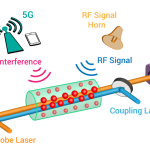
Scientists at Innopolis University have developed a new Rydberg-atom receiver capable of recovering radio frequency (RF) signals without the need for a local oscillator. Vladislav Katkov and Nikola Zlatanov present a theoretical framework enabling phase and amplitude recovery of a single RF field without injecting an RF local oscillator into the atoms. This is achieved through the application of a static DC bias, activating a key optical pathway and establishing a phase-sensitive loop within the receiver. The research details how this technique yields direct estimators for signal phase and amplitude, offering a minimal route to coherent RF reception and potentially simplifying receiver design.
Direct radio frequency signal recovery via static field biased Rydberg atoms
The nth probe harmonic now carries the factor eiΦS, representing a significant improvement over previous methods lacking a direct phase relationship to the received signal. Coherent Rydberg reception previously demanded either an auxiliary radio-frequency local oscillator or time-varying optical references, but this advancement unlocks a minimal route bypassing both requirements. This unlocks the potential for simplified receiver designs, as accurate phase and amplitude recovery is achieved solely through a static DC bias applied to the Rydberg atoms. Traditional superheterodyne receivers rely on down-converting the incoming RF signal to an intermediate frequency (IF) using a local oscillator, a process that introduces complexity and potential sources of noise. This new approach, however, operates directly on the received signal, potentially leading to more efficient and compact receiver architectures. The ability to directly recover the carrier phase is particularly significant, as phase information is crucial for advanced modulation schemes used in modern wireless communication systems, such as quadrature amplitude modulation (QAM).
Innopolis University researchers have demonstrated a method for recovering both the amplitude and carrier phase of a radio frequency (RF) signal using Rydberg atoms, eliminating the need for a local oscillator commonly found in traditional receivers. This relies on applying a static direct current (DC) bias to a vapour cell containing the atoms, activating a previously unused optical pathway by Stark-mixing a near-degenerate Rydberg pair. Consequently, a self-contained phase-sensitive loop is created, and the nth probe harmonic carries a precise phase factor of eiΦS, allowing direct estimation of the signal’s characteristics. The team also derived explicit root-mean-square error (RMSE) laws to identify optimal bias angles for both phase and amplitude recovery, alongside a balanced compromise angle to equalize potential penalties in each measurement. The RMSE laws provide a quantitative measure of the accuracy of the phase and amplitude estimates, allowing researchers to optimise the DC bias for specific application requirements. These laws account for various noise sources and imperfections in the system, providing a realistic assessment of achievable performance. The concept of a ‘compromise angle’ acknowledges the inherent trade-off between phase and amplitude accuracy, allowing for a balanced design that minimises overall error.
Stark mixing enables phase-sensitive radio detection via Rydberg atoms
A static DC bias gently nudges an atom’s energy levels with an electric field, similar to tuning a radio dial to a specific station; this process, known as Stark mixing, is central to the new technology. Careful control of this bias activated a previously inaccessible optical pathway within the atom, establishing a new route for radio signal detection. This wasn’t simply about boosting the signal strength; it established a self-contained, phase-sensitive loop, allowing the receiver to determine both the strength and timing of the incoming radio waves without a traditional local oscillator. Rydberg atoms, with their large principal quantum numbers, exhibit enhanced sensitivity to external electric fields, making them ideal for Stark mixing. The near-degenerate Rydberg pair refers to two energy levels within the atom that are very close in energy, allowing for efficient mixing via the DC bias. This mixing creates a coherent superposition of states, enabling the detection of the RF signal’s phase.
The technique of Stark mixing manipulates the energy levels of Rydberg atoms using a static DC bias, activating a previously unused optical pathway. The analysis focused on a minimal model utilising an isolated-pair Stark approximation, simplifying calculations by neglecting factors such as magnetic-sublevel structure and Doppler effects. Bias inhomogeneity was also considered through spatial averaging, revealing its impact on coherent gain and amplitude response. The isolated-pair Stark approximation assumes that the interaction between the DC bias and the Rydberg atoms can be accurately described by considering only the two near-degenerate energy levels, neglecting the complex interactions between all possible energy levels. This simplification significantly reduces the computational complexity of the model while still capturing the essential physics. Doppler effects, arising from the thermal motion of the atoms, can broaden the spectral linewidth of the received signal, potentially degrading performance. Spatial averaging of the bias inhomogeneity accounts for the fact that the DC bias may not be perfectly uniform across the entire vapour cell, and its impact on the receiver’s response is assessed.
DC bias calibration governs performance in Rydberg-atom wireless receivers
Rydberg-atom receivers offer a potentially major path to wireless communication, promising compact designs and heightened sensitivity. However, this theoretical work highlights a vital dependency on precise control of the static DC bias applied to the atoms. Achieving optimal performance demands careful calibration of this bias, despite eliminating the need for auxiliary RF components, and a trade-off between accurate phase and amplitude recovery was revealed, requiring a ‘compromise angle’ to balance potential penalties in each measurement. The sensitivity of Rydberg atoms to external fields, while advantageous for detection, also necessitates precise control of the DC bias to maintain stable operation and avoid unwanted signal distortions. Any drift or fluctuations in the DC bias can lead to errors in the phase and amplitude estimates, reducing the receiver’s overall performance.
Rydberg-atom receivers represent a fundamentally new approach to wireless technology, potentially offering advantages in size and sensitivity over conventional designs. Demonstrating coherent signal reception without a local oscillator, even with calibration demands, establishes a key proof of principle and opens avenues for further refinement of the DC bias control mechanisms to minimise performance penalties. This establishes a pathway to coherent radio frequency (RF) signal reception utilising Rydberg atoms, circumventing the need for a conventional radio-frequency local oscillator, which mixes with the incoming signal to produce a fixed intermediate frequency, simplifying processing. Applying a static direct current, or DC bias, to these atoms activated a previously unused optical pathway, creating a self-contained loop for determining signal characteristics. The resulting harmonic signal directly encodes the phase of the received RF field, enabling accurate amplitude and phase recovery without auxiliary components. Future research will likely focus on developing robust and automated calibration techniques for the DC bias, as well as exploring methods to mitigate the effects of noise and imperfections in the system. The potential for integrating Rydberg-atom receivers into miniaturised wireless devices remains a significant long-term goal.
The research demonstrated coherent recovery of both the amplitude and carrier phase of a radio frequency (RF) signal using a Rydberg-atom receiver without requiring a local oscillator. This is achieved by applying a static DC bias to the atoms, activating a pathway for signal detection and creating a self-contained system for determining signal characteristics. The study reveals a trade-off between accurate phase and amplitude recovery, necessitating careful calibration of the DC bias for optimal performance. Authors suggest future work will concentrate on automated calibration techniques and noise mitigation to further refine the system.
👉 More information
🗞 LO-Free Phase and Amplitude Recovery of an RF Signal with a DC-Stark-Enabled Rydberg Receiver
🧠 ArXiv: https://arxiv.org/abs/2603.30023



See today’s quantum computing news on Quantum Zeitgeist for the latest breakthroughs in qubits, hardware, algorithms, and industry deals.