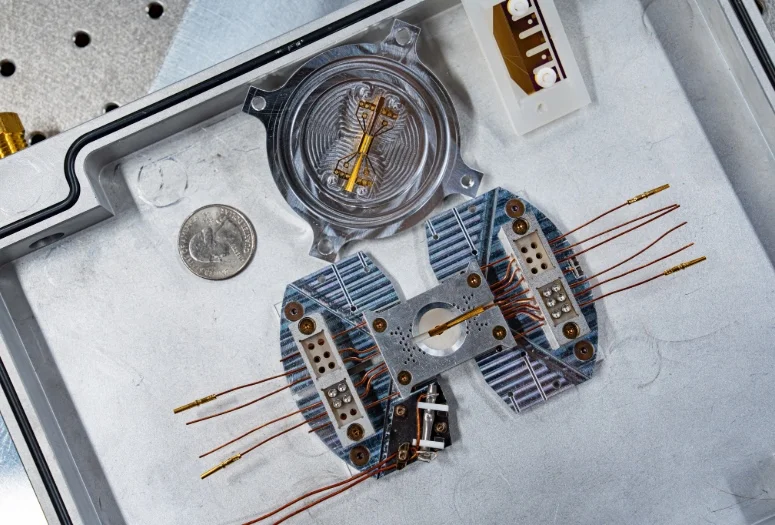
Rice University researchers have developed a new monolithic segmented 3D ion trap that combines the strengths of both blade-style and microfabricated chip designs, overcoming previous limitations in the field of quantum simulation. The trap enabled the team to study complex systems using heavy ytterbium ions, a capability beyond that of lighter ion types. “Trapped ion simulators can help us understand complex problems, like charge transfer in photosynthesis,” said Guido Pagano, an associate professor of physics and astronomy and senior author on this study.
Monolithic 3D Trap Design Combines Blade & Chip Features
Blade-style traps, traditionally favored for their high performance, are limited by their manual assembly and resulting lack of geometric precision; conversely, microfabricated chip traps offer superior precision but often fall short in overall performance. This new design successfully combines the strengths of both approaches within a single, compact architecture, a feat previously limited to lighter ions. The key to this integration lies in the trap’s fabrication process, beginning with a block of fusilica glass etched with lasers and chemicals to create channels for ions and trenches for electrodes.
These trenches are not merely structural. They actively isolate the electrodes, preventing short circuits during gold sputtering and dielectric breakdown under high vacuum conditions. “Our first generation failed, although in a promising and informative way: It had a significant thermal and electrical management problem. The trap began to glow visibly when the desired high radio-frequency voltage was applied in a vacuum,” explained Abhishek Menon, a graduate student and the corresponding author on this study.
Subsequent iterations refined the design, culminating in a viable trap capable of handling heavier ions like ytterbium. The ability to trap heavier ions is particularly significant, expanding the range of complex systems that can be modeled using trapped ion simulators.
Roman Zhuravel, an assistant research professor, emphasized the broader impact of this accessibility, stating, “The monolithic trap makes trapped-ion simulators more accessible to academic labs.” The team’s design allows researchers to simplify challenging quantum problems into manageable components, then map those solutions onto larger, more complex scenarios. The researchers confirmed through testing and computer simulations that the trap functions as intended.
Trapped ion simulators can help us understand complex problems, like charge transfer in photosynthesis.
Guido Pagano, associate professor of physics and astronomy and senior author on this study
Ytterbium Ions Enable Accessible Quantum Simulations
The ability to manipulate heavier ions, specifically ytterbium, expands the range of complex systems amenable to simulation, a capability previously limited by trap design. This refinement was needed to achieve a functional and versatile ion trap capable of handling heavier ionic species while also simplifying the trapping of lighter ions for diverse quantum technologies.
In our monolithic ion trap, we wanted to combine the high-performance features and accessibility of the blade trap with the scalability and modularity of the chip trap in a way that was compatible with the heavier ions.
Abhishek Menon, a graduate student and the corresponding author on this study
Source: https://news.rice.edu/news/2026/new-monolithic-ion-trap-developed-accessible-quantum-simulations



See today’s quantum computing news on Quantum Zeitgeist for the latest breakthroughs in qubits, hardware, algorithms, and industry deals.