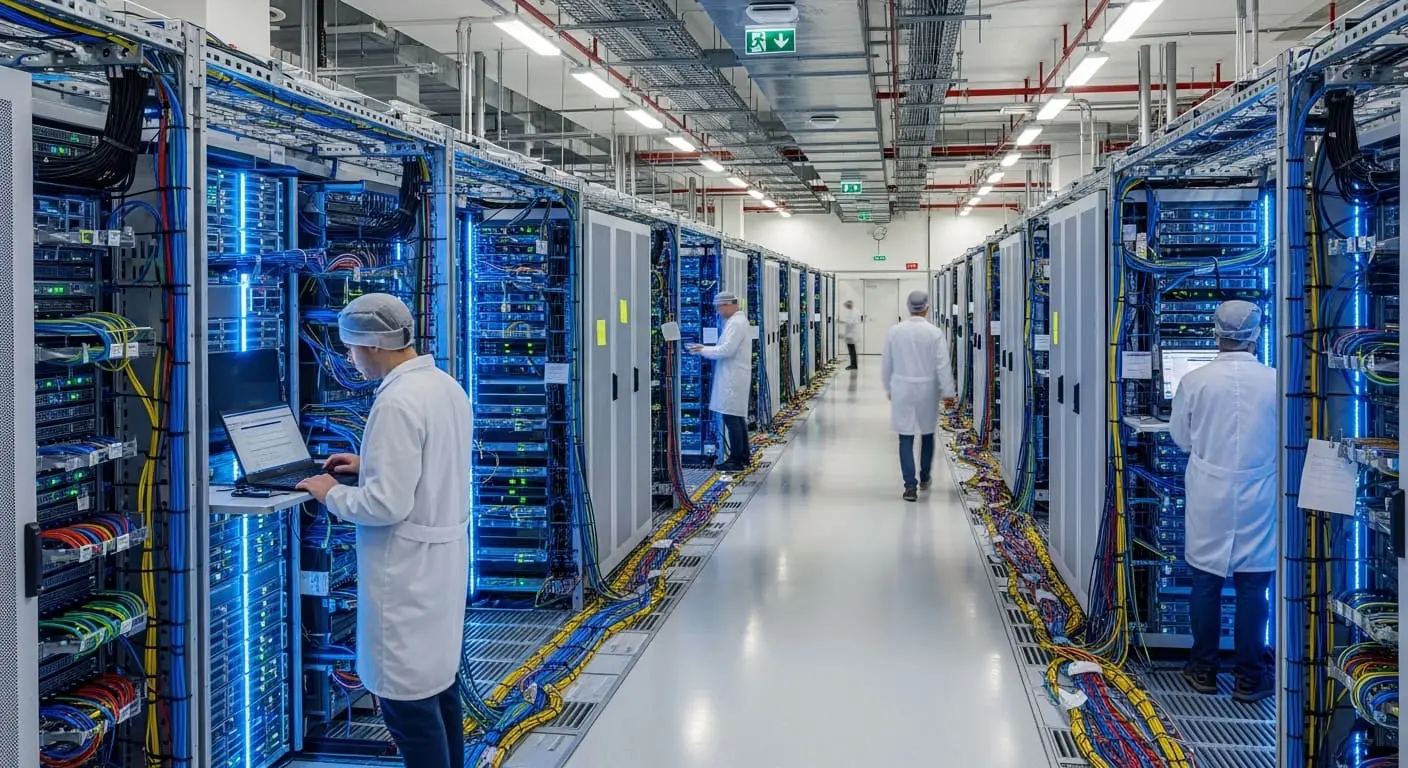
Qunnect and Cisco have achieved a landmark breakthrough, demonstrating the first metro-scale quantum network with high-speed entanglement swapping over deployed commercial fiber. The February 18, 2026, demonstration, conducted on Qunnect’s GothamQ testbed throughout New York City, spanned 17.6 kilometers of fiber and achieved record swapping rates exceeding 5,400 entangled pairs per hour, nearly 10,000 times better than previous benchmarks. This milestone utilizes Qunnect’s room-temperature quantum hardware and Cisco’s software, paving the way for scalable deployment and a new spoke-and-hub model for quantum networks. “Entanglement swapping is a fundamental operation in the quantum internet. Today, we not only broke the record for rate and scalability, we did so in New York City using some of the noisiest, most chaotic fiber on Earth,” said Mehdi Namazi, Co-Founder and Chief Science Officer for Qunnect.
Record 1.7M+ Pairs/Hour Entanglement Swapping Achieved in NYC
A staggering 1.7 million entangled photon pairs per hour were generated locally, marking a new benchmark in quantum networking achieved within New York City’s infrastructure, according to recent results from Qunnect and Cisco. This achievement surpasses previous benchmarks by nearly 10,000 times, utilizing similar platforms. Maintaining greater than 99% polarization fidelity, the system successfully navigated the challenges presented by a real-world urban environment. The experiment decoupled nodes from the need for shared lasers, enabling a scalable hub-and-spoke architecture. This advancement relies on Qunnect’s room-temperature endpoints and Automatic Polarization Controllers, which continuously compensate for signal degradation in deployed fiber.
Cisco’s unified quantum networking software stack functioned as a coordinating system, managing the hardware across geographically separated nodes. Reza Nejabati, Head of Quantum Research at Cisco, stated, “This milestone accelerates our quantum networking vision. Our orchestration software enabled field-ready entanglement distribution and swapping, foundational capabilities for distributed quantum computing and the global quantum grid.”
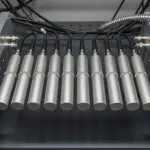
Room-Temperature Carina System & Automatic Polarization Controllers
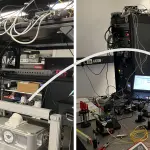
The burgeoning field of quantum networking is rapidly moving beyond laboratory curiosities toward practical applications, and a recent demonstration in New York City highlights significant progress. Unlike earlier systems requiring bulky and expensive cryogenic cooling, Qunnect’s Carina system operates at room temperature, a critical step toward wider deployment. Qunnect addressed this with Automatic Polarization Controllers (APCs) that continuously compensate for polarization drift in the fiber, achieving greater than 99% polarization fidelity. By utilizing independent atomic sources, the system eliminates the need for a shared master laser to connect nodes, allowing for a scalable “hub-and-spoke” model.
This milestone accelerates our quantum networking vision. Our orchestration software enabled field-ready entanglement distribution and swapping-foundational capabilities for distributed quantum computing and the global quantum grid.
Reza Nejabati, Head of Quantum Research at Cisco
Decoupled Nodes Enable Scalable Hub-and-Spoke Quantum Networking
The pursuit of a practical quantum internet took a significant step forward with a demonstration in New York City, where Qunnect and Cisco achieved record entanglement swapping rates over deployed fiber optic cable. The experiment, conducted on Qunnect’s GothamQ testbed spanning 17.6 kilometers between Brooklyn and Manhattan, recorded over 1.7 million entanglement pairs per hour locally and 5,400 pairs per hour over the fiber, a performance increase of nearly 10,000 times compared to similar platforms. This wasn’t simply a speed test; it validated a new architectural approach to scaling quantum networks.
By utilizing Qunnect’s independent atomic sources, the system eliminated the physical “tether” that traditionally constrained network expansion. This modularity allows for the addition of new endpoints without requiring dedicated synchronization links, paving the way for a scalable hub-and-spoke model.


See today’s quantum computing news on Quantum Zeitgeist for the latest breakthroughs in qubits, hardware, algorithms, and industry deals.