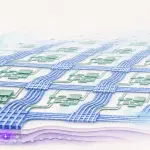
Purdue University engineers are tackling a central challenge in scaling quantum computing: building circuits that can reliably control individual photons as qubits. Researchers Vladimir Shalaev and Alexandra Boltasseva have developed potential solutions for fabricating quantum photonic integrated circuits, addressing hurdles that currently limit the number of qubits possible on a single chip.
Unlike many qubit types, photons offer the potential for stable operation at room temperature, reducing energy consumption; “Single photons are the building blocks of quantum photonics,” says Shalaev, the Bob and Anne Burnett Distinguished Professor in Electrical and Computer Engineering. This work promises faster data transfer and minimized delays by enabling qubits to move through circuits at the speed of light.
Silicon Nitride Enables Consistent Single-Photon Emission
Silicon nitride platforms emit single photons at room temperature. The team’s method generates exactly one photon from dozens of locations on the silicon nitride platform each time a laser beam passes through it, a significant improvement over earlier techniques. These photons originate from intentionally created atomic defects within the silicon nitride, limiting light emission to single photons. Shalaev and Boltasseva further refined this process, presenting research at the 2022 Conference on Lasers and Electro-Optics detailing control over defect placement and quantity.
Embedding these defects within nanosized pillars on the platform allows for more uniform manufacturing, a critical step toward creating functional quantum photonic integrated circuits. “Let’s say you need a hundred qubits to run a quantum algorithm, but typically far more than that, say 10,000 qubits, to deal with errors caused by decoherence. If I minimize those errors somehow, then the number of qubits needed to run my algorithm would also be minimized,” explained Shalaev.
Controlling photon interaction has also been a challenge, as single photons do not readily interact, hindering their use in on-chip switches. Last year, Shalaev and Boltasseva’s team published a paper in Nature Nanotechnology detailing a switch capable of operating at the single-photon level.
This switch adapts a mechanism used in fiber-optic communications, optical nonlinearity, but modifies it for use with single photons. The Purdue-developed switch uses a control photon striking silicon, triggering an avalanche of electrons. This avalanche alters the material’s refractive index, effectively changing how light propagates.
By modulating the refractive index, the switch allows a probe beam to pass through only when a single photon initiates the electron avalanche, enabling the photon to switch the beam on and off. Researchers also discovered how to create this single-photon switch, a necessary component for processing information in a quantum photonic integrated circuit.
You can’t get rid of decoherence – it’s the law of nature that everything fluctuates. But if you recognize the pattern of decoherence and learn how to control it, then you can minimize it.
Vladimir Shalaev, the Bob and Anne Burnett Distinguished Professor in Electrical and Computer Engineering
Defect Engineering Controls Photon Source Uniformity
Creating predictable sources of single photons relies on carefully engineered imperfections within silicon nitride platforms, a technique Purdue University researchers have refined to improve the uniformity of quantum photonic integrated circuits. Shalaev and Boltasseva’s team demonstrated control over the placement and density of atomic-level “defects” by embedding them within nanosized pillars, a method that promises more consistent manufacturing of these components. This precise control addresses a key challenge in scaling quantum computers built on photons, where reliable single-photon emission is paramount for qubit creation.
Single photons are the building blocks of quantum photonics. The biggest challenges in scaling up a quantum photonic integrated circuit have to do with creating good single-photon sources.
Vladimir Shalaev, the Bob and Anne Burnett Distinguished Professor in Electrical and Computer Engineering
Optical Nonlinearity Creates a Single-Photon Switch
The newly demonstrated switch relies on a principle called optical nonlinearity to manipulate light at the scale of individual photons. The Purdue University team harnessed a cascade of electrons triggered by a single photon to alter light’s path. This process begins when a photon from a “control” beam strikes silicon, initiating an avalanche of electrons within the material. The team adapted an existing industry technique, using light to modulate light, but refined it to operate at the single-photon level. Previously, this modulation required power levels incompatible with delicate quantum states.
The current setup uses a commercial single-photon avalanche diode to detect the initial photon and confirm the switching action, allowing a single photon to control a more powerful beam. Beyond the switch itself, the researchers are also addressing the problem of decoherence, the loss of quantum information, which plagues all qubit technologies. Their work on predicting and mitigating decoherence received support from the U.S. Department of Energy’s Quantum Science Center and the Purdue-led Quantum Photonic Integrated Design Center.
Funding for the single-photon switch development came from the U.S. Army Research Laboratory’s Army Contracting Command, Aberdeen Proving Ground, Research Triangle Park division. This research is part of Purdue Computes, a university-wide initiative focused on advancing computing, artificial intelligence, quantum science and semiconductor innovation. The team’s advancements demonstrate Purdue’s growing role in quantum science and engineering.
Machine Learning Predicts Quantum Decoherence Patterns
Statistical analysis revealed that the progression of decoherence isn’t random, but patterned, allowing researchers to apply machine learning to validate predictability. The team’s framework learns and anticipates quantum system dynamics, enabling proactive control of decoherence instead of simply reacting to it after it occurs. The researchers specifically demonstrated a method to predict and reduce spectral diffusion, a major source of decoherence occurring when emitted photons shift in frequency due to environmental disorder.
Maintaining indistinguishability among photons is critical for superposition, and even a single photon’s energy level change can disrupt this delicate state. “You can’t get rid of decoherence — it’s the law of nature that everything fluctuates,” explained Vladimir Shalaev. The framework’s potential extends beyond individual systems, offering a pathway to anticipate decoherence across multiple quantum systems, a necessity for scalable quantum architectures.
Future work will focus on extracting hidden properties of a quantum system’s fluctuating environment using tools from statistical physics. These physical insights will be integrated into machine-learning models to further enhance their predictive abilities. The team also intends to investigate whether the models can pinpoint the microscopic processes responsible for spectral shifts, ultimately aiming to predict and suppress decoherence before it significantly degrades the quantum state.
Decoherence is seemingly random, but in fact there is a certain pattern that can be recognized. This study takes an important step in identifying such a pattern using machine learning.
Alexandra Boltasseva, the Ron and Dotty Garvin Tonjes Distinguished Professor in Electrical and Computer Engineering


See today’s quantum computing news on Quantum Zeitgeist for the latest breakthroughs in qubits, hardware, algorithms, and industry deals.