These directional codes operate on standard square-grid superconducting hardware without requiring the complex, noise-prone long-range connections found in codes like the Gross code, which “needs two extra non-local connections at every qubit.” According to Riverlane’s simulations, the best performing code matches the rotated toric code’s performance at a physical error rate of 0.1%, addressing a major hurdle in scaling quantum computers. The team’s research was recently published in Nature Communications.
Directional Codes Reduce Qubit Count for Error Correction
This performance is achieved while reducing the number of physical qubits needed for error correction by approximately 25 to 33 percent, addressing a critical challenge in scaling quantum processors. The company benchmarked two code families, N²E³N² (rectangular) and N²E⁴N² (rotated), under the SI-1000 noise model using the Stim and Tesseract tools. Riverlane’s work includes a theorem proving which arrangements of error checks create a valid circuit, and then applies this construction to a torus shape to produce a functional code, the company says.
The N²E³N² code family, using 12 logical qubits, requires roughly 50% of the physical qubits needed by the rotated toric code, while the N²E⁴N² family, with 18 logical qubits, needs approximately 33%. While bivariate bicycle codes currently outperform directional codes in Riverlane’s simulations, the comparison is not entirely straightforward.
The SI-1000 model does not account for the noise introduced by the long-range connections required by bicycle codes, potentially skewing the results in their favor. The team’s research focuses on demonstrating that good qLDPC codes and simple hardware connectivity are not mutually exclusive, a previously held assumption within the field, according to Riverlane. The ability to run these codes on existing square-grid hardware represents a practical advantage, potentially accelerating the development and deployment of more robust quantum computers.
iSWAP Gates Enable Local Connectivity for qLDPC Codes
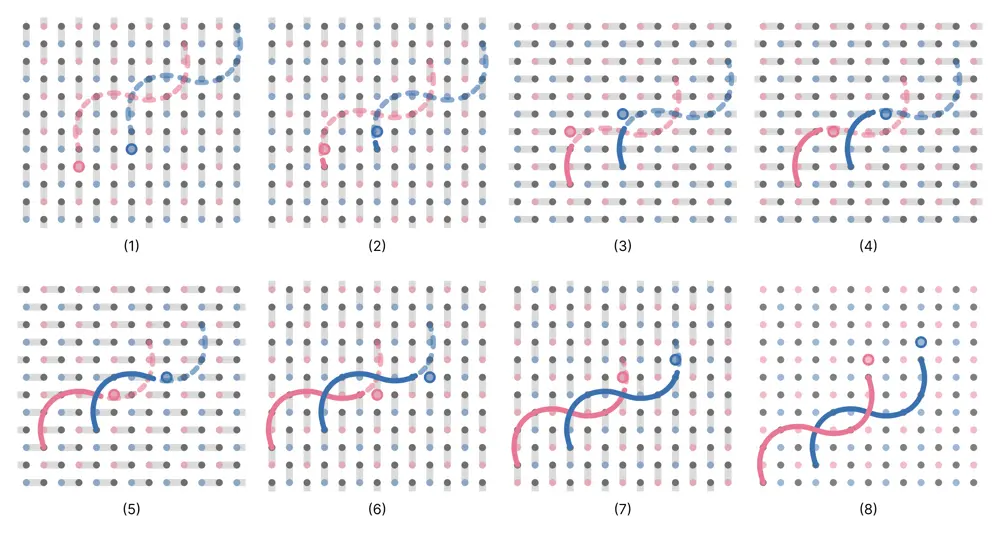
Directional codes rely on iSWAP gates to achieve local connectivity, an important step towards reducing the complexity of quantum error correction circuits. These gates facilitate the necessary qubit interactions without requiring the extensive, long-range connections that plague other quantum low-density parity-check (qLDPC) codes, and therefore avoid the increased noise they introduce. While the current research focuses on demonstrating these codes as quantum memories, future work will address the challenges of implementing full fault-tolerant architectures.
Specifically, the team is investigating lattice surgery techniques that respect the square-grid connectivity, and pathways to generate non-Clifford gates, essential for universal quantum computation. Real-time decoding remains a key area of focus, with the team exploring alternatives to Tesseract, such as belief-propagation decoders, to meet the demands of practical applications, the company says. “The iSWAP trick is one tool, and the search space it opens is large,” a Riverlane researcher stated, highlighting the potential for further innovation in this area.
N²E³N² Codes Outperform Toric Code in Simulations
At a physical error rate of 1%, the N²E³N² code requires approximately 29% of the physical qubits needed by its competitor. The company’s research, detailed in a recent publication, involved extensive simulations totaling 45 CPU-core-years, distributed across 200 CPUs over three months, using the Stim sampling tool and Tesseract decoder, Riverlane reports.
Comparing twelve-logical-qubit codes, Riverlane found that the N²E³N² code, at equal code distance, uses half the physical qubits of the rotated toric code. Its logical error rate decreases more rapidly as the physical error rate declines from 1% to 0.1%. Several code families were benchmarked, including rectangular and rotated variations of N²E²N² and N²E³N², each demonstrating reductions in physical qubit requirements compared to the rotated toric code, ranging from approximately 30% to 56%.
Planar Code Adaptations Expand Directional Code Applications
This reduction in qubit count addresses a critical challenge in scaling quantum computers, as fewer physical qubits are needed to create a stable logical qubit. The company’s approach focuses on designing codes directly from hardware constraints, a departure from traditional methods that prioritize code invention before considering hardware limitations.
Riverlane’s work represents the first systematic method for discovering new qLDPC codes by beginning with hardware constraints, a strategy the team believes will unlock further advancements, by the company’s account. The team’s findings are detailed in a recent publication in Nature Communications, with simulation circuits and data available on Zenodo.

See today’s quantum computing news on Quantum Zeitgeist for the latest breakthroughs in qubits, hardware, algorithms, and industry deals.