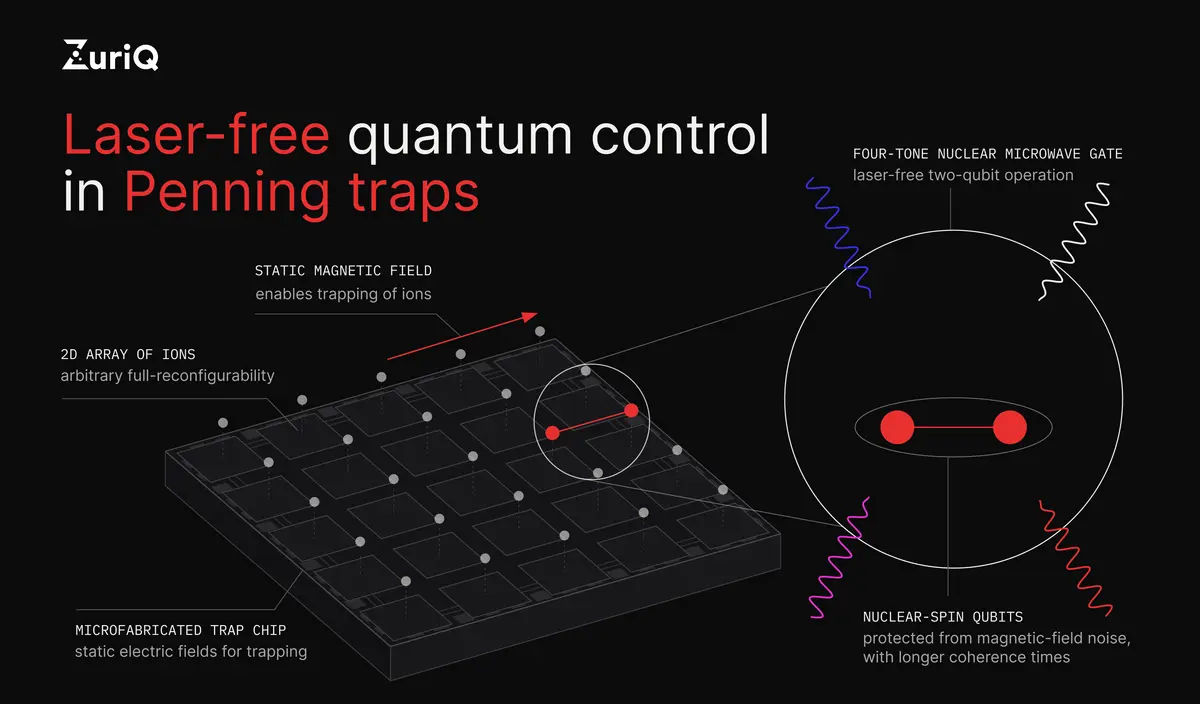
ETH Zürich and ZuriQ have demonstrated a new method for controlling quantum bits, or qubits, using microwaves instead of lasers within Penning traps, the company says. The approach uses nuclear-spin qubits, naturally shielded from disruptive magnetic field fluctuations, to achieve operation speeds comparable to electron-spin qubits. This result represents a milestone for ZuriQ’s quantum computing architecture, showing compatibility with laser-free gate approaches for high-fidelity operations. “This work builds on the broader Penning-trap research carried out at ETH Zürich,” and supports efforts to develop scalable quantum computers based on reconfigurable two-dimensional ion arrays.
Microwave control now enables two-qubit operations within Penning traps, achieving speeds competitive with electron-spin qubits. This approach bypasses the typical reliance on laser systems for manipulating quantum states, instead using the inherent protection offered by nuclear-spin qubits against magnetic field fluctuations. The team demonstrated gate speeds comparable to those of electron-spin qubits, a significant achievement given the added benefit of noise protection, according to ZuriQ.
Encoding quantum information in nuclear spin, naturally shielded from disruptive magnetic fields, is central to this new method. The researchers detail a microwave-based technique for performing these operations, presenting a gate that minimizes external dependencies and maintains qubit coherence. This advance directly supports ZuriQ’s development of scalable quantum computers built on reconfigurable two-dimensional ion arrays within Penning traps.
The ability to precisely control qubits using microwaves, rather than lasers, is important for realizing the potential scaling advantages of this physical system. Prof. Jonathan Home of ETH Zürich, a scientific advisor to ZuriQ, led the research that builds on extensive Penning-trap studies already underway. Advances like these will be essential for transforming the theoretical benefits of Penning traps into functional quantum processors.




See today’s quantum computing news on Quantum Zeitgeist for the latest breakthroughs in qubits, hardware, algorithms, and industry deals.