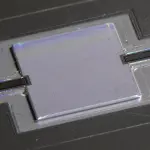
Quantum Motion has achieved a 10,000-times reduction in qubit sensor footprint by demonstrating an IC-native superinductor built directly into a standard silicon chip, the company says. The team integrated titanium nitride (TiN), a material already present in Global Foundries’ 22nm FDSOI process, to create a superconducting inductor that eliminates the need for bulky, visible spiral inductors. This innovation also delivers a minimum integration time of 1 ± 0.3 ps, a substantial improvement over the previous 625 ps standard.
IC-Native Superinductor Achieves 10,000x Qubit Sensor Footprint Reduction
This approach bypasses the need for discrete, large inductive components traditionally required for qubit readout. This speed increase is not solely due to integration. The team also exploited a new operational regime where the non-linear inductance of the TiN film amplifies the readout signal at higher power levels. The reduction in parasitic elements, a common challenge in miniaturized circuits, further contributes to the enhanced performance.
Staff Quantum Engineer at Quantum Motion, Tom Swift, emphasized the broader implications of this work for scaling quantum computers, according to the company. “In reality, we need to think about the scalability of the entire system and in particular how we might scale to a million-qubit system,” Swift said.
“With that goal in mind, we need to consider how we can make all of the different aspects of a quantum computer, the readout, the control, smaller and if possible, as close in size to the qubits themselves.” This focus on scaling the entire system is critical for realizing practical, large-scale quantum computation. The new rfSET’s compact footprint and low power consumption address key limitations in current silicon spin qubit readout technology.
VP of Quantum Engineering at Quantum Motion and Professor of Quantum Computing Hardware at CIC nanoGUNE, Fernando González-Zalba, believes this demonstration resolves a significant hurdle in the field, the firm reports. “Using the superinductors native to the CMOS process, we have shown a way to meet all the requirements for spin qubit readout,” González-Zalba stated.
“We’ve created a method with a compact on-chip footprint that is low-power and extremely sensitive. I believe with this demonstration we have shown how to solve the readout problem for semiconductor spin qubits.” The research team, comprised of Tom Swift, Alberto Gomez-Saiz, Fabio Olivieri, Gorka Aizpurua-Iraola, Manuel Suárez-Rodríguez, James Kirkman, Grayson Noah, Mathieu de Kruijf, Felix-Ekkehard von Horstig, John Morton and M. Fernando Gonzalez-Zalba, is now focused on integrating the rfSET with arrays of silicon spin qubits. The goal is to demonstrate high-speed, high-fidelity spin readout operating well below the microsecond timescale.
This work, published in Nature Electronics, reinforces Quantum Motion’s position that spin qubits offer a viable pathway toward building a large-scale, fault-tolerant quantum computer through the combination of high-performance integrated readout and established industrial CMOS manufacturing processes.
In quantum computing we talk a lot about scalability, but we focus mainly on the qubits themselves. In reality, we need to think about the scalability of the entire system and in particular how we might scale to a million-qubit system.
Tom Swift, Staff Quantum Engineer at Quantum Motion



See today’s quantum computing news on Quantum Zeitgeist for the latest breakthroughs in qubits, hardware, algorithms, and industry deals.