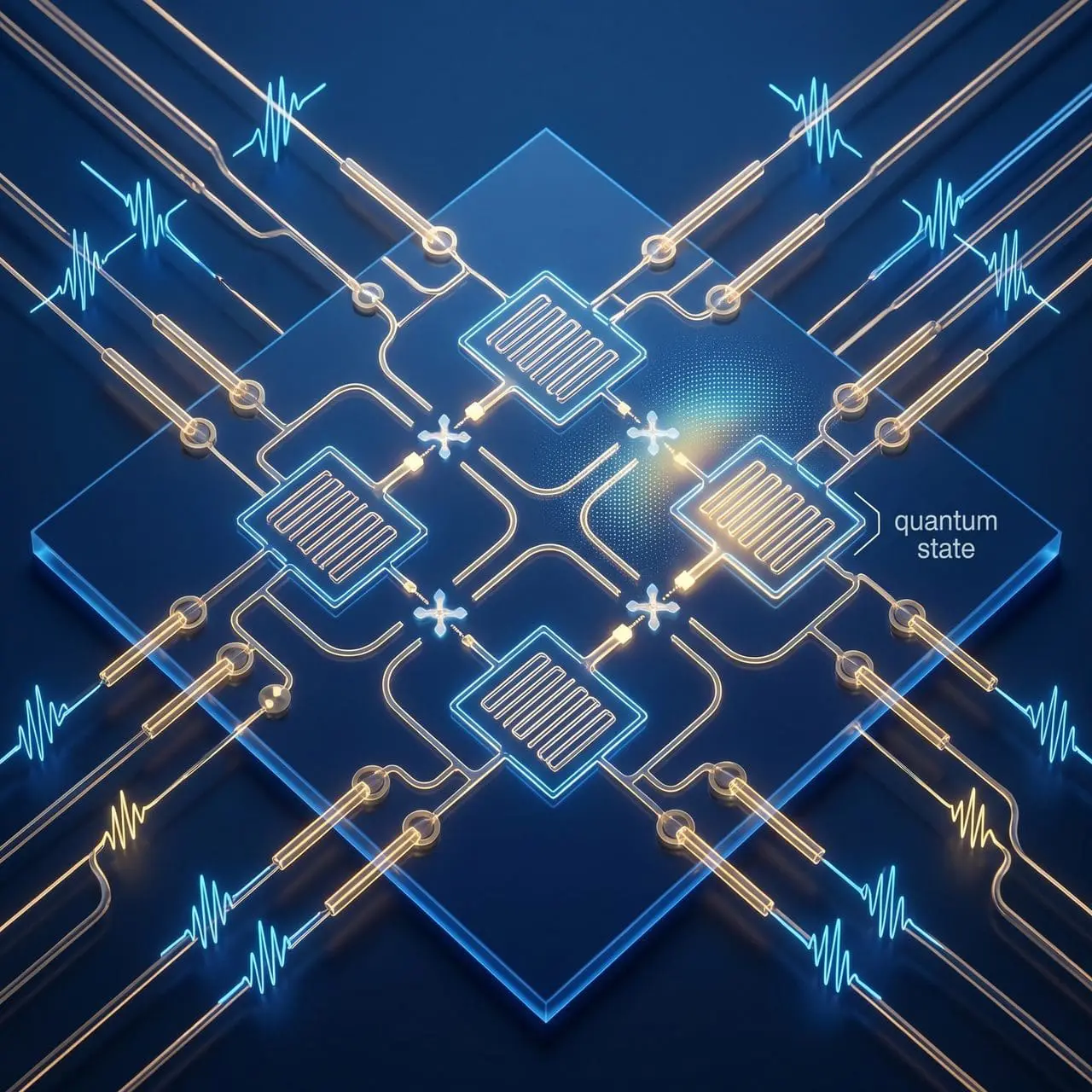
Quantum X Labs reports its AI-driven quantum error correction decoder, QECCT, outperformed a classical approach in specific simulated conditions, representing a potential step toward faster and more efficient quantum computing. The company completed a “Deep Quantum Error Correction” workflow utilizing an NVIDIA GPU within an Amazon Web Services environment, demonstrating progress beyond theoretical work and toward cloud-based scalability. Testing involved synthetic surface-code configurations modeled on Google’s established quantum architecture, allowing for direct comparability with existing research. “These results are meaningful because they move our program from cloud deployment into measured decoder performance and a surface-code data pipeline,” said Prof. Nir Sharon, Chief Quantum Technology Scientist at Quantum X Labs. This validation of QECCT, based on a proprietary transformer architecture, signals Quantum X Labs’ acceleration of its roadmap with NVIDIA technology and a staged approach toward practical, real-time quantum error correction.
DQEC Transformer Decoder Outperforms MWPM in Simulated Toric Codes
The company benchmarked QECCT against MWPM using synthetic toric-code configurations, a common approach for evaluating error correction schemes, and observed superior performance in select noise regimes. This direct comparison highlights a functional benefit of the AI-driven approach. The validation process extended beyond basic functionality, with Quantum X Labs assessing QECCT’s stability across varying code distances and physical error rates; the decoder maintained consistent logical and bit error rates under these conditions, indicating robustness in diverse scenarios. The company’s approach centers on a proprietary transformer architecture, designed to leverage the structure of quantum error correction codes and syndrome information to predict and apply logical corrections, supporting multiple stabilizer-code workflows. Future development will focus on applying these evaluations to real-world experimental datasets and refining data pipelines to align with NVIDIA’s CUDA-Q QEC frameworks; the company also plans to collaborate with IQCC, a Quantum Machines company, to generate syndrome data from superconducting quantum hardware.
Quantum X Labs is also investigating the potential of AI-based pre-decoder workflows, utilizing NVIDIA Ising and low-latency optimization techniques to further enhance performance. The program aims to evaluate the decoder not only as a standalone component but also as a pre-decoder or hybrid element within broader accelerated quantum error correction systems, signifying a versatile approach to tackling the challenges of maintaining quantum coherence.
These results are meaningful because they move our program from cloud deployment into measured decoder performance and a surface-code data pipeline.
Prof. Nir Sharon, Chief Quantum Technology Scientist at Quantum X Labs




See today’s quantum computing news on Quantum Zeitgeist for the latest breakthroughs in qubits, hardware, algorithms, and industry deals.