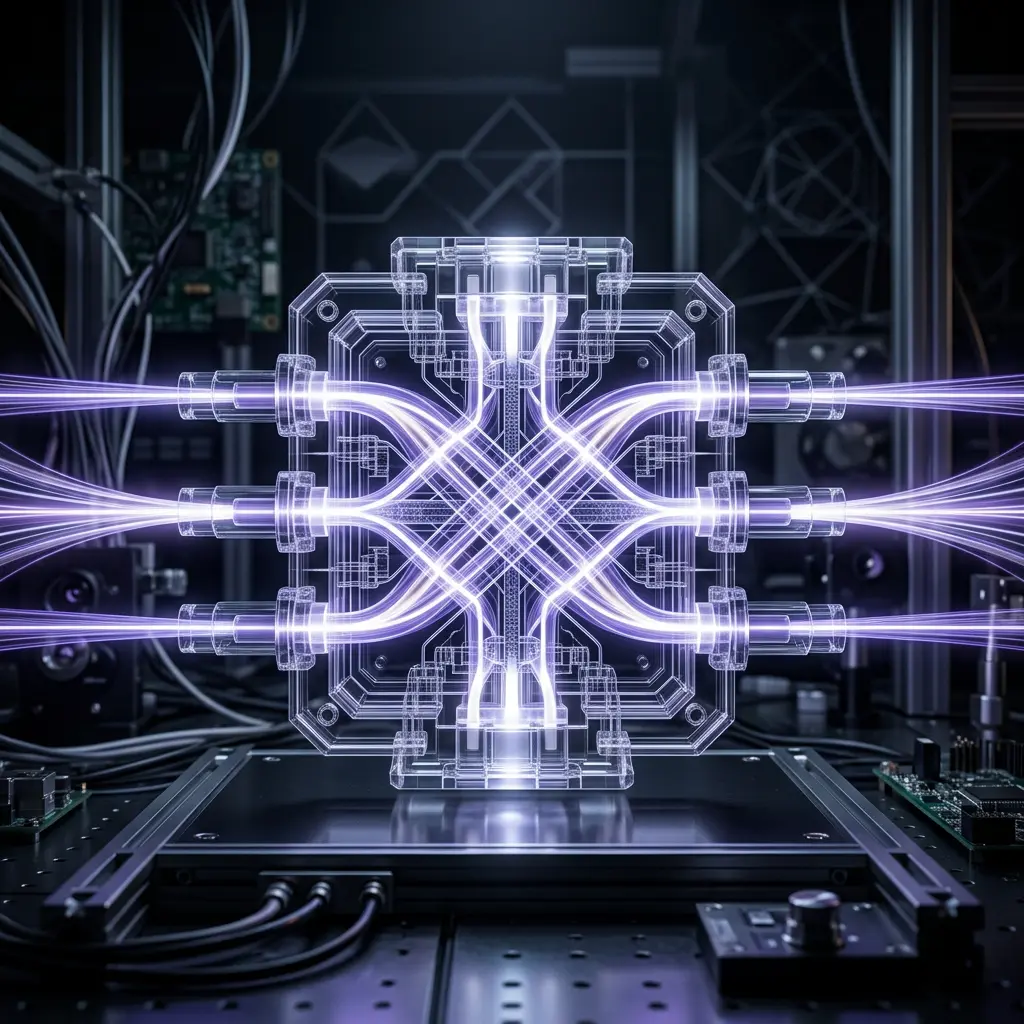
A new quantum computing architecture founded on a transistor-based approach has been presented by Y.-D. Liu of the Chinese Academy of Sciences and colleagues. The architecture utilises ‘telesistors’, quantum transistors grounded in symmetry-protected topological order, offering a universal computing scheme that inherently mitigates noise and enables high-fidelity Clifford gates without immediate active error correction. This intrinsic protection, measured through string order parameters, provides a key and potentially low-overhead basis for building conventional fault-tolerant encoding and achieving universal quantum computation. The proposed architecture offers advantages in modularity, integration, and program storage when contrasted with existing qubit-based circuits, suggesting a pathway towards practical realisation with near-future technology.
Symmetry-protected topological order delivers fault-tolerance in novel telesistor quantum
Error rates for Clifford gates, key for fault-tolerant quantum computation, have been reduced to levels achievable without active error correction utilising this new architecture. It surpasses previous methods reliant on adiabatic control or quantum state transfer, which demanded complex error mitigation strategies. The architecture centres on ‘telesistors’, quantum transistors constructed from ground states exhibiting symmetry-protected topological order, and this inherent stability arises from a unique arrangement of quantum particles resisting errors. Symmetry-protected topological order is a phase of matter characterised by robust edge states that are immune to local perturbations, providing a natural defence against decoherence, the loss of quantum information. These topological phases are defined not by a local order parameter, but by global properties of the wavefunction, making them exceptionally stable. The ‘telesistors’ leverage this stability by encoding quantum information in these topologically protected states, significantly reducing the need for complex and resource-intensive error correction schemes typically required in quantum computation.
A design integrating more quantum elements than qubit-based circuits offers improved modularity, integration, and program storage, potentially enabling practical realisation with near-future technology. Traditional qubit-based quantum circuits require separate components for qubits and quantum gates. The ‘telesistor’ architecture, however, integrates these functionalities within a single physical structure, streamlining the design and reducing the complexity of interconnects. This integration is achieved through the manipulation of topological defects within the symmetry-protected topological phase, effectively acting as quantum switches and logic gates. The discrete universal gate set employed includes the Hadamard, phase, T, and CZ gates, forming a foundation for conventional fault-tolerant encoding and universal quantum computation. The choice of this specific gate set allows for the construction of any arbitrary quantum algorithm. Implementation of the CZ gate benefits from quasi-2D cluster phases, such as square or honeycomb lattices. The system supports alternative universal gate sets like {H, CCZ}. Current limitations include the fidelity of the T gate, affected by coupling to the quantum dot edge, suggesting further optimisation of these interactions is required for fully strong operation. These transistors, constructed from error-resistant ground states, deliver improved modularity and program storage capabilities. The ability to store quantum programs directly within the physical architecture, rather than relying on external control signals, represents a significant advancement in quantum computer design. While near-future realisation is promising, the system’s performance is currently constrained by interactions at the quantum dot edge, highlighting a need for material refinement to achieve optimal functionality.
Symmetry-protected topological order offers a pathway to stable quantum computation
Establishing a new quantum computing architecture is a complex undertaking, with numerous approaches vying for dominance. Superconducting qubits, trapped ions, and photonic systems all represent viable, yet challenging, pathways to building a scalable quantum computer. ‘Telesistors’, quantum transistors using symmetry-protected topological order, are proposed as a means of building more stable and scalable processors, sidestepping the immediate need for demanding error correction. The conventional approach to achieving fault-tolerance involves encoding quantum information across multiple physical qubits using complex error-correcting codes. This requires a significant overhead in terms of qubit count and control complexity. The ‘telesistor’ architecture, by leveraging intrinsic protection, aims to reduce this overhead, potentially paving the way for more practical quantum computers. Professor Andrew Houck of Princeton University and collaborators acknowledge that achieving fully strong operation necessitates optimising interactions and addressing potential symmetry breaking in real-world materials, a key limitation. Imperfections in the materials used to fabricate the ‘telesistors’ can disrupt the symmetry-protected topological order, leading to increased error rates. Addressing these imperfections requires careful material selection and fabrication techniques. Despite the need for further material optimisation to realise fully strong ‘telesistors’, the significance of this work remains substantial.
Improved modularity and program storage are promised, potentially accelerating progress towards practical, scalable quantum processors. The ability to create a modular architecture, where individual ‘telesistor’ units can be interconnected to form larger quantum circuits, is crucial for scaling up the system. This modularity simplifies the design and fabrication process, and allows for the creation of more complex quantum algorithms. This work establishes a new quantum computing architecture utilising ‘telesistors’, effectively quantum transistors built from materials exhibiting symmetry-protected topological order. Unlike conventional qubit-based circuits, this design integrates both qubits and the necessary quantum gates within a single physical medium, improving modularity and the potential for on-chip program storage. This on-chip storage reduces the latency associated with transferring quantum information between different components, improving the overall performance of the quantum computer. High-fidelity Clifford gates, essential building blocks for complex quantum calculations, are achievable without immediately implementing active error correction, simplifying circuit design and reducing resource demands. Clifford gates are particularly important because they form the basis of many quantum error correction codes, and their high fidelity is crucial for achieving fault-tolerant quantum computation. The string order parameters, used to quantify the intrinsic protection offered by the ‘telesistors’, provide a valuable metric for assessing the robustness of the architecture and guiding further optimisation efforts. The research represents a significant step towards realising a more robust and scalable quantum computing platform.
This research demonstrated a new quantum computing architecture utilising ‘telesistors’, quantum transistors built from materials with symmetry-protected topological order. This design offers intrinsic protection against noise and enables high-fidelity Clifford gates without immediate need for active error correction, potentially simplifying quantum circuit design. The architecture also promises improved modularity and on-chip program storage compared to qubit-based circuits, which could accelerate the development of scalable quantum processors. Researchers suggest further material optimisation will be necessary to fully realise strong ‘telesistors’ and enhance the system’s performance.
👉 More information
🗞 Towards transistor-based quantum computing
🧠 ArXiv: https://arxiv.org/abs/2605.21045


See today’s quantum computing news on Quantum Zeitgeist for the latest breakthroughs in qubits, hardware, algorithms, and industry deals.