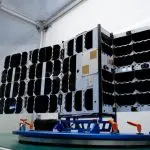
SEALSQ and its subsidiary WISeSat are planning a 100-satellite constellation, the Quantum Spatial Orbital Cloud (QSOC), indicating a substantial investment in globally accessible, quantum-secured communications. The companies unveiled the roadmap for QSOC at the Space Symposium this week, outlining a platform designed to deliver secure communications, quantum randomness, and post-quantum security services from space as a subscription-based cloud service. WISeSat’s 6U post-quantum satellite platform is scheduled for launch in November 2026. This dual-layer architecture, with WISeSat managing orbital infrastructure and SEALSQ operating the quantum cloud layer, aims to provide scalable quantum security services with a targeted 99.9% uptime.
SEALSQ and WISeSat Showcase Quantum Spatial Orbital Cloud Roadmap
The convergence of quantum security and space-based infrastructure was a central focus at the Space Symposium, as SEALSQ Corp and WISeSat unveiled plans for what they term the Quantum Spatial Orbital Cloud (QSOC). This project, centered around a planned 100-satellite constellation, signals an escalation in efforts to safeguard communications against the threat of quantum computing and represents a considerable investment in proactive cybersecurity measures. Unlike limited demonstrations, the scale of QSOC indicates SEALSQ and WISeSat intend to establish broad, global coverage with their quantum-secured services. WISeSat’s role within this partnership is particularly noteworthy, functioning as the orbital infrastructure owner and operator responsible for satellite design, deployment, and mission operations. SEALSQ, a subsidiary of WISeKey International Holding Ltd (SIX: WIHN, NASDAQ: WKEY), will focus on operating the quantum cloud layer, delivering secure services directly to end-users.
The first phase of the WISeSat constellation, comprising 15 satellites, is fully funded and expected to be operational by 2027, demonstrating a commitment to rapid deployment. The QSOC platform aims to deliver a suite of advanced services, including quantum key distribution (QKD), quantum random number generation (QRNG), and post-quantum digital identity, offered as a subscription-based cloud service to a diverse clientele.
These services will be available to governments, enterprises, financial institutions, and defense organizations, addressing a critical need for enhanced security in an increasingly interconnected world. Carlos Moreira, Founder and CEO of SEALSQ, said, “This marks a pivotal moment in our mission to democratize access to secure space infrastructure.” He continued, “With the launch of QSOC and the integration of post-quantum cybersecurity into our satellite ecosystem, we are building a future-proof foundation for a trusted digital world powered from orbit.” The companies are also actively seeking strategic partnerships with aerospace stakeholders and research institutions to accelerate the expansion of the WISeSat constellation, with another satellite launch scheduled aboard a SpaceX rocket in June 2026. WISeKey, the parent company, encompasses a broader portfolio of cybersecurity, blockchain, and IoT solutions, creating a vertically integrated structure that could offer unique advantages in the development and deployment of this complex technology.
WISeSat’s 6U Satellite Platform Enables Secure IoT Connectivity
The increasing proliferation of IoT devices and the threat of quantum computing have created a need for robust, future-proofed satellite communication systems. Currently, many IoT networks rely on terrestrial infrastructure vulnerable to both conventional cyberattacks and, critically, decryption by future quantum computers; existing satellite solutions often lack the advanced security features necessary to address these evolving risks. The company’s approach centers on the Quantum Spatial Orbital Cloud (QSOC), envisioned as the world’s first commercial quantum-enabled orbital cloud platform. This scale signals a commitment to broad coverage, rather than limited demonstration projects. The next satellite is scheduled to launch aboard a SpaceX rocket in June 2026, and their first 6U post-quantum satellite platform is scheduled for November 2026.
This marks a pivotal moment in our mission to democratize access to secure space infrastructure.
Carlos Moreira, Founder and CEO of SEALSQ
QSOC Platform Architecture: Dual-Layer Quantum Service Delivery
The planned infrastructure relies on a 100-satellite constellation, indicating a significant investment beyond limited demonstrations and positioning SEALSQ and WISeSat for broad, global coverage. The QSOC architecture is distinctly dual-layered, designed for both scalability and reliability. This division of labor is intended to ensure service level agreement-backed quantum security with a targeted 99.9% uptime, a crucial metric for organizations requiring consistently available protection. This approach addresses a growing vulnerability in current cryptographic systems. As quantum computing capabilities advance, traditional encryption methods face increasing risk of being compromised, threatening data security, digital identities, and critical infrastructure. By combining post-quantum cryptography with resilient space-based infrastructure, SEALSQ and WISeSat aim to deliver security independent of vulnerable terrestrial systems, particularly in regions with limited or compromised infrastructure.
With the launch of QSOC and the integration of post-quantum cybersecurity into our satellite ecosystem, we are building a future-proof foundation for a trusted digital world powered from orbit.
Carlos Moreira, Founder and CEO of SEALSQ
Post-Quantum Cryptography Addresses Evolving Digital Security Threats
The escalating threat to digital security stems not solely from increasingly sophisticated hackers, but from the potential of quantum computers to render current encryption methods obsolete, demanding a proactive shift towards post-quantum cryptography. While largely theoretical, the development of sufficiently powerful quantum computers poses a clear and present danger to systems relying on algorithms like RSA and Elliptic Curve Cryptography, prompting a focused effort to secure communications for the future. This project, slated for initial deployment with 15 satellites operational by 2027, isn’t simply a research exercise; it’s a fully funded initiative demonstrating a serious commitment to practical implementation. The urgency stems from the fundamental limitations of existing cryptographic systems.
This is about enabling governments, enterprises, and critical industries to operate with confidence in an era defined by accelerating digital transformation and emerging quantum threats.
Carlos Moreira, Founder and CEO of SEALSQ




See today’s quantum computing news on Quantum Zeitgeist for the latest breakthroughs in qubits, hardware, algorithms, and industry deals.