

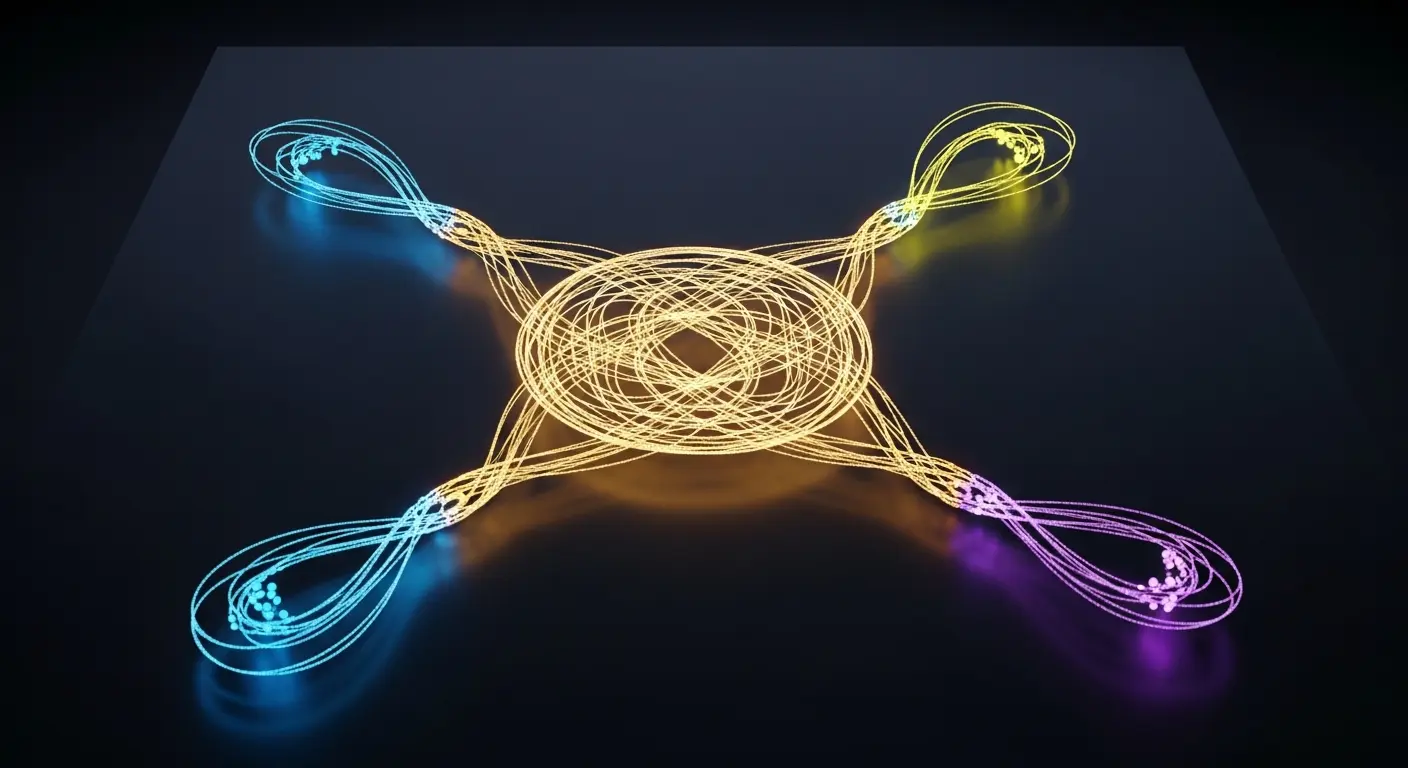
Manuel John and colleagues at the Institute for Quantum Optics and Quantum Information, in collaboration with University of Innsbruck and Academy of Sciences, have performed the first quantum simulation of non-abelian string-breaking dynamics using a trapped-ion quantum computer. The simulation addresses a key challenge for classical computation by showing how gauge-field self-interactions can drive string breaking, even without dynamical matter. It also locally resolves string oscillations and coherent breaking via gluonic excitations. The team’s hardware-efficient, problem-tailored qudit simulations offer a promising pathway towards understanding non-perturbative dynamics vital to high-energy physics.
Quantum simulation reveals dynamics of non-abelian string breaking at unprecedented timescales
A six-fold increase in the simulation timescale of non-abelian string-breaking dynamics has been achieved, extending simulations to approximately 260 femtoseconds. This breakthrough surpasses the capabilities of classical computation for modelling these complex interactions, which are important to understanding the strong force governing quarks and gluons. Dr. Christina Moschi and Dr. Roger Melko conducted the experiment, representing the first successful quantum simulation of genuine SU(2) lattice gauge theory, a sharp step beyond prior work restricted to simpler, Abelian systems. The significance of this lies in the fact that the strong force, one of the four fundamental forces of nature, is described by quantum chromodynamics (QCD), a non-abelian gauge theory. Classical simulations of QCD are hampered by the exponential growth of computational resources required as the strength of the interaction increases, a phenomenon known as the ‘sign problem’. Quantum simulation offers a potential solution by leveraging the principles of quantum mechanics to represent and evolve the system more efficiently.
Encoding gauge fields using qudits, quantum units with more than two states, and a tailored truncation scheme provided new insights into the behaviour of fundamental particles, specifically locally resolved string oscillations and coherent string breaking driven by gluonic excitations. This advancement builds upon prior Abelian simulations by tackling the complexities of non-abelian theories where gauge fields themselves possess charge and interact. The experiment utilised a ladder geometry with truncated gauge fields encoded using qudits, enabling a more efficient representation of the system. The ladder geometry, a one-dimensional arrangement of qubits, simplifies the simulation while still capturing the essential physics of string breaking. The qudits, utilising multiple quantum states, allow for a more nuanced representation of the gauge fields compared to traditional qubits. Although the current system still requires substantial scaling to model realistic physical scenarios and bridge the gap towards practical applications in high-energy physics, the achieved timescale allows observation of the string-breaking process and provides a foundation for future investigations. Understanding the precise mechanisms of string breaking is crucial for calculating quantities like the mass spectrum of hadrons, composite particles made of quarks and gluons.
Simulating strong force dynamics via truncated qudit Hilbert spaces
Trapped ions were employed to encode the complex dynamics of the strong force using qudit Hilbert spaces, representing information in a quantum computer and allowing for greater computational power than standard bits. These ions’ natural properties, held in electromagnetic traps, represented the fundamental building blocks of the theory, effectively creating a controllable quantum system. Each ion acts as a qubit, and by manipulating their internal energy levels, researchers can encode and process quantum information. The use of qudits, specifically ions with eight energy levels, provides a significant advantage in representing the complex degrees of freedom of the gauge fields. A tailored truncation scheme, a method of simplifying calculations without losing essential physics, aligned the quantum computer’s structure with the theoretical model, allowing for a more efficient simulation of the non-abelian lattice gauge theory, a mathematical framework describing the interactions of gluons. Lattice gauge theory discretises spacetime into a grid, simplifying the calculations while preserving the essential physics. The truncation scheme reduces the size of the Hilbert space, the space of all possible quantum states, making the simulation tractable on current quantum hardware.
Simulating quark confinement with flux strings using trapped-ion quantum computation
Simulating the behaviour of ‘flux strings’ is required to understand how the strong force confines quarks within particles like protons, theoretical lines of force mediating the interaction. These strings arise due to the self-interaction of the gluons, the force carriers of the strong force. When quarks are pulled apart, the energy between them doesn’t decrease as expected from Coulomb’s law, but instead remains constant, forming a linear potential, the flux string. This new quantum simulation offers a key step towards modelling these strings and their eventual breaking, a process where energy transforms into new particles. String breaking is thought to be the mechanism by which quarks are liberated, leading to the creation of new hadrons. The team’s approach relies on approximations to make the simulation manageable, specifically a truncated lattice geometry and digital Trotter dynamics, which are essential for reducing computational demands. Digital Trotter dynamics is a method of approximating the time evolution operator, which governs the dynamics of the quantum system, by breaking it down into a series of simpler operations.
The use of approximations like a simplified lattice structure and digital Trotter dynamics introduces potential errors into the simulation, and acknowledging this is important. The accuracy of the simulation is limited by the order of the Trotter expansion and the size of the lattice. However, the consistent agreement between experimental data and simulations across all measured states suggests the underlying physics is being accurately captured. This level of fidelity, despite the limitations, demonstrates the potential of trapped-ion quantum computers to tackle complex problems in high-energy physics previously inaccessible to classical methods, and highlights the durability of the simulation. Future work will focus on refining the approximations and increasing the size of the simulated system to improve the accuracy and realism of the results.
This quantum simulation marks the first demonstration of non-abelian string-breaking dynamics, an important process in understanding how fundamental particles interact via the strong force. The experiment models the behaviour of gauge fields that themselves carry charge, mirroring the complexities of real-world particle interactions, unlike previous work limited to simpler, abelian theories. Scientists locally observed string oscillations and coherent string breaking driven by gluonic excitations, disturbances within the force field, by utilising trapped ions to encode information as qudits, offering a new perspective on these fundamental interactions. The ability to observe these dynamics at the femtosecond timescale provides unprecedented insight into the fundamental processes governing the strong force and opens up new avenues for exploring the quantum vacuum and the nature of confinement. This research represents a significant step towards utilising quantum computers to solve long-standing problems in fundamental physics.
This research successfully demonstrated the first quantum simulation of non-abelian string-breaking dynamics in a pure SU(2) lattice gauge theory. This is significant because it models a key process in the strong force, which governs how particles interact, and differs from previous simulations that used simpler systems. Researchers used a trapped-ion quantum computer and native qudit Hilbert spaces to observe string oscillations and coherent string breaking driven by gluonic excitations. The authors intend to refine approximations and increase the size of the simulated system to further improve accuracy.
👉 More information
🗞 Non-Abelian String-Breaking Dynamics on a Qudit Quantum Computer
🧠 ArXiv: https://arxiv.org/abs/2605.05841

See today’s quantum computing news on Quantum Zeitgeist for the latest breakthroughs in qubits, hardware, algorithms, and industry deals.



