

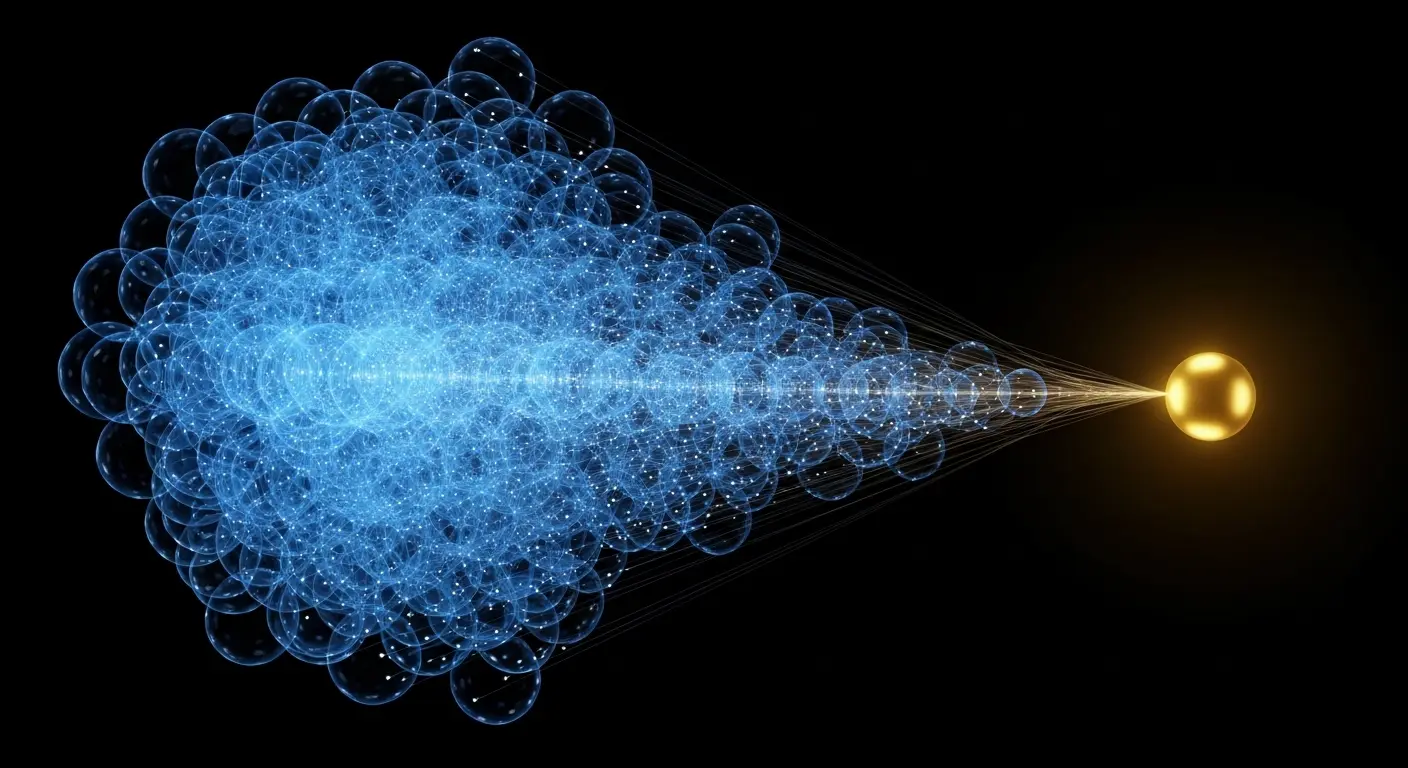
Paolo Luppi of the University of Milan and colleagues report memory effects in sequential quantum measurements and a departure from the quantum regression theorem. They identify a decomposition of two-time propagators into contributions determined by the reduced dynamical map and a new memory term reflecting system-environment correlations. A key operational quantifier measures violations of the quantum regression theorem and thoroughly analyses how spectral parameters, temperature, and measurement protocols influence non-Markovian statistics. Their findings reveal that multitime memory, assessed through sequential measurements, represents a distinct phenomenon from reduced-state non-Markovianity and can emerge at higher temporal orders even when two-time statistics align with QRT predictions.
Sequential measurements quantify non-Markovian dynamics and system-environment correlations
A quantifiable departure from the quantum regression theorem (QRT) has been demonstrated, with violations now measurable to within a 0.3 factor of Markovian predictions. The QRT, a cornerstone of quantum stochastic dynamics, posits that multitime correlation functions can be predicted solely from knowledge of the system’s reduced dynamics, essentially, the evolution of the system without direct consideration of the environment. This theorem holds under the assumption of Markovianity, where the environment’s influence is limited to instantaneous interactions. However, open quantum systems inevitably interact with their surroundings, leading to decoherence and potentially, non-Markovian behaviour. Previously, detecting deviations from the QRT necessitated complete access to the system’s density matrix, a task often impractical or impossible for complex systems. This new approach, utilising sequential measurements, circumvents this limitation by directly revealing memory effects inaccessible through reduced-state dynamics alone. This advancement stems from decomposing the two-time propagator of an open quantum system, isolating a ‘memory term’ representing system-environment correlations and expressing it as a second-order correction in the weak-coupling regime.
The two-time propagator, a central object in the study of non-equilibrium dynamics, describes the probability amplitude for a system to evolve from an initial state at time 0 to a final state at time t, given an initial state at time 0 and a subsequent measurement at time t. Decomposing this propagator allows researchers to disentangle the contributions from Markovian and non-Markovian processes. The identified ‘memory term’ specifically captures the influence of the environment’s past states on the system’s present evolution, effectively quantifying the system’s ‘memory’ of its interaction history. Joint probabilities now precisely quantify these QRT violations, allowing detailed analysis of how spectral parameters, temperature, and measurement protocols influence non-Markovian statistics. The spectral density of the environmental bath, for example, plays a crucial role in determining the strength and timescale of these memory effects. Higher temperatures generally lead to faster decoherence and weaker memory, while specific spectral features can enhance or suppress non-Markovian behaviour. Analysis of a spin-boson model, a widely used theoretical framework for studying quantum dissipation, showed that multitime memory, assessed through sequential statistics, differs from standard one-time measures of non-Markovianity. The latter, often based on the divisibility or complete positivity of the reduced dynamics, can fail to detect memory effects visible at higher temporal orders. This highlights the importance of employing sequential measurements to fully characterise the dynamics of open quantum systems. Increasingly, scientists are focused on understanding how quantum systems lose information to their surroundings, a process known as decoherence, and how this impacts their ability to perform complex calculations.
The research details how dissection of the ‘two-time propagator’ reveals hidden connections between the system and its environment, offering insights into the limitations of current decoherence models. Traditional decoherence models often assume Markovianity as a simplifying approximation. However, the demonstrated violations of the QRT suggest that these approximations may not always be valid, particularly in systems with strong system-environment coupling or structured environments. The authors acknowledge that their current framework relies on a specific model, the spin-boson model, raising questions about how broadly applicable these findings might be to more complex quantum technologies and the challenges of scaling these techniques. The spin-boson model, while analytically tractable, represents a simplified depiction of a complex environment. However, acknowledging the current application to a specific ‘spin-boson’ model is not a limitation, but rather an important first step towards broader applicability. Future work will need to explore the validity of these findings in more realistic and complex scenarios, potentially involving multiple environmental modes or non-quadratic couplings. The quantification method developed here, however, provides a robust framework for assessing memory effects regardless of the specific system-environment interaction.
Understanding decoherence is universally vital for building stable quantum computers, and this work provides a new set of tools to map system evolution and pinpoint environmental influences. Quantum computers rely on the delicate superposition and entanglement of quantum states, which are highly susceptible to decoherence. Identifying and mitigating decoherence mechanisms is therefore paramount for achieving fault-tolerant quantum computation. The ability to quantify memory effects and assess violations of the QRT will enable researchers to develop more accurate models of decoherence and design more effective strategies for protecting quantum information. The principles established here will inform future investigations into more complex and realistic quantum technologies, potentially extending to systems with stronger coupling or more intricate environmental structures. A new method for quantifying memory effects in open quantum systems is now available, moving beyond reliance on tracking only the system’s current state. By decomposing the two-time propagator, a ‘memory term’ reflecting correlations between the system and its environment was isolated, revealing how past interactions influence present behaviour even when standard quantum predictions appear accurate. This decomposition provides a second-order correction applicable when system-environment interactions are weak, offering a more nuanced understanding of quantum dynamics. The operational quantifier introduced in this study provides a direct measure of the deviation from the QRT, allowing for a systematic comparison of different systems and environments and facilitating the development of improved decoherence mitigation techniques.
Researchers have demonstrated a new way to quantify memory effects in open quantum systems by isolating a ‘memory term’ within the two-time propagator. This decomposition reveals how past interactions between a system and its environment influence current behaviour, even when standard quantum predictions hold true. The study introduces an operational quantifier to measure deviations from the quantum regression theorem, providing a tool to systematically compare systems and environments. Understanding these memory effects is vital for accurately modelling decoherence, a key challenge in developing stable quantum technologies.
👉 More information
🗞 Multitime memory beyond the quantum regression theorem in sequential measurement statistics
🧠 ArXiv: https://arxiv.org/abs/2605.06427




See today’s quantum computing news on Quantum Zeitgeist for the latest breakthroughs in qubits, hardware, algorithms, and industry deals.



