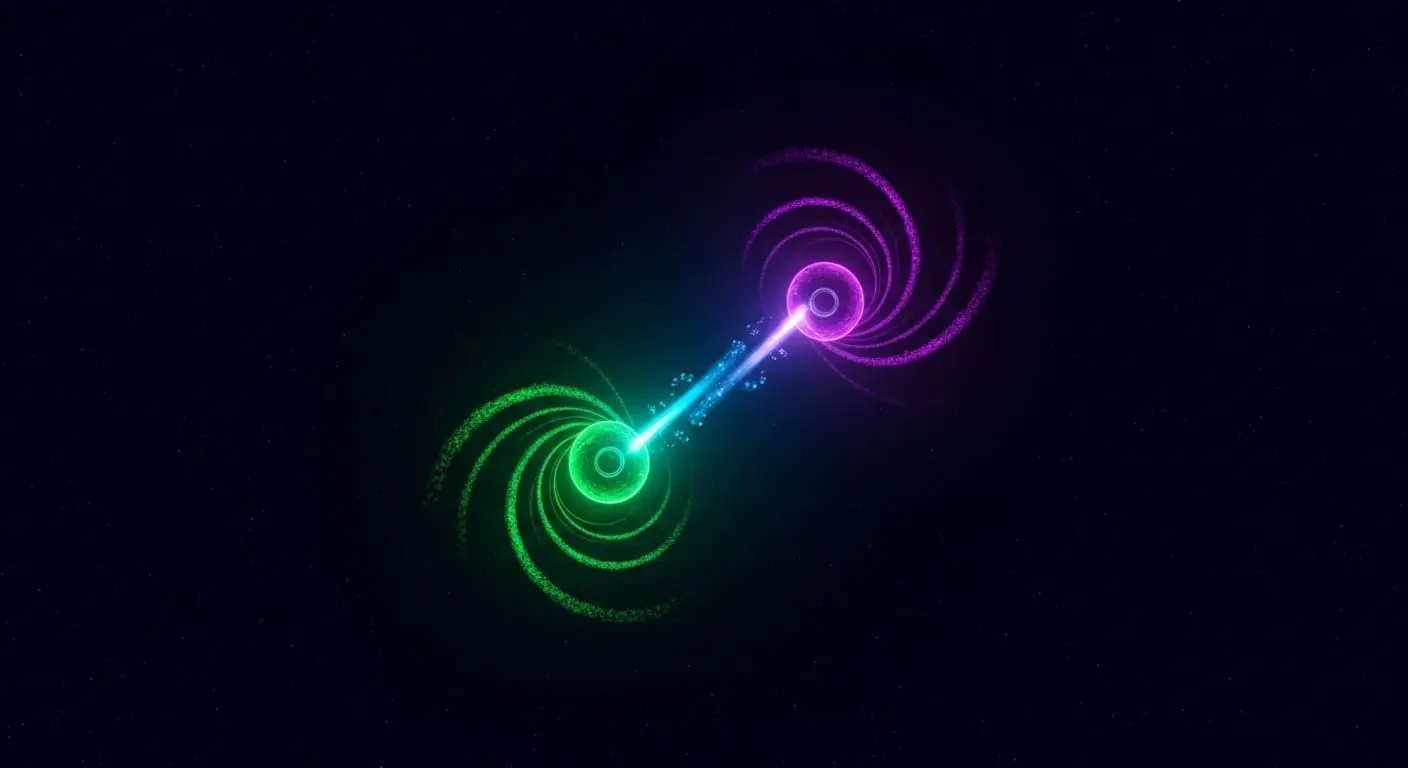
James Fullwood and colleagues at Hainan University show that Lorentzian symmetries emerge naturally from the internal properties of qubits, without considering external factors like position or momentum. Building upon previous work demonstrating the Lorentz non-invariance of von Neumann entropy, the study links preserving linear entropy to the action of the restricted Lorentz group on a single qubit. Sharply, the team demonstrate that linear quantum mutual information remains invariant under transformations from the special linear group, suggesting that relativistic spacetime structure can emerge intrinsically from quantum information itself, supporting the “It from Qubit” paradigm.
Relativistic spacetime emerges from preservation of quantum state purity
The central technique in this work carefully examined the preservation of ‘linear entropy’, a measure of quantum purity reflecting the mixed nature of a quantum state, as a guiding principle. Instead of beginning with established notions of spacetime, the focus lay on transformations that leave this linear entropy unchanged; this approach circumvented the need for pre-defined spatial or temporal coordinates. Treating these entropy-preserving transformations as fundamental allowed a mapping onto the mathematical structure of the Lorentz group, which describes how measurements of space and time change for observers in relative motion; this is comparable to identifying a fingerprint that remains consistent even when the hand holding it rotates.
The investigation explored how relativistic symmetries arise from quantum information without assuming a pre-existing spacetime. This enabled the mapping of transformations preserving linear entropy onto the Lorentz group, describing changes in space and time measurements with relative motion; the work focused on a single qubit, without specifying temperature or sample size. The aim was to derive spacetime symmetries from the internal properties of qubits, aligning with the “It from Qubit” model. Consequently, spacetime isn’t a pre-existing framework, but emerges from the behaviour of these fundamental quantum units, opening avenues for exploring the relationship between information and the universe’s structure.
Quantum mutual information invariance defines relativistic spacetime structure
Researchers have demonstrated that linear n-partite quantum mutual information, a measure of correlation, remains invariant under transformations from the special linear group SL(2,\mathbb C)⊗ n. This is a significant leap beyond previous limitations with von Neumann entropy, which lacked Lorentz invariance. The invariance extends to all n-qubit states, removing the need for finite-dimensional unitary representations previously required to couple spin and momentum; it allows the derivation of relativistic spacetime structure without a pre-existing spacetime background. Confirmation has been achieved that the linear n-partite quantum mutual information, a key indicator of quantum correlation, remains constant under transformations belonging to the special linear group SL(2,\mathbb C)⊗ n. This invariance extends across all multi-qubit states, sidestepping previous restrictions that demanded finite-dimensional unitary representations. Specifically, for a pair of qubits, the correlation function in the singlet state directly produces the Minkowski metric, the foundation of Lorentz symmetry, confirming a link between quantum information and spacetime geometry. This result highlights the potential for using quantum entanglement as a building block for understanding the fabric of spacetime itself.
Spacetime emergence linked to quantum information and qubit behaviour
The pursuit of a unified theory continues to drive physicists towards increasingly abstract concepts, but this work offers a compellingly grounded approach by focusing on the intrinsic properties of qubits. While the “It from Qubit” model gains traction, a striking tension arises from the limitations of current mathematical tools. The team’s reliance on SL(2,\mathbb C)⊗ n invariance, though powerful, does not guarantee a complete description of spacetime.
However, acknowledging that current mathematical frameworks may not fully capture all subtle nuances of spacetime is not cause for dismissal; rather, it highlights areas for future development. This work provides a concrete link between quantum information and relativity, demonstrating how fundamental spacetime properties emerge from the behaviour of qubits, the basic units of quantum information. Relativistic spacetime structure can arise from the fundamental properties of these basic quantum units.
By focusing on the preservation of linear entropy, scientists bypassed the need to assume a pre-existing spacetime framework; instead, symmetries mirroring those of relativity emerged naturally from qubit interactions. Invariants within a mathematical object called the ‘W-matrix’ remain constant under specific transformations, extending this principle to multiple entangled qubits via quantum mutual information. Further investigation will be needed to determine if this approach can fully reconcile quantum mechanics with general relativity, but it represents a significant step towards a deeper understanding of the universe’s fundamental building blocks.
Scientists demonstrated that relativistic spacetime structure emerges from the intrinsic properties of quantum information, specifically the behaviour of qubits. This finding establishes a connection between fundamental spacetime properties and the preservation of linear entropy within these quantum systems. The research reveals that invariants of a ‘W-matrix’ remain constant under transformations, extending this principle to multiple entangled qubits. Researchers intend to further investigate whether this approach can fully reconcile quantum mechanics with general relativity, representing progress towards understanding the universe’s fundamental building blocks.
👉 More information
🗞 On Lorentzian symmetries of quantum information
🧠 ArXiv: https://arxiv.org/abs/2604.07471



See today’s quantum computing news on Quantum Zeitgeist for the latest breakthroughs in qubits, hardware, algorithms, and industry deals.