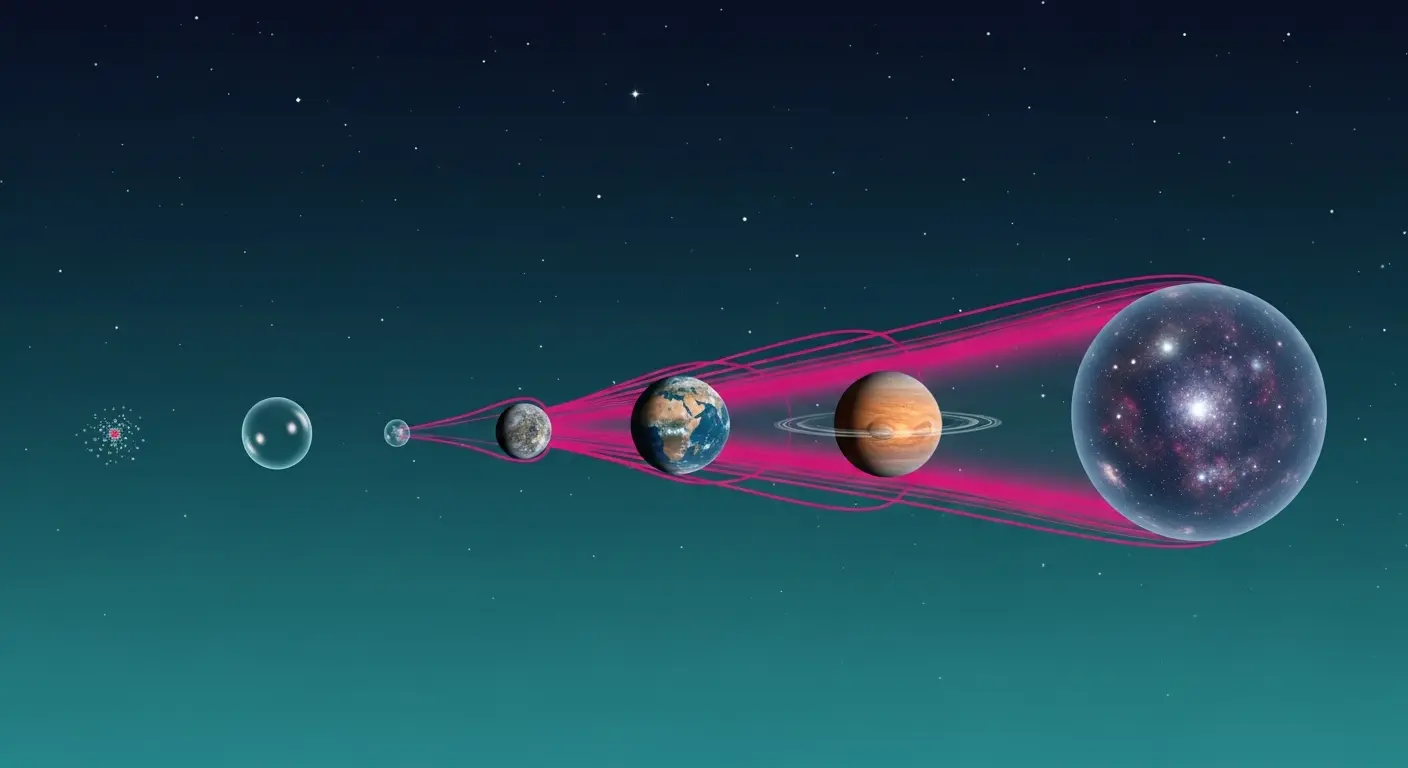
Scientists at the Indian Institute of Technology Guwahati have demonstrated a quantum resolution of the classical big bang singularity within a plane-symmetric Bianchi type-I universe, utilising the framework of quantum gravity. Vishal and Malay K. Nandy achieved this by employing the Page-Wootters formalism, a technique that addresses the problem of time in quantum cosmology by defining dynamics relationally through conditioning on an internal clock subsystem. Their approach constructs conditional quantum states, leveraging a mathematical transformation that casts the Wheeler-DeWitt equation into a form analogous to the Klein-Gordon equation, and subsequently building a general solution as a Gaussian superposition of momentum eigenstates. Crucially, the resulting probability density vanishes as the universe’s volume approaches zero, suggesting that quantum correlations play a fundamental role in relational dynamics and providing a consistent, nonsingular probabilistic description of the universe’s earliest moments.
Singularity resolution via consistent probability density across all internal clock values
The conditional probability density, central to resolving the big bang singularity, now demonstrably vanishes for all permissible values of the internal clock, representing a significant advancement over previous attempts. Earlier methodologies often struggled to achieve a consistent, nonsingular result, frequently encountering mathematical difficulties or requiring specific, often unphysical, conditions. This vanishing occurs at a volume threshold previously inaccessible within the Wheeler-DeWitt framework without introducing inconsistencies, such as negative probabilities or undefined quantities. Researchers at the Indian Institute of Technology Guwahati, postal code 781 039, demonstrated this quantum resolution of the singularity within a plane-symmetric Bianchi type-I universe by meticulously applying the Page-Wootters formalism. The Bianchi type-I model is characterised by homogeneity in two spatial directions and isotropy in the third, simplifying the mathematical treatment while still capturing essential cosmological features.
Misner variables, a specific parameterisation of the gravitational degrees of freedom, were strategically utilised in the calculations. This transformation effectively recast the Wheeler-DeWitt equation, the fundamental equation of quantum gravity in this context, into a form closely resembling the Klein-Gordon equation, a well-established equation in quantum mechanics describing the evolution of relativistic particles. This mathematical equivalence allowed the researchers to construct a general solution to the Wheeler-DeWitt equation as a superposition of momentum eigenstates, thereby creating quantum entanglement between the chosen clock subsystem and the remaining degrees of freedom of the universe. The positivity of the probability density, a fundamental requirement for any physically meaningful quantum theory, imposed specific constraints on the permissible range of clock values, which are directly dependent on the characteristics of the Gaussian wavepacket employed in the calculations. The width and centre of this Gaussian packet dictate the precision with which the clock variable is defined and influence the behaviour of the probability density near the singularity.
Instead of invoking absolute time, a concept problematic in general relativity, this relational approach defines change and dynamics through correlations with an internal ‘clock’ subsystem. This clock doesn’t measure time in the conventional sense but rather provides a relational standard against which the evolution of other variables can be assessed. The resulting calculations reveal a consistent probabilistic description of quantum cosmology, demonstrating that quantum correlations are not merely a byproduct but are, in fact, vital for understanding how relational dynamics emerge from the underlying quantum framework. Further investigation will focus on the sensitivity of these results to the specific parameters defining the Gaussian wavepacket, such as its width and central momentum, and the potential for extending the analysis to encompass more complex wavepacket shapes, potentially offering an even more robust and nonsingular description of quantum cosmology. Exploring different wavepacket shapes could reveal whether the singularity resolution is a general feature of the formalism or dependent on the specific choice of initial conditions.
Singularity resolution in a simplified cosmology validates relational time approaches to quantum
Resolving the big bang singularity, even within the confines of a simplified cosmological model, represents a crucial step towards the development of a complete and self-consistent theory of quantum gravity. However, it is important to acknowledge that this result is predicated on the use of a plane-symmetric Bianchi type-I model, a universe assumed to be homogenous in two spatial dimensions and expanding in one. While this simplification is mathematically tractable and allows for analytical solutions, it naturally raises whether the observed singularity resolution will persist in more realistic, anisotropic cosmologies that more accurately reflect the observed large-scale structure of the universe. The universe, as we observe it, exhibits inhomogeneities and anisotropies at various scales, and incorporating these complexities into the quantum cosmological model presents a significant theoretical challenge.
The Indian Institute of Technology Guwahati has established a consistent quantum description of the universe’s very early stages by successfully resolving the classical big bang singularity. Researchers demonstrated that the probability of the universe attaining zero volume effectively disappears, thereby circumventing the mathematical inconsistencies that have plagued earlier models. This technique offers a promising and potentially fruitful avenue for further exploration of quantum gravity, and the team intends to investigate the implications of this resolution for the subsequent evolution of the universe, including the emergence of inflation and the formation of large-scale structures. Understanding how the quantum state evolves beyond the singularity is crucial for connecting the quantum cosmological model to observational data. The team also plans to explore the effects of introducing small perturbations to the Bianchi type-I model to assess the robustness of the singularity resolution in a more realistic setting. The value of 781 039 remains the postal code for the institution.
Researchers successfully resolved the classical big bang singularity within a plane-symmetric Bianchi type-I universe using a relational framework and quantum correlations. This means the calculated probability of the universe reaching zero volume diminishes, avoiding a problematic outcome in previous cosmological models. The study highlights the importance of considering quantum relationships when describing the universe’s earliest moments and provides a consistent, non-singular probabilistic description of quantum cosmology. The team at the Indian Institute of Technology Guwahati intends to further investigate how this resolution impacts the universe’s subsequent evolution and to test its robustness with more complex models.
👉 More information
🗞 Singularity Resolution in Quantum Cosmology via Page-Wootters Formalism
🧠 ArXiv: https://arxiv.org/abs/2605.06093



See today’s quantum computing news on Quantum Zeitgeist for the latest breakthroughs in qubits, hardware, algorithms, and industry deals.