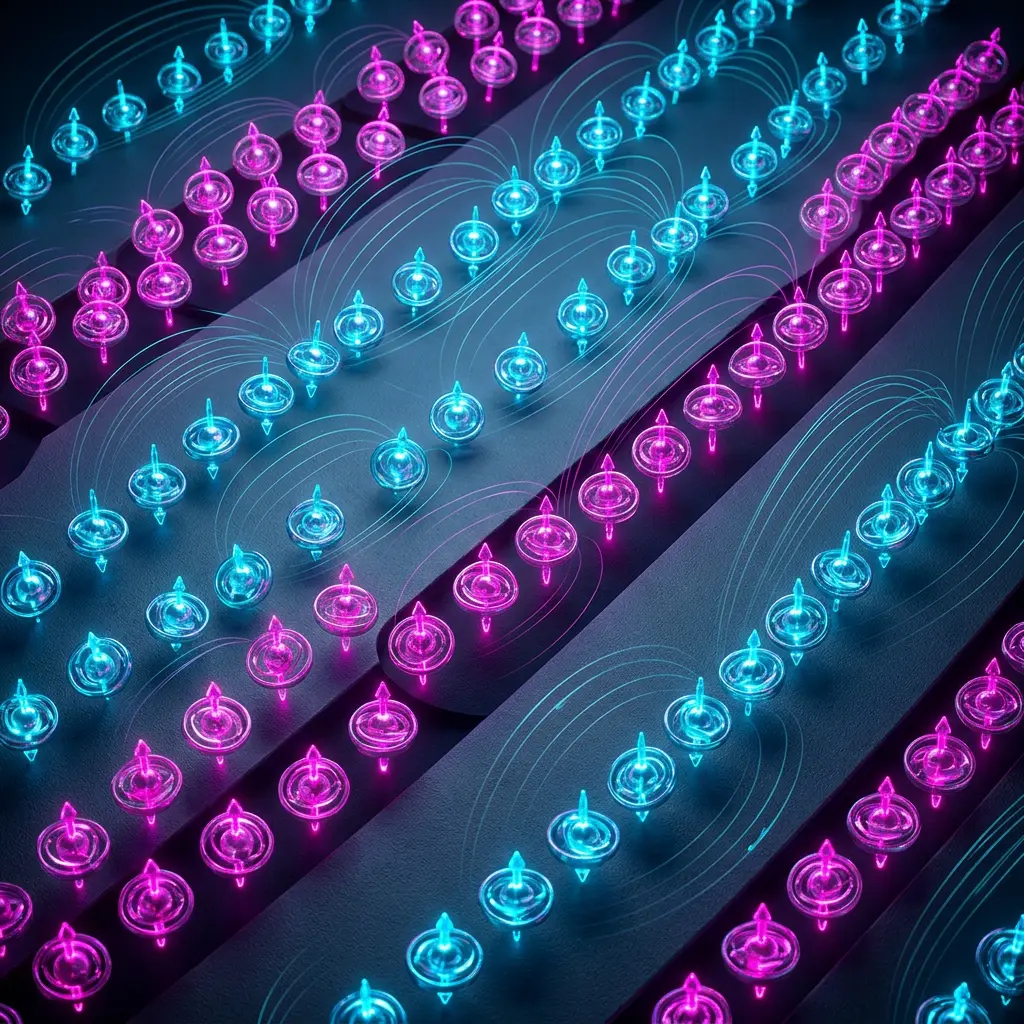
Miquel Carrasco-Codina and colleagues at ICFO, in collaboration with National Quantum Co, Harvard University, Galicia Supercomputing Centre (CESGA), ETH, Chip technologies for photonic co, and The Barcelona Institute of Science and Technology, are quantifying the energy efficiency of various quantum computing platforms. The research defines energy efficiency as the ratio between algorithmic performance and hardware energy consumption, analysing superconducting qubits, silicon spin qubits, trapped ions, neutral atoms, and photonic qubits. Consideration of both current energy usage and the constraints of algorithm compilation provides a key benchmark framework for evaluating the energy efficiency of future quantum computing architectures and assessing their potential advantage over classical computation.
Algorithms per joule delineate performance differences between quantum computing platforms
Superconducting qubits currently perform approximately ten times more algorithms per joule than photonic qubits, according to a newly defined metric for quantum computer energy efficiency. Establishing this threshold is key, as it provides a baseline for comparing diverse quantum architectures, something previously impossible due to a lack of standardised measurement. Prior assessments relied on theoretical lower bounds rather than actual hardware performance, hindering objective evaluation of progress. The significance of this metric lies in its ability to move beyond simply counting qubits, a metric that does not correlate directly with computational power, and instead focus on the practical utility derived from energy input. This is particularly crucial as quantum computers scale up in complexity, with increasing qubit counts not automatically translating to improved performance if energy consumption rises disproportionately.
Calculating the ratio of algorithms performed to energy consumed allows meaningful comparisons between platforms such as superconducting qubits, silicon spin qubits, trapped ions, neutral atoms, and photonic qubits, moving beyond simple qubit counts. Silicon spin qubits currently achieve approximately 100 algorithms per joule when assessing energy efficiency across several quantum computing platforms. Trapped ion systems perform around 10 algorithms per joule, while neutral atom platforms manage roughly 1 algorithm per joule; photonic qubits demonstrate the lowest performance at 0.1 algorithms per joule. These figures highlight a substantial disparity in energy efficiency between the different modalities, suggesting that certain platforms may be more viable candidates for large-scale, practical quantum computation. The observed differences are attributable to variations in qubit coherence times, gate fidelities, and the overhead associated with control and measurement processes. For instance, the relatively low performance of photonic qubits is linked to the challenges of generating and maintaining single photons, as well as the losses inherent in optical components.
These values were calculated using existing hardware components and established compilation models, assessing the number of algorithms completed within a given timeframe against total energy consumption. Specifically, active reset techniques on superconducting platforms and qubit connectivity in spin qubit systems were analysed as factors influencing performance. Active reset, a process of quickly returning qubits to a known state, improves algorithmic throughput but introduces energy overhead. Similarly, the connectivity of qubits, how easily they can interact with each other, impacts the complexity of algorithm compilation and, consequently, energy usage. However, these numbers do not yet account for substantial manufacturing costs or the limited reusability of quantum devices, meaning a complete life-cycle assessment could yield sharply different results. A comprehensive life-cycle analysis would need to consider the energy expenditure associated with fabrication, materials sourcing, and eventual disposal of the quantum hardware, providing a more holistic picture of its environmental impact.
Quantifying total energy demand across diverse quantum computing architectures
A detailed accounting of each platform’s hardware components and their respective power draws was necessary to define a standardised method for evaluating energy use. This involved carefully mapping the energy consumption of elements like cryostats and cooling systems, which maintain extremely low temperatures for superconducting qubits. Superconducting qubits require temperatures near absolute zero to exhibit quantum behaviour, necessitating the use of sophisticated and energy-intensive cryogenic systems. These systems, typically utilising liquid helium, contribute significantly to the overall energy footprint of superconducting quantum computers. Laser systems used to manipulate trapped ions, akin to precisely controlling tiny marbles suspended in a maze, were also included. The precision required to control and measure the state of individual ions demands highly stable and powerful laser sources. The team didn’t simply measure power during computation; they accounted for the continuous energy demand of maintaining qubit stability, even when idle, revealing that these baseline costs often dominate overall consumption. This ‘idle’ power consumption is a critical factor, as quantum computers are not always actively processing information, and the energy required to maintain qubit coherence can be substantial.
Benchmarking algorithmic performance per energy unit across quantum computing platforms
Quantifying the energy demands of quantum computers is vital as the field progresses beyond mere qubit counts towards practical applications. This work establishes a key framework for benchmarking energy efficiency, calculated as algorithms performed per unit of energy consumed, across five leading platforms. While tailoring efficiency measures to particular problems will certainly refine future analyses, this broad assessment establishes a common ground for tracking progress and identifying promising avenues for energy optimisation across all platforms. The ability to compare different architectures on a standardised metric will accelerate the development of more energy-efficient quantum computers, potentially unlocking their widespread adoption.
This initial assessment, focused on general computational capability, will allow for meaningful comparisons as the technology matures. Task-specific optimisation will begin with future development. Establishing a standardised metric for energy efficiency marks a major advance in quantum computing evaluation, shifting focus from simple qubit counts to assess practical performance. By accounting for the continuous energy demands of maintaining qubit stability, alongside the complexities of translating instructions for quantum processors, the work offers a foundational framework for benchmarking future designs. The compilation process, which translates high-level algorithms into a sequence of qubit operations, introduces significant overhead and can dramatically impact energy consumption.
Evaluating algorithms per energy unit provides a foundational metric for comparing diverse quantum computing approaches at a key early stage. The assessment deliberately focuses on general computational capability, avoiding comparisons tailored to specific tasks; this simplification, while necessary at this early stage, obscures a critical tension. While a general metric is useful for initial comparisons, the optimal quantum architecture may vary depending on the specific application. For example, certain algorithms may be better suited to superconducting qubits, while others may benefit from the longer coherence times of trapped ions. A baseline for energy efficiency across five quantum computing platforms has now been established. This will facilitate meaningful comparisons as the technology matures. Further research will need to explore the interplay between algorithm design, hardware characteristics, and energy consumption to fully optimise quantum computing performance.
This research established a standardised metric for evaluating the energy efficiency of five quantum computing platforms, superconducting qubits, silicon spin qubits, trapped ions, neutral atoms and photonic qubits. The study calculated energy efficiency as the ratio of algorithms performed to energy consumed, providing a baseline for comparison between different architectures. This framework allows researchers to move beyond simply counting qubits and instead assess practical performance based on energy use. The authors intend for this metric to facilitate the development of more energy-efficient quantum computers as the technology advances.
👉 More information
🗞 Energy efficiency of quantum computers
🧠 ArXiv: https://arxiv.org/abs/2605.15090


See today’s quantum computing news on Quantum Zeitgeist for the latest breakthroughs in qubits, hardware, algorithms, and industry deals.