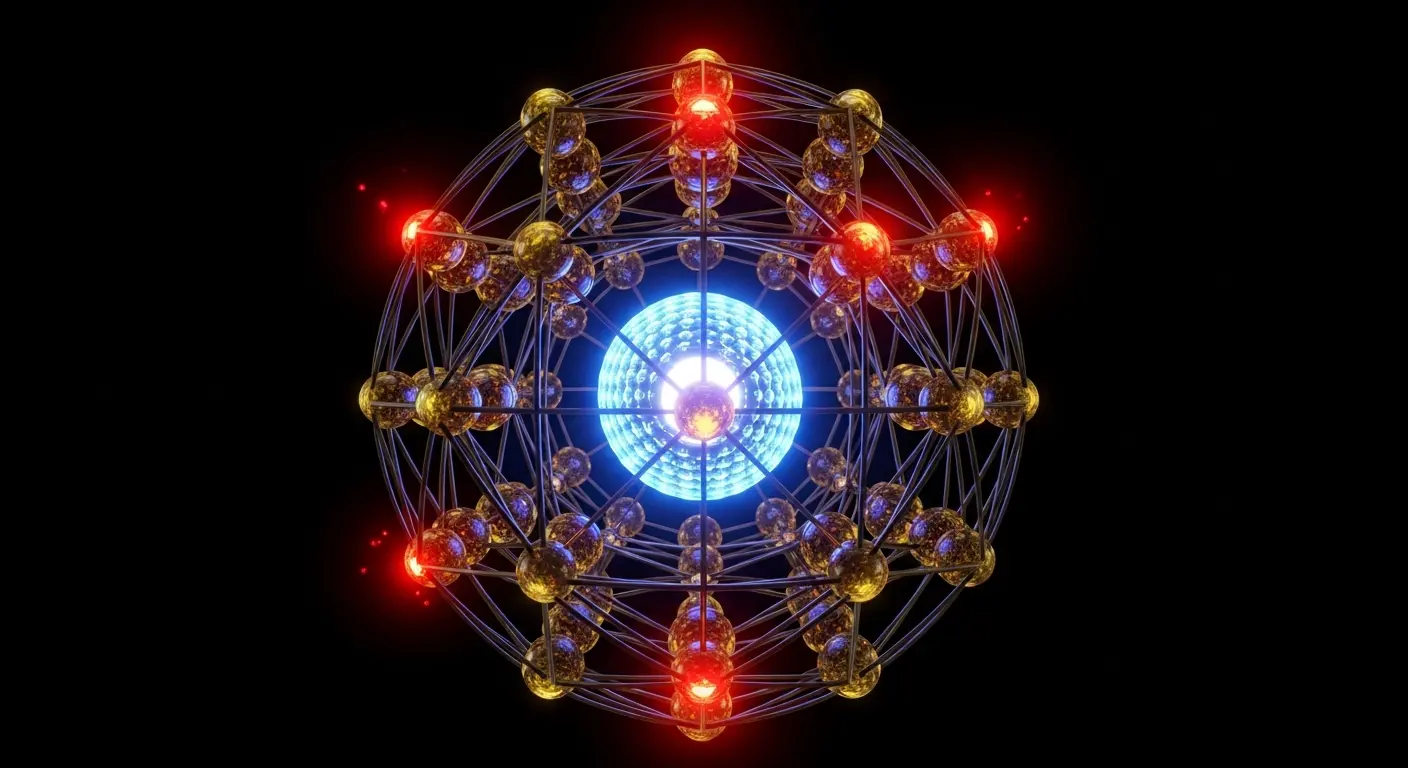
Hikaru Wakaura and colleagues at Quantum Integrated Research Institute present a new technique, blind catalytic quantum error correction, which advances quantum error correction. The method recovers quantum states without prior knowledge of the target state, overcoming a key hurdle in the field. Their research introduces a strategy to estimate the target state directly from noisy outputs. This strategy benchmarks five estimation approaches across various noise models, quantum algorithms, and state dimensions up to 256. Results show coherence maximisation achieves high recovery fidelity, exceeding 0.95 for smaller dimensions, and identify target estimation as the primary limitation. The work establishes an analytical crossover dimension separating noise-model-free and informed regimes, and validates the need for decoherence-aware strategies, ultimately demonstrating a 3.4-fold reduction in energy error for a hydrogen molecule simulation.
Blind error correction surpasses limitations through coherence maximisation and state estimation
Recovery fidelity exceeding 0.95 was achieved for quantum states up to 16 dimensions without any prior knowledge of the target state, a feat previously impossible. Conventional methods demanded complete knowledge of the ideal quantum state for error correction, but this breakthrough utilises coherence maximisation to estimate the target state directly from noisy outputs. Scientists identified an analytical crossover dimension of approximately 25 to 40, separating regimes where noise-model-free and informed approaches are most effective.
A 3.4-fold reduction in energy error also occurred during a hydrogen molecule simulation. Further analysis revealed that channel inversion, a method requiring knowledge of the noise affecting the quantum system, became necessary at higher dimensions of 64, yielding a recovery fidelity of 0.905. A strong linear correlation, with a coefficient greater than 0.99, was found between the accuracy of target estimation and the overall recovery fidelity, pinpointing estimation as the primary limitation. Copy scaling analysis indicated that between five and ten copies of the noisy quantum state were sufficient to maintain high fidelity at lower dimensions.
Despite achieving impressive fidelity in recovering quantum states without prior knowledge, this blind catalytic quantum error correction method isn’t a panacea. A critical trade-off was revealed. Coherence maximisation works well for smaller systems, but performance noticeably drops as the complexity, and therefore the dimensions, increase. At higher dimensions, channel inversion, a technique demanding prior knowledge of the noise affecting the quantum system, becomes necessary, revealing a fundamental limit to the ‘blind’ approach.
This suggests a need for hybrid strategies combining both informed and uninformed techniques. This represents a major step forward in quantum error correction, demonstrating effective recovery of quantum states without prior noise knowledge and expanding the possibilities for building more durable quantum computers. The identification of a key crossover point, around 25 to 40 quantum bits, guides future research towards hybrid approaches for optimal performance across all system sizes. Successful demonstration of this technique broadens the scope of catalytic quantum error correction, previously limited to scenarios where the original state was fully known, and opens possibilities for application within variational quantum algorithms. Pinpointing target estimation as the primary performance bottleneck, particularly as system complexity increases, directs future work towards hybrid strategies to optimise fidelity across all system sizes.
The researchers successfully recovered quantum states using a new ‘blind’ catalytic quantum error correction method, achieving over 95% fidelity for systems up to dimension 16 without needing prior knowledge of the noise affecting the quantum system. This is important because it expands the potential of quantum error correction to scenarios where the original quantum state is unknown. Performance decreased with increasing system complexity, requiring noise-informed techniques at higher dimensions of 64, and the study identified target estimation as the main limitation to recovery fidelity. The authors suggest future work will focus on hybrid strategies combining informed and uninformed techniques to optimise performance across all system sizes.
👉 More information
🗞 Blind Catalytic Quantum Error Correction: Target-State Estimation and Fidelity Recovery Without A Priori Knowledge
🧠 ArXiv: https://arxiv.org/abs/2604.11857

See today’s quantum computing news on Quantum Zeitgeist for the latest breakthroughs in qubits, hardware, algorithms, and industry deals.