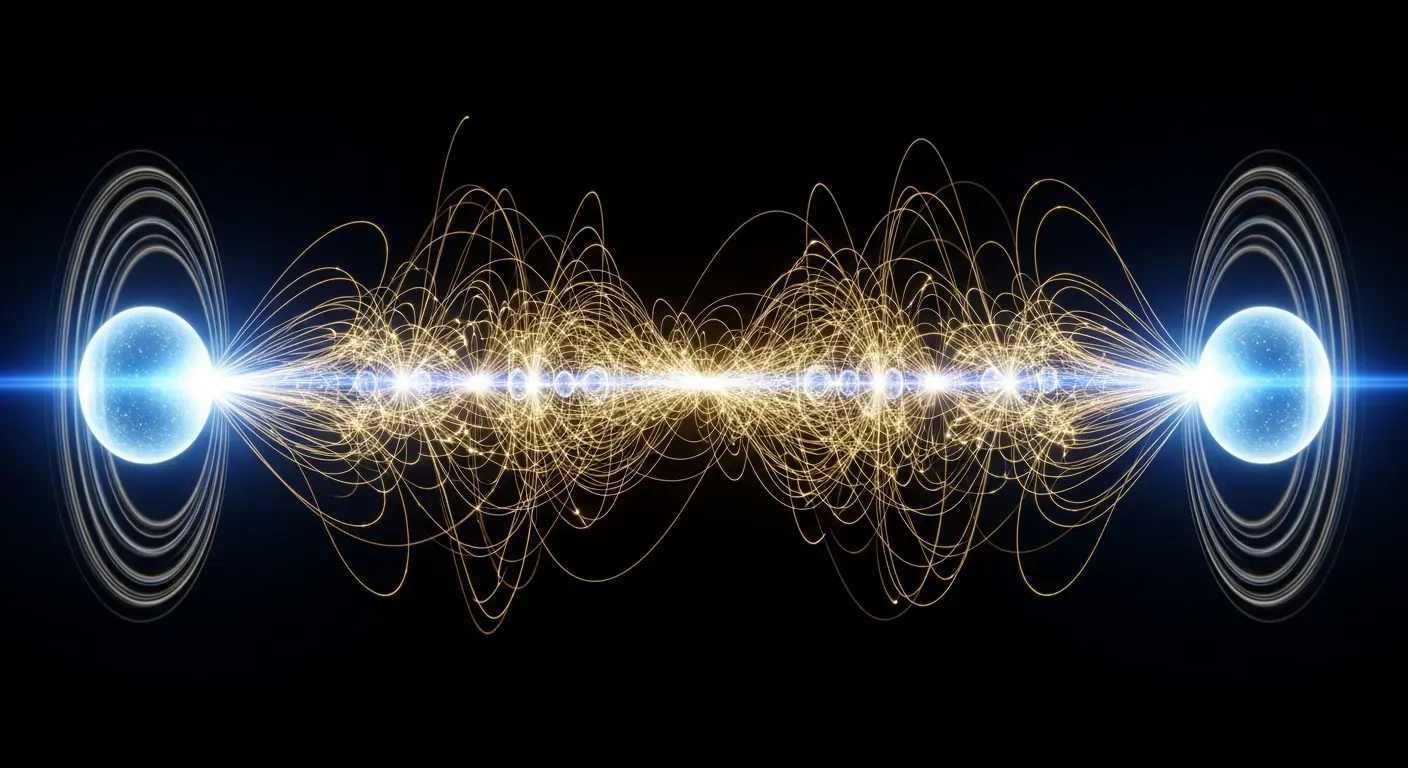
Scientists are employing a novel method to generate macroscopic quantum entanglement, a phenomenon traditionally associated with the microscopic realm. Rong-Can Yang and colleagues at Zhejiang University, in collaboration with College of Physics and Energy, Fujian Normal University, and Fujian Provincial Engineering Technology Research Centre of Solar Energy Conversion and Energy Storage, have demonstrated the entanglement of two magnon modes within yttrium-iron-garnet (YIG) spheres utilising a superconducting qubit driven by a two-tone field. The approach achieves demonstrable entanglement, involving over $1018$ spins within millimeter-sized spheres, with parameters readily achievable using existing technology. These findings enable investigation into fundamental aspects of macroscopic quantum mechanics and testing theories surrounding unconventional decoherence, potentially bridging the gap between quantum and classical physics.
Magnon entanglement surpasses previous limits using coupled YIG spheres and superconducting qubits
Entanglement, quantified by a logarithmic negativity, now reaches a value of 0.7, representing a substantial improvement over prior attempts to create macroscopic quantum links. Previous efforts struggled to demonstrate entanglement involving more than $1018$ spins within millimeter-sized materials, a significant limitation in exploring macroscopic quantum phenomena. This new approach successfully achieves that threshold, opening new possibilities for investigating the behaviour of quantum systems at larger scales. A key innovation lies in the method utilising a two-tone driving field and cavity-mediated coupling between magnons, collective excitations of magnetic spins, and a superconducting qubit. The two-tone field allows for precise control over the qubit’s excitation, enabling selective coupling to the magnon modes in the YIG spheres.
Researchers have demonstrated a method for entangling magnons within two yttrium-iron-garnet (YIG) spheres, each measuring just a few millimeters in size. YIG is particularly suitable for this purpose due to its low magnetic damping and relatively high spin wave velocities, facilitating the propagation and manipulation of magnons. The system enables the creation of a magnonic two-mode squeezing interaction, effectively linking the spin states of the two YIG spheres. This squeezing reduces the quantum noise in the magnon modes, enhancing the entanglement. A qubit acts as an intermediary, mediating the coupling between the magnons via a microwave cavity. This cavity is designed to virtually interact with both the qubit and the magnons, establishing a vital link. The cavity’s resonant frequency is carefully tuned to match the energy levels of the qubit and the magnons. The cavity-mediated interaction enhances the strength of the coupling, allowing for efficient entanglement generation. While the achieved logarithmic negativity indicates strong entanglement, maintaining coherence for extended periods and scaling this system to more complex networks remain substantial hurdles to practical quantum technologies. Further investigation will focus on improving the stability of the entangled state, mitigating environmental noise, and exploring potential applications in quantum information processing, such as quantum sensing and quantum communication.
Towards macroscopic quantum states via large-scale spin entanglement in yttrium-iron-garnet
Achieving entanglement involving a vast number of spins, exceeding ten to the power of eighteen in these yttrium-iron-garnet spheres, is a remarkable feat, representing a significant step towards realising macroscopic quantum states. The sheer number of entangled spins amplifies the quantum effects, making them potentially observable and measurable. However, the authors acknowledge their work presently stops short of definitive proof of macroscopic superposition. They detail a scheme for detecting this entanglement via Wigner-function tomography, a complex process reconstructing the quantum state from experimental measurements, but have not yet experimentally verified its existence. This involves performing a series of measurements on the system and using the results to reconstruct the Wigner function, which provides a complete description of the quantum state. Nevertheless, this represents a significant step forward in cavity optomagnonics, a rapidly developing field combining magnons, quantum excitations in magnetic materials, with superconducting circuits. This synergy allows for the strong coupling of disparate quantum systems, opening up new avenues for exploring fundamental physics and developing novel quantum technologies, and could begin to unlock macroscopic quantum effects previously only theorised, and enable exploration of unconventional decoherence mechanisms that may arise in large quantum systems.
The team connected two millimeter-sized spheres composed of yttrium-iron-garnet, establishing entanglement between their internal magnetic excitations. The choice of YIG allows for strong magnon-photon coupling within the microwave cavity. A superconducting qubit and a precisely tuned microwave field served to demonstrate a pathway to connect these spheres indirectly via a microwave cavity. The microwave field is crucial for driving transitions in the qubit and mediating the interaction between the qubit and the magnons. This achieved entanglement represents a substantial increase over previous demonstrations, which were limited by weak coupling and low entanglement fidelity. It is a key step towards exploring quantum effects in larger systems. The team are now investigating the limits of this entanglement. They are exploring factors that affect its stability and duration, and potential applications in quantum sensing, where the entangled magnons could be used to enhance the sensitivity of magnetic field detectors, and quantum communication, where the entangled state could be used to transmit quantum information.
Researchers successfully entangled two magnon modes within millimeter-sized yttrium-iron-garnet spheres, demonstrating a connection between their magnetic excitations. This entanglement, involving over $1018$ spins, represents a significant advance in the field of cavity optomagnonics and allows for the exploration of quantum behaviour in larger systems. The team verified a detection scheme for this entanglement and are currently investigating factors affecting its stability and duration. This work provides a platform for fundamental studies into macroscopic quantum mechanics and unconventional decoherence theories.
👉 More information
🗞 Macroscopic entanglement between two magnon modes via two-tone driving of a superconducting qubit
🧠 ArXiv: https://arxiv.org/abs/2605.06297




See today’s quantum computing news on Quantum Zeitgeist for the latest breakthroughs in qubits, hardware, algorithms, and industry deals.