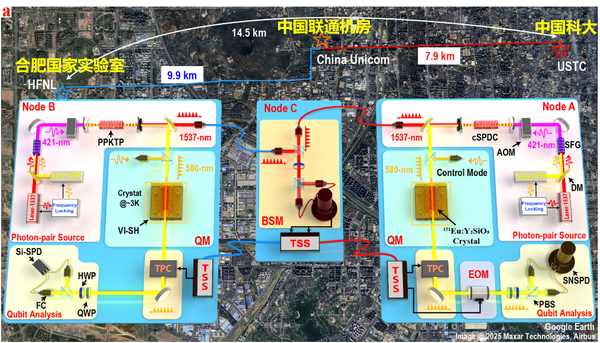
Scientists in China have demonstrated a quantum relay network, dubbed Xinghan-2, capable of sustaining matter-matter entanglement across 14.5 kilometers, the longest reported distance for this type of entanglement. The system overcomes a critical limitation in quantum communication by simultaneously achieving both high transmission rates and fidelity, a feat previously requiring compromise. Reviewers for Nature Photonics noted that Xinghan-2’s entanglement distribution rate is more than 100 times faster than previous metropolitan quantum relays, while maintaining 78.6% entanglement fidelity using existing fiber optic infrastructure. Li Chuanfeng said that this work achieves the longest reported distance for matter-matter entanglement, noting the transition from proof-of-concept to urban network application, and adding that the multi-mode approach is a fundamental technical route for future networks.
Xinghan-2 System Achieves 14.5km Matter-Matter Entanglement
The Xinghan-2 system developed in China has established a new benchmark in quantum communication by achieving matter-matter entanglement across 14.5 kilometers of fiber optic cable. This distance represents the longest reported to date for this type of entanglement and is a critical step toward building a practical quantum internet. Quantum relays are essential for extending signal reach by segmenting long-distance channels and mitigating signal loss. Unlike earlier systems that forced a compromise between speed and accuracy, Xinghan-2 employs a time-measurement protocol allowing photons to arrive at relay stations at varying times, circumventing the need for strict synchronization. Maintaining 78.6% entanglement fidelity over the 14.5km span, while leveraging existing fiber optic infrastructure, is particularly noteworthy because high fidelity is often sacrificed to achieve greater distances, suggesting a more readily deployable solution for secure communication networks.
The pursuit of a functional quantum internet has long been hampered by the limitations of signal degradation over distance, necessitating the development of quantum repeaters to extend communication ranges. This achievement bypasses a common constraint in quantum communication, previously requiring a compromise between transmission speed and fidelity. The system maintained 78.6% entanglement fidelity over the 14.5km span utilizing pre-existing fiber optic infrastructure.
He added that the multi-mode approach is a fundamental technical route for future networks.


See today’s quantum computing news on Quantum Zeitgeist for the latest breakthroughs in qubits, hardware, algorithms, and industry deals.