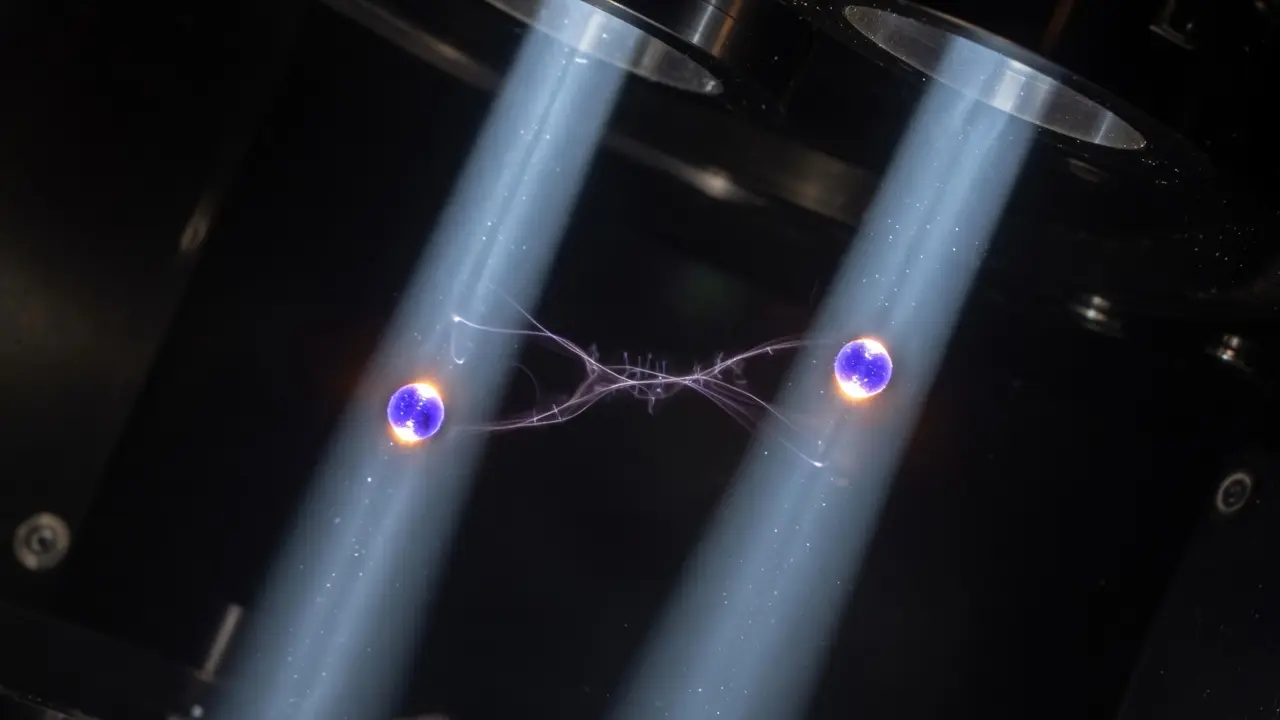
Can solid-state quantum emitters exhibiting large differences in their optical properties be reliably entangled. A new technique uses pairs of entangled photons to connect these typically incompatible components within an interferometric setup. It overcomes limitations requiring optically identical emitters, enabling scalable platforms for future quantum technologies. This technique successfully entangles solid-state components, like those used in quantum dots, even when they possess differing optical properties.
Current methods require nearly identical parts for entanglement, limiting scalability due to manufacturing challenges. The approach instead utilises pre-existing entangled photons as intermediaries, connecting dissimilar emitters within an interferometric setup. Demonstrating high levels of connection between these non-identical elements is key for creating more complex and practical quantum devices. Researchers at the University of Sheffield have developed a new technique to reliably entangle solid-state quantum components, such as those found in quantum dots, even when they differ sharply in their optical properties.
Existing methods demand nearly identical emitters for entanglement; this limits scalability because manufacturing perfect copies is difficult. Think of it like shining two lights on a doorway: observing where light didn’t come from reveals something about how the sources are connected. This approach measures ‘concurrence’, essentially a score indicating how strongly linked two particles are, achieving a high value of 0.95 with typical quantum dots. The ability to connect non-identical components unlocks more complex designs and raises the question: can this technique be scaled up to create truly practical large-scale quantum networks.
Strong Entanglement Now Links Dissimilar Quantum Dots Via Waveguide Spin State Control
Entanglement measures now routinely exceed C=0.95, a sharp leap beyond previous methods struggling to maintain entanglement above 0.5 as quantum dots exhibited minor variations in optical properties. This threshold is key; prior techniques demanded nearly identical solid-state emitters, an impractical requirement given inherent manufacturing inconsistencies. Utilising pre-existing entangled photon pairs within an interferometric setup allowed the University of Sheffield team to bypass this limitation, successfully linking disparate quantum dot qubits despite substantial differences in transition frequencies and linewidths up to fifty nanometres apart.
Selective connections between emitter spin states and photon direction at points within a waveguide structure form the basis of the technique, effectively removing information about each photon’s path during interaction. The University of Sheffield team achieved entanglement concurrence reaching C=0.95 with quantum dots differing in optical properties by as much as fifty nanometres; narrowband photon inputs were specifically tuned for simultaneous interaction with each solid-state emitter. Detecting both photons, regardless of which detector registered them, consistently indicated a highly entangled state between qubits, creating Bell states under near-resonant conditions while analysis showed minimal difference in concurrence values.
Entanglement fidelity balances against photon source limitations and material sensitivity
While this new technique offers a path towards scalable quantum devices by relaxing demands on emitter uniformity, it relies heavily on readily available entangled photon pairs, a resource that isn’t limitless nor easily produced at scale, making sufficient high-quality photon generation an ongoing challenge. The team demonstrated success with “typical” quantum dots but haven’t yet explored the method’s sensitivity to variations beyond those observed initially; questions remain about its durability across different materials and fabrication processes. Still, performance with more substantial variations in quantum dot quality requires further investigation.
The University of Sheffield team achieved strong connections between solid-state quantum dots despite optical property differences through pre-existing entangled photons within an interferometric setup, circumventing a key limitation hindering scalability in existing protocols demanding nearly identical components. This technique selectively links emitter spin states with photon direction at specific points within a waveguide structure, effectively ‘erasing’ information regarding each photon’s path during interaction and creating high fidelity entanglement even when emission lines differ by up to fifty nanometres; this allows for robust entanglement across dissimilar qubits.
This research demonstrated a method for entangling solid-state quantum dots, even those with differing optical properties, using readily available pairs of entangled photons. By utilizing narrowband photon inputs, the researchers achieved a concurrence value of 0.95, indicating strong entanglement despite variations in transition frequency separations as large as fifty nanometers. This approach bypasses the need to fabricate perfectly identical emitters, which presents challenges for scalability. The study suggests that pre-existing entangled photons can effectively connect emitter spin states within an interferometric setup and create high fidelity entanglement between qubits.
👉 More information
🗞 High-fidelity entanglement of two spectrally-distinct solid state emitters
✍️ Daniel R. E. Hodgson and Pieter Kok (University of Sheffield)
🧠 ArXiv: https://arxiv.org/abs/2610.31283




See today’s quantum computing news on Quantum Zeitgeist for the latest breakthroughs in qubits, hardware, algorithms, and industry deals.