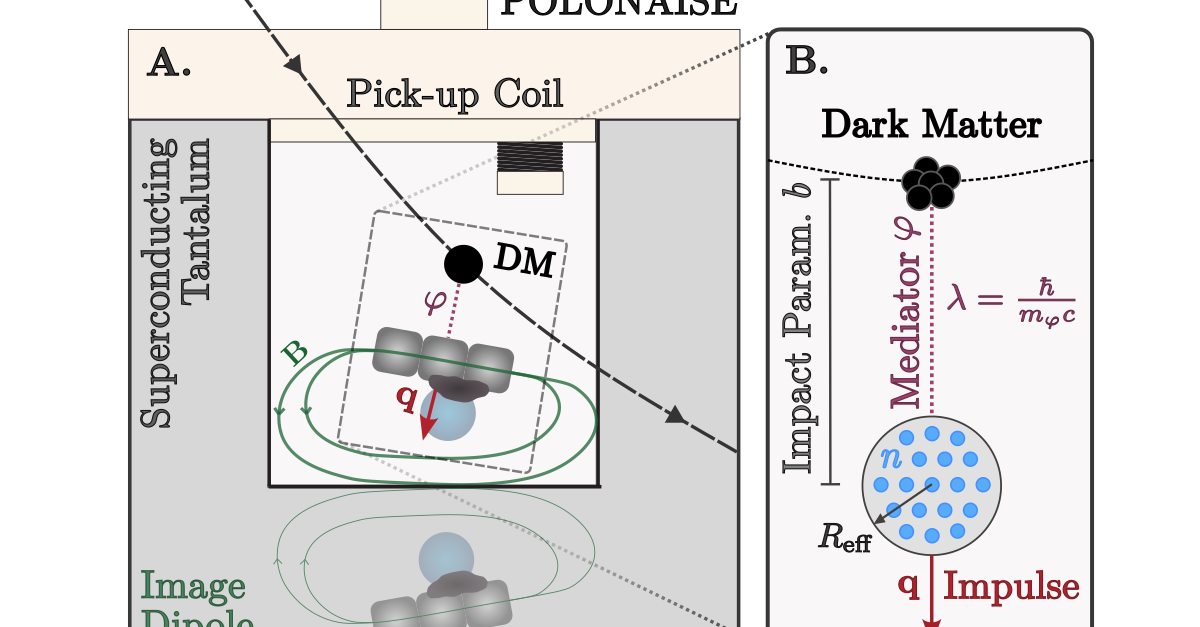
A milligram-scale magnet, suspended in a superconducting trap, now forms the core of a search for ultraheavy dark matter. IFAE researcher Dorian Amaral and collaborators report on a new method for detecting potential interactions, seeking the minute impulse a dark matter particle could impart on this macroscopic sensor.
While the experiment found no evidence of ultraheavy dark matter, the results constrain previously unexplored combinations of mass and interaction strength, demonstrating the versatility of magnetic levitation for probing a wide range of dark matter possibilities. Amaral, formerly of Rice University, continues to explore precision sensing technologies at IFAE to address fundamental questions in physics.
Magnetically Levitated Particle Constrains Ultraheavy Dark Matter Interactions
The experiment employed a milligram-scale ferromagnet suspended within a superconducting trap, a surprisingly small mass utilized as a sensor for potentially enormous ultraheavy dark matter particles. This innovative approach deviates from conventional dark matter detection methods that focus on energy deposited into atomic nuclei; instead, it seeks to identify the minuscule impulse imparted by a passing ultraheavy particle.
Dorian Amaral, postdoctoral researcher in IFAE’s Theory Division and corresponding author of the study, previously investigated the potential of magnetic levitation and precision sensing at Rice University to detect both dark matter and other extremely weak interactions. This work extends Amaral’s previous research, demonstrating the versatility of magnetic levitation techniques to explore a broad spectrum of possible dark matter masses, from ultralight to ultraheavy candidates.
The sensitivity of the levitated magnet stems from its ability to register extremely small forces and sudden changes in momentum, allowing the team to probe interactions previously inaccessible to other experiments. While the current search yielded no evidence of ultraheavy dark matter interactions, the results significantly narrow the range of plausible dark matter masses and interaction strengths, refining the parameters for future investigations. The team reports demonstrating a new method for constraining dark matter interactions, a technique that complements existing searches and opens avenues for exploring previously uncharted territory in the dark matter landscape.
“First Search for Ultraheavy Dark Matter Using a Magnetically Levitated Particle” is authored by Dennis G. Uitenbroek, Dorian W. Amaral, Juehang Qin, Jurriaan Langendorff, Andrew Gingerich, Tjerk H. Oosterkamp and Christopher D.
Amaral’s ongoing research at IFAE centers on expanding the application of precision and quantum sensing technologies to address fundamental physics questions, including the search for dark matter and the detection of gravitational waves. He is also involved in GravNet, a project funded by an ERC grant aiming to build a highly sensitive gravitational wave detector capable of identifying signals from exotic sources like merging primordial black holes.


See today’s quantum computing news on Quantum Zeitgeist for the latest breakthroughs in qubits, hardware, algorithms, and industry deals.