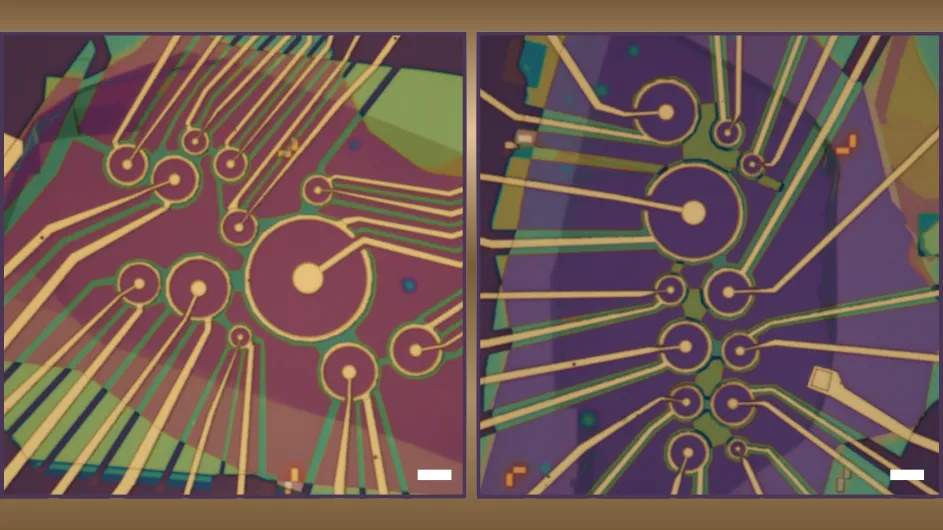
Columbia University researchers led by physicist Cory Dean have quantified the rate of electron interactions, a parameter previously inaccessible in condensed matter physics. Using mono and bilayer graphene visualized with 5-micron scale bars, the team developed a technique to measure how electrons collide within a material, a critical step toward understanding unconventional superconductivity and other unusual quantum phenomena.
“When electrons in a material interact strongly with each other, the behavior tends to become strange and unexpected,” says Dean, explaining that this measurement addresses a fundamental problem in physics. The research, published in Science, will enable more accurate predictive models of correlated electron behavior.
Graphene Circular Geometry Enables Electron Interaction Quantification
Simultaneously measuring electrical resistance and electronic viscosity in graphene, a feat previously unattainable, has now been achieved by the team with their newly developed technique. Yihang Zeng, now an assistant professor of physics and astronomy at Purdue University, designed a device that shapes graphene into a circular geometry with concentric ring electrical contacts to achieve this, allowing for the disentanglement of material collisions from electron-electron collisions even when material collisions are dominant.
This innovation bypasses limitations of earlier measurements restricted to narrow temperature windows and enables characterization of electron behavior across a broader range of temperatures and densities. The circular graphene geometry is critical because it allows researchers to isolate the effect of electron-electron interactions, a challenge that has long hampered progress in understanding quantum materials.
By applying a magnetic field and measuring the resulting changes in electrical resistance between the concentric rings, Zeng and colleagues can differentiate between resistance caused by collisions with the graphene lattice and resistance arising from electrons interacting with each other. Separating these two sources of resistance is important, as traditional resistance measurements cannot distinguish between them. The ability to measure both simultaneously provides a more complete picture of electron behavior within the material.
Measurements conducted between 30 kelvin (-406 °F) and room temperature revealed an unexpected inverse linear relationship between viscosity and temperature. This finding challenges the predictions of the established Fermi Liquid Theory, which posits that viscosity should increase with the inverse square of temperature.
Theoretical collaborators Leonid Levitov at MIT and Haoyu Guo at Cornell University propose that these observations align with a recently developed theoretical framework called tomographic transport, suggesting that different collective electronic motions relax at varying rates. This discrepancy between experimental results and established theory highlights the need for new models to accurately describe the behavior of strongly interacting electron systems. The team’s success at approximately 100K (-279.67 °F) is particularly noteworthy, as this temperature represents a “sweet spot” where electron-electron scattering dominates over collisions with the graphene lattice.
This allows the flowing electron current to behave as a viscous fluid, providing a clear signal for measurement. However, the team’s ability to extend these measurements beyond this optimal temperature range is what truly sets their work apart.
The initial measurements themselves yielded surprising results, indicating the potential for further discoveries in this area. “The very first measurement that we made already gave us a surprise. No doubt there will be more to come,” said Cory Dean, the Columbia physicist leading the research. This suggests that the current understanding of electron interactions in quantum materials may be incomplete, and that further investigation using this new technique could reveal previously unknown phenomena.
The ability to quantify electron interaction rates is a fundamental advancement, essential for building predictive models of correlated electron behavior. The implications of this research extend beyond graphene itself, offering a pathway to understanding a wider range of quantum materials. Unconventional superconductivity, strange metals and exotic insulating states all rely on the complex interplay of electron interactions, and this new measurement technique provides an essential tool for unraveling the underlying mechanisms driving these phenomena.
By providing a means to quantify these interactions, researchers can refine existing theoretical models and develop new ones that more accurately capture the behavior of these materials. “These cases with strongly interacting electrons are the most interesting, but the least well understood in part because we didn’t know how to measure the essential parameter in these systems: the rate at which electrons collide with each other. This is a fundamental problem in physics.” The team’s work represents a step towards resolving this fundamental problem. “These results are a bit radical,” Dean added, suggesting that the findings may challenge existing paradigms and open up new avenues of research.
When electrons in a material interact strongly with each other, the behavior tends to become strange and unexpected.
Cory Dean, Physicist at Columbia University


See today’s quantum computing news on Quantum Zeitgeist for the latest breakthroughs in qubits, hardware, algorithms, and industry deals.