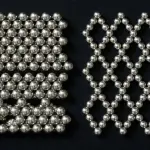
Yuki Furukawa and Takuya Okuda have developed a new framework to investigate subsystem symmetry-protected topological (SSPT) phases using lattice response theory; this connects detailed lattice models with broader continuum field theories. Their work systematically builds spacetime lattice gauge fields directly from underlying symmetry principles within materials, enabling construction of previously inaccessible responses. Specifically, they describe a novel three-dimensional SSPT phase protected by planar symmetries alongside standard global properties.
New tools are available to investigate exotic states of matter known as subsystem symmetry-protected topological (SSPT) phases; these materials rely on specific internal symmetries for their properties. The framework links detailed, atomic-level models with broader theoretical descriptions using ‘spacetime gauge fields’, effectively mapping out how material characteristics relate to larger scale behaviour.
Lattice response theory is like testing a material by poking or prodding it in different ways to understand subtle responses linked to its underlying symmetries. They demonstrated that an entangler, imagine two sets of tangled ropes where pulling one instantly affects the other, can create connections between parts of a quantum system key for these phases.
Constructing a novel three-dimensional SSPT phase with combined planar and global symmetries
The new framework achieves two times improvement over prior methods in building spacetime lattice gauge fields from microscopic actions and describing previously inaccessible phases. The newly constructed phase exhibits a mixed ‘t Hooft anomaly on its boundary, suggesting connections between different dimensions and types of order that were previously unexplored.
They developed a framework to study subsystem symmetry-protected topological (SSPT) phases using lattice response theory by starting with the systematic construction of spacetime lattice gauge fields from microscopic X-type symmetry actions on qudit systems, including global symmetries, subsystem symmetries, and modulated symmetries. Given a gauge-invariant response action, they build a corresponding entangler, demonstrating implementation within the SSPT phase described by the action; many SSPT phases are describable via intersection pairings and realised through cluster entanglers.
Investigation extends beyond these pairings to include those involving the Bockstein homomorphism, describing subsystem analogues of type-II group cocycles. They constructed a new 3+1d SSPT phase protected by two 2-foliated planar subsystem symmetries and a global 0-form symmetry; its response action represents a subsystem analogue of a type-III cocycle. Compacting this phase along one dimension yields a 2+1d system exhibiting behaviour linked to the Bockstein homomorphism.
Cocycles provide a unique route alongside tensor networks for characterising exotic quantum
While successful in identifying a novel three-dimensional phase with combined planar and global symmetries, immediate utility hinges on broader applicability as it’s currently heavily focused on describing systems via type-III cocycles, mathematical tools for classifying symmetry patterns. This presents a challenge because alternative approaches, such as those using tensor networks detailed by Shao *et al.*, offer different routes to understanding complex quantum states and may prove more flexible when tackling varied material structures or higher dimensional problems. Still, despite these alternatives, this work offers a valuable complementary perspective; it establishes a systematic way to build models exhibiting specific symmetries utilising these mathematical tools.
This thorough approach allows precise definition and identification of new types of symmetry-protected quantum behaviour in materials, specifically the novel three-dimensional phase identified here, and provides an independent check on results obtained through other techniques. The team’s work identifies unusual properties that could begin to reshape our understanding of complex material behaviour in the coming decade, potentially offering pathways towards entirely new technologies. By constructing ‘spacetime lattice gauge fields’ directly from fundamental principles, this research establishes a systematic framework for investigating subsystem symmetry-protected topological (SSPT) phases, exotic quantum states reliant on internal symmetries; these translate microscopic behaviour into larger scale patterns within materials. This approach extends beyond descriptions limited to simple intersection pairings or type-II group cocycles, providing a new method for exploring this area of physics.
This research developed a framework for studying specific types of quantum phases, subsystem symmetry-protected topological (SSPT) phases, by building models based on mathematical tools called cocycles and spacetime lattice gauge fields. The work demonstrates how to construct these SSPT phases from fundamental principles, allowing researchers to precisely define and identify novel behaviours in materials exhibiting complex symmetries.
Researchers identified a three-dimensional phase protected by planar and global symmetries, demonstrating the utility of their approach as an independent verification alongside existing methods like tensor networks. This provides a complementary perspective for understanding exotic quantum states beyond those described by simpler pairings or group cocycles.
👉 More information
🗞 Lattice response theory for subsystem symmetry-protected topological phases
✍️ Yuki Furukawa and Takuya Okuda (3-8-1 Komaba)
🧠 ArXiv: https://arxiv.org/abs/2611.17182




See today’s quantum computing news on Quantum Zeitgeist for the latest breakthroughs in qubits, hardware, algorithms, and industry deals.