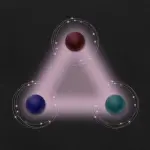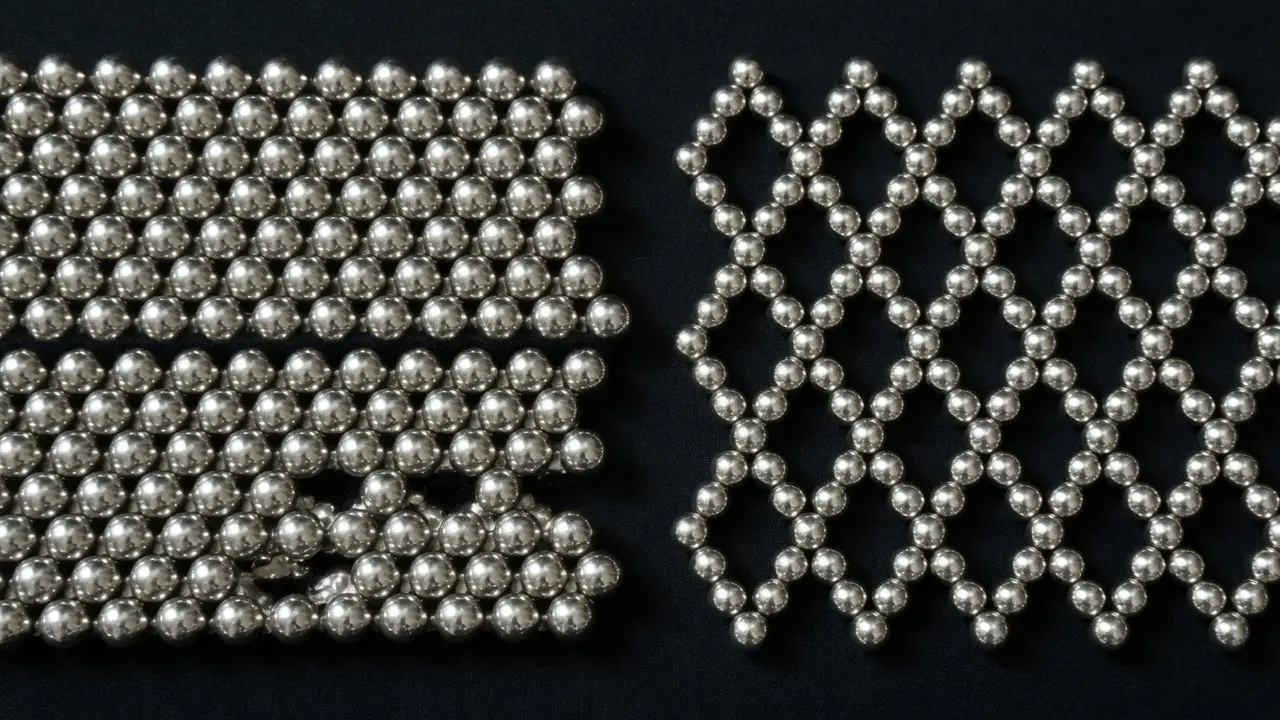
A method for characterising complex quantum materials now defines how topological defects couple; previously, distinguishing such systems relied solely on individual defect properties. A lattice framework identifies ‘higher-group statistics’ as Berry phases from sequences of microscopic operations, specifically constructing a loop-flip process yielding a phase of +i. This differentiation extends to two Z4 toric codes with identical anyon behaviour but distinct underlying structures. The team devised a method for characterising materials by examining how “defects”, imperfections affecting electron behaviour, interact; previously, analysis focused only on individual flaws.
This approach uses advanced mathematical concepts called “higher group statistics” to define interactions as measurable phases arising from sequences of microscopic operations within the material. This approach employs advanced mathematical concepts called “higher group statistics”, which describe how different types of defects influence each other like a complicated dance choreography where each flaw has specific moves affecting its partners.
They define interactions as measurable phases arising from sequences of microscopic operations performed within the material, using a closed Majorana chain, a type of topological superconductor, as their central example to demonstrate this process and construct a loop-flip with phase +i.
Defect Interactions in Topological Superconductors Via Higher-Group Statistics and Berry Phases
A technique centred around ‘higher-group statistics’ was developed to describe defect interactions within quantum materials, a complicated dance choreography where each flaw has specific moves affecting its partners. This framework defines these interactions not simply through individual properties but via measurable “Berry phases.” Akin to walking around a hill and experiencing an internal change despite returning to your starting point, these phases arise from carefully constructed microscopic operations on the material itself.
A one-dimensional topological superconductor, specifically a closed Majorana chain embedded in three dimensions, served as their central example; constructing a loop-flip process yielded a phase of +i for refined calculations. The approach allows classifying statistical processes via homology groups and detecting complex higher-group structures that would be computationally prohibitive with alternative methods.
Homology Classes Enable Analysis of Higher Group Statistics Beyond Lattice Size Sixteen
Calculations now demonstrate results exceeding previous limits imposed by exponential scaling with defect configurations, extending analysis beyond lattice size 16. This was achieved by constructing statistical processes directly from homology classes without exhaustive enumeration, bypassing bottlenecks inherent in Smith normal form algorithms. Researchers validated their framework across one, two, and three dimensions successfully identifying boundary anomalies present in higher-group symmetry-protected topological phases; for instance, they distinguished 2-group anomalies in each dimension tested.
Homology-based classification advances defect analysis in topological materials
Peking University researchers have demonstrably extended computational reach beyond previous limits imposed by exponential scaling, differentiating complex topological phases previously out of grasp. While constructing statistical processes from homology classes drives this success, it doesn’t guarantee effortless scalability to all higher groups or applicability outside specific toric codes, arbitrarily intricate structures may yet prove analytically intractable. Despite these acknowledged limitations regarding broader applicability and complete scalability, the work represents strong progress; offering new tools for classifying topological phases of matter, materials exhibiting exotic quantum properties, by examining how defects within them interact. By using mathematical structures called homology classes, scientists overcame computational limitations hindering analysis of complex systems and detected boundary anomalies in higher-group symmetry-protected topological phases across multiple dimensions, a result that highlights potential impact on designing novel materials with tailored functionalities and advancing quantum computing technologies.
Researchers developed a framework to classify interactions between defects in topological materials, systems possessing unusual quantum properties, by calculating Berry phases from sequences of hopping operators. This approach allowed differentiation between two seemingly identical toric codes (based on the dihedral and quaternion groups) through their “charge-wall statistics,” revealing distinctions in their underlying structure. The method bypasses previous computational bottlenecks by constructing statistical processes directly from homology classes, enabling identification of boundary anomalies in one-, two-, and three-dimensional systems. These findings provide new tools for characterizing complex topological phases and understanding how defects influence material behavior.
👉 More information
🗞 Higher-Group Statistics on Lattices
✍️ Chen Yang and Yu-An Chen (Peking University)
🧠 ArXiv: https://arxiv.org/abs/2611.16962



See today’s quantum computing news on Quantum Zeitgeist for the latest breakthroughs in qubits, hardware, algorithms, and industry deals.