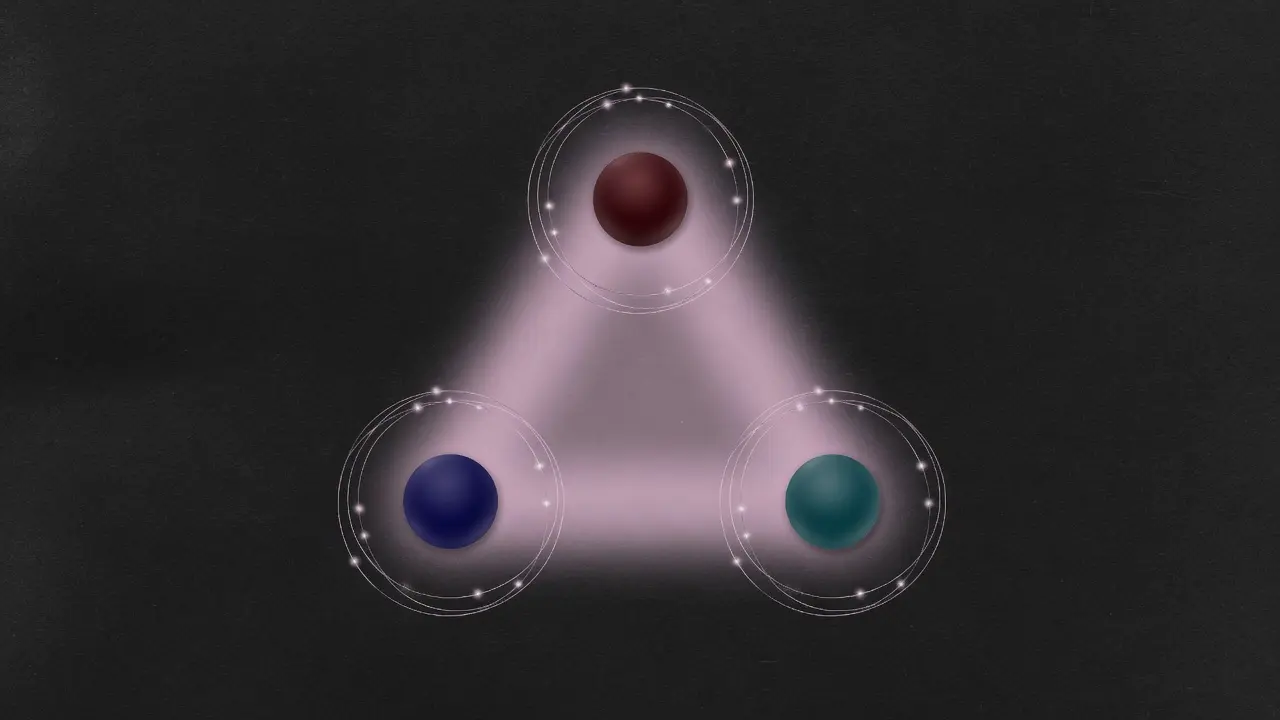
Cumulants of operator semigroups offer a new way to represent solutions governing quantum many-particle systems and enable computation of states even within infinite particle systems. This non-perturbative approach builds on advances in understanding how correlations between particles dictate their evolution and improves upon previous methods reliant on approximations applied to hierarchies describing these interactions. This method focuses on understanding how relationships, or “correlations”, between individual particles dictate their behaviour over time.
By analysing these correlations, researchers can create more accurate models without relying on approximations previously needed in complex system simulations and gain insight into fundamental aspects of quantum mechanics. The NAS of Ukraine has advanced our understanding of quantum many-particle systems through new mathematical modelling techniques; these allow calculations even with an unlimited number of particles.
A key concept here is that of ‘reduced density operators’; imagine trying to summarise a vast dataset, instead of tracking every single data point, you focus only on essential summary statistics to understand the overall trends. This work demonstrates this approach can accurately model systems regardless of particle count; but will these new tools unlock deeper insights into fundamental aspects of quantum mechanics.
Cumulant Analysis Streamlines Many-Particle Quantum System Calculations
Matthew Downer and Alessandro De Luca developed cumulants of operator semigroups, a mathematical toolkit that describes collective quantum particle behaviour without individually calculating every interaction. This sidesteps computational bottlenecks when modelling many-particle systems, similar to using summary statistics instead of raw data for analysing datasets. By focusing on relationships between particles, solutions applicable whether dealing with a few or an infinite number were constructed; this effectively simplifies calculations within the BBGKY hierarchy, akin to zooming out from individual trees to view forest structure.
Systems containing an indefinite but finite average number of identical spinless particles obeying Maxwell and Boltzmann statistics underwent examination; Planck’s constant and particle mass both equalled one in this work. Bounded and trace-class operators defined system evolution governed by Heisenberg equations, offering a non-perturbative solution regardless of particle count. This approach allows analysis without relying on approximations often needed when tackling complex systems.
Cumulant Semigroup Analysis Resolves Infinite Particle System Dynamics
A breakthrough has been achieved in modelling quantum many-particle systems with a new mathematical framework. Calculations previously limited by computational complexity can now be performed even with an infinite number of interacting particles, a sharp improvement over existing methods that struggled beyond finite counts. Representing solutions using cumulants of operator semigroups enables this non-perturbative analysis and bypasses the need for perturbative scaling to the BBGKY hierarchy; it demonstrates correlations between particles fundamentally govern state evolution regardless of system size, applying equally well whether analysing reduced density or correlation operators.
This offers deeper insight into predicting active behaviour within these intricate physical models, further validated by extending findings beyond spinless particles to encompass bosons and fermions, broadening applicability across different types of quantum matter as detailed in related work. The method accurately models hierarchies describing observables alongside those governing state evolution, providing a dual perspective on dynamics that reveals not only how systems change but also what measurable properties define their current state.
Current limitations and potential broader applicability of the framework
Even with this new framework elegantly demonstrating how particle relationships underpin evolution within complex quantum systems, even infinite ones, a vital question remains unanswered: just *how* widely applicable is it. Current focus lies on interactions defined within a specific range for gamma, leaving open whether these techniques can be readily adapted to markedly different physical scenarios or system parameters.
Still, despite this limitation to interaction ranges between 0 and 1, this offers an alternative approach to traditional methods which often struggle with large numbers of interacting components, potentially unlocking insights into materials science or even fundamental physics.
Matthew Downer and Alessandro De Luca established a novel way to mathematically describe many-particle quantum interactions; this could unlock advances in materials science over the next decade and beyond by enabling more accurate simulations of complex systems. The framework’s ability to model both state evolution *and* measurable properties provides researchers with powerful tools for understanding these intricate models.
This research demonstrated that particle correlations govern the dynamics of states in quantum systems, whether those systems contain finitely or infinitely many particles. This finding means the behavior of how particles relate to one another fundamentally determines how the entire system evolves. Researchers proved this applies when analyzing either reduced density operators or correlation operators within hierarchies describing observables and state evolution. Current work extends findings across bosons and fermions, broadening applicability to different types of quantum matter; future efforts will focus on expanding the range of interactions modeled by this framework.
👉 More information
🗞 Cumulants of Operator Semigroups for Hierarchies of Many-Particle Evolution Equations
✍️ V. I. Gerasimenko
🧠 ArXiv: https://arxiv.org/abs/2611.15304




See today’s quantum computing news on Quantum Zeitgeist for the latest breakthroughs in qubits, hardware, algorithms, and industry deals.