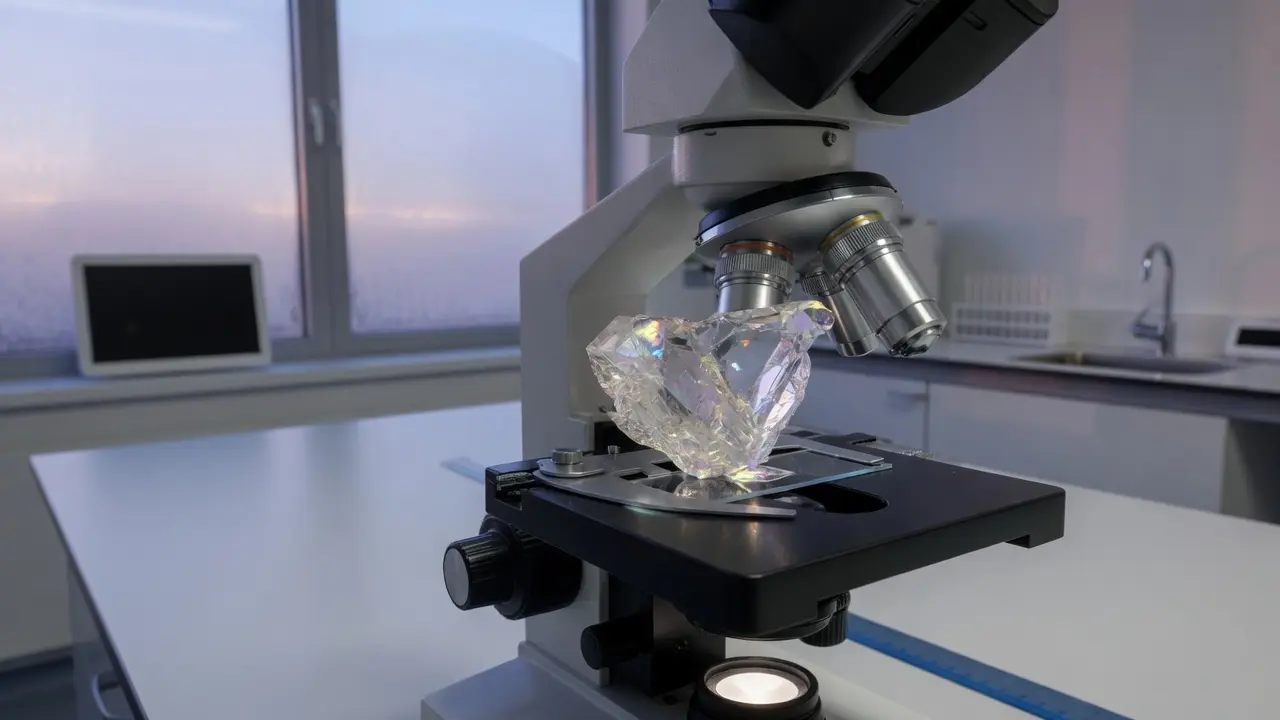
Researchers at the Okinawa Institute of Science and Technology Graduate University have demonstrated the first non-superconducting maser amplifier operating at millikelvin temperatures, a feat previously limited to Josephson and kinetic-inductance devices. The amplifier uses nitrogen impurity spins within diamond to achieve a power gain exceeding 30 dB with an added noise of approximately 2.55 quanta above the standard quantum limit. This advance offers a potential route for applications ranging from spin-qubit readout to dark-matter axion searches, and establishes a complementary approach to amplifying weak signals at temperatures near absolute zero.
Diamond Maser Achieves Near-Quantum Limit at Millikelvin Temperatures
Millikelvin temperatures, a fraction above absolute zero, were important for achieving near-quantum-limited amplification in a newly demonstrated diamond maser amplifier. This contrasts with many existing amplification technologies that do not require such intensely cold operating environments, a necessity for suppressing thermal noise and reaching this performance level. Previously, a ruby maser operating at 1.6 Kelvin achieved a noise temperature of 1.43 Kelvin at 8.4 GHz, requiring approximately 200 milliwatts of pump power and a specific measurement technique.
The diamond-based approach demonstrates amplification with noise performance approaching the quantum limit at millikelvin temperatures, offering a fundamentally different pathway for low-noise signal amplification. Characterization of the diamond’s impurity spins involved echo-detected field-sweep spectroscopy, revealing details about the “fast-relaxing spins” present within the material.
Microwave Pumping Drives Population Inversion
This level of performance, realized at millikelvin temperatures, demonstrates a fundamentally distinct approach to microwave amplification beyond superconducting technologies. The device uses a four-spin cross-relaxation mechanism to drive this inversion, a process that progressively accumulates spins in a higher energy state. Energy relaxation times between the P1+ and P1- spin states were also characterized, revealing a faster decay in P1- spins, with a timescale of approximately ten milliseconds.
This asymmetry helps sustain the population inversion necessary for amplification. The resulting maser amplifier achieves a maximum power gain exceeding 30 dB and a maximum 1 dB output compression point of -63 dBm at 6.595 GHz, demonstrating a significant step towards non-superconducting, near-quantum-limited microwave amplification. The researchers detail how population inversion, essential for amplification, is achieved through microwave pumping and a four-spin cross-relaxation mechanism.
6.595 GHz Performance and Output Compression Point
Measurements of the noise power spectrum revealed a pump-on/off signal-to-noise ratio change of approximately 6 dB, translating to an SNR improvement of roughly 4.4 dB after accounting for insertion loss. This indicates the amplifier’s ability to reduce noise during operation.
The team assessed noise performance using a weak microwave probe tone as a reference, comparing signal strength with the maser both activated and deactivated, and found the noise contribution from a high-electron-mobility transistor (HEMT) to be approximately 9.33 quanta. Subsequent noise measurements taken at varying maser amplifier gains further refined this analysis, allowing calculation of effective input noise and maser noise contributions.
Diamond Maser Operation in Static Magnetic Fields
The diamond maser’s gain profile is demonstrably tunable, shifting with alterations to an externally applied static magnetic field. Measurements reveal a 10 MHz shift in central gain and a 6 MHz full-width at half-maximum as the field varies, demonstrating a capacity for frequency adjustment within the resonator bandwidth. This tunability expands the potential of the amplifier beyond fixed-frequency applications, allowing it to adapt to diverse signal requirements and potentially track changing frequencies in the amplified source.
Beyond frequency control, the system’s operation under strong static magnetic fields distinguishes it from many current amplification technologies. The ability to operate in strong static magnetic fields of arbitrary orientation may offer a complementary, non-superconducting route for applications such as semiconducting spin-qubit readout, magnetic-resonance spectroscopy, and dark-matter axion searches. This resilience opens possibilities for integration into experiments where strong magnetic fields are intrinsic, such as those exploring semiconducting spin-qubit readout or ultra-sensitive magnetic resonance spectroscopy.
Further refinement of the system could address current limitations, including a gain-bandwidth product of approximately 2.8 MHz. The researchers suggest employing multi-mode resonator architectures or a travelling-wave geometry to broaden this bandwidth. Reducing insertion loss and pump power remains a priority for practical implementation as a millikelvin preamplifier.
“Maser amplification may emerge as a fundamentally distinct approach,” the study notes, and such a platform could prove valuable for fundamental physics experiments, including the challenging search for dark-matter axions, and represents a non-superconducting route for quantum technologies. This near-quantum-limited operation at millikelvin temperatures is particularly noteworthy given the historical challenges of solid-state masers, which have traditionally relied on cryogenic operation.
Ruby Maser Benchmark: 1.43 K Noise Temperature
The demonstrated amplifier achieved an added noise of approximately 2.55 quanta above the standard quantum limit. This efficiency stems from the use of nitrogen impurity spins, known as P1 centres, within the diamond structure to achieve population inversion, a critical step in maser operation. Detailed analysis of the system’s noise characteristics involved modelling the signal path through a high-electron-mobility transistor (HEMT) amplifier, accounting for attenuation and noise contributions at each stage.
The experimental approach involved a precise measurement of noise power both with and without the maser amplifier engaged, using equations to separate the contributions from each component. Specifically, the team used a four-spin cross-relaxation mechanism to achieve population inversion, a process important for amplifying weak microwave signals.
Potential for Broadband Masers Beyond HEMTs
While cryogenic operation historically limited solid-state maser development, the context of modern microwave quantum technologies removes that barrier, allowing exploration of their potential as alternatives to existing amplifiers. The device uses a loop-gap microwave resonator and a diamond crystal containing P1 centers, positioning it as a distinct solid-state option within the field of microwave quantum technology.



See today’s quantum computing news on Quantum Zeitgeist for the latest breakthroughs in qubits, hardware, algorithms, and industry deals.