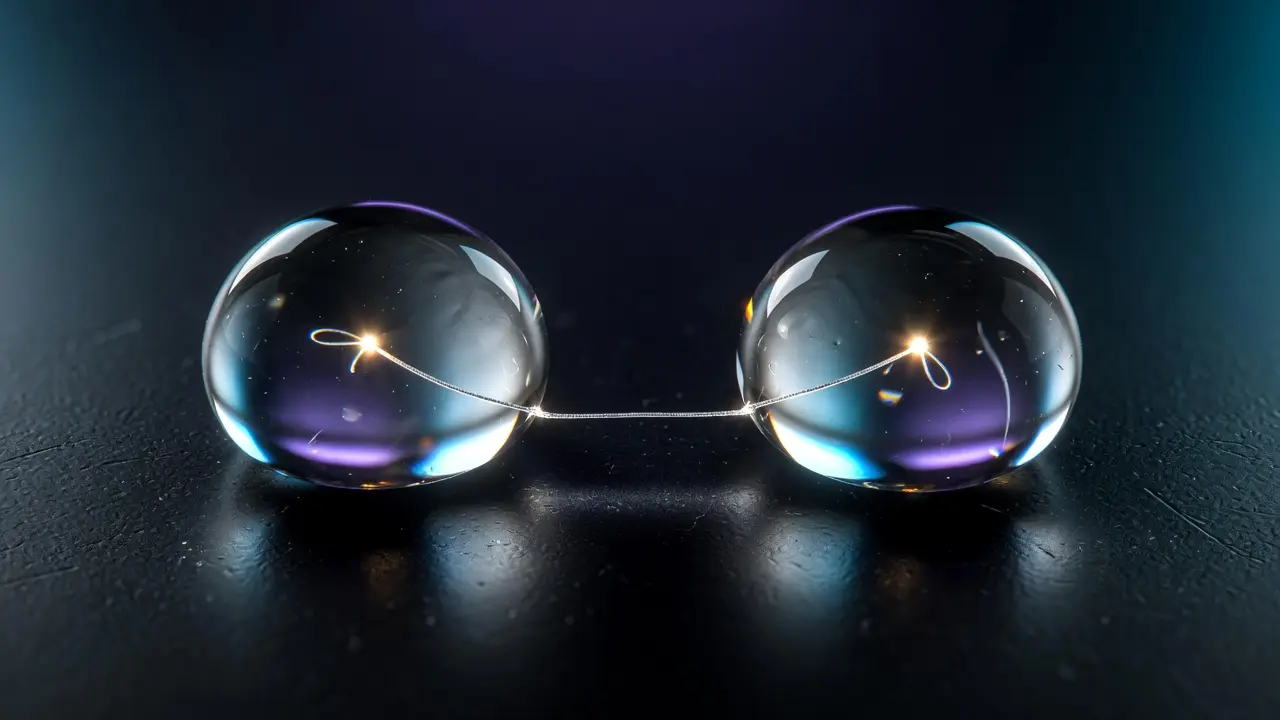
A single 80 nanosecond pulse can dramatically increase entanglement between two spin qubits, according to new work from researchers at Universidade Federal de Uberlândia in Brazil. The team demonstrated that entanglement, as measured by first-recurrence negativity, jumps from 0.18 to 0.64 at 12 K with this purification process, and remains above 0.6 up to 30 K. This finding challenges the conventional understanding of dissipation as solely a source of noise, establishing it instead as a resource for robust entanglement generation. These results establish dissipation, not as noise to be suppressed, but as the very resource that makes robust entanglement generation possible.
Dissipation Enables Entanglement via High-Spin Mediator
Researchers at the Universidade Federal de Uberlândia demonstrated that a dissipative channel can purify a high-spin (S=5/2) magnetic impurity up to a purity level of approximately 0.8. This purification, achieved through resonant optical pumping, surpasses the limits of coherent control, which the study found incapable of exceeding the mediator’s initial thermal value due to the fundamental properties of unitary evolution. The team used the Lindblad master equation to model and compare these control methods, revealing a critical distinction in their ability to manipulate the mediator’s state.
Modeling revealed that maximizing pump strength does not guarantee optimal entanglement; instead, the process peaks at a finite rate before decreasing, as the same channel responsible for purification also introduces decoherence to the qubits it connects. This detailed relationship highlights a trade-off inherent in using dissipation for entanglement, where excessive pumping can undermine the very coherence it seeks to establish.
Optical Pumping Purifies Mediator to 0.8 Purity
Optical pumping achieved a mediator purity of approximately 0.8, a level previously unattainable through coherent control methods alone. Unitary evolution, the standard framework for quantum dynamics, inherently preserves the initial purity of a system, preventing any coherent drive, no matter how strong, from exceeding the mediator’s thermal equilibrium state. This work demonstrates a distinct pathway, using dissipation to surpass those limitations and reach a purity level dictated by the specifics of the optical pumping cycle itself.
The same dissipative channel responsible for purifying the mediator also introduces decoherence into the coupled qubits, ultimately limiting the peak entanglement achievable. Maximizing purification must be balanced against minimizing the leakage of quantum information.
80ns Pulse Increases Entanglement from 0.18 to 0.64
The application of a single 80 nanosecond pulse elevates entanglement, as measured by first-recurrence negativity, from 0.18 to 0.64 at 12 Kelvin, remaining above 0.6 up to 30 Kelvin. This improvement demonstrates that carefully managed dissipation can surpass the limitations of purely coherent control methods in quantum systems. The observed entanglement remains above 0.6 across this temperature range, indicating a robust effect not easily diminished by thermal fluctuations.
This purification process doesn’t merely halt decoherence. It actively establishes a state where entanglement can thrive, a finding that challenges conventional wisdom regarding dissipation as solely detrimental noise. The paper explains, detailing the inherent trade-off between purification and maintaining coherence. The researchers found that the purification achieved by the pulse is limited not by the purification process itself, but by the residual mixing inherent in the optical pumping cycle and the qubits’ dephasing.
Mediator Polarization Persists Beyond Entangling Dynamics
Entanglement rose to 0.64 at 12 Kelvin, demonstrating a substantial and measurable increase in entanglement quality. This purification process, enabled by dissipation, maintains entanglement above a value of 0.6 even as temperatures rise to 30 Kelvin, extending the operational range for quantum technologies. The research reveals that the mediator’s purity, after the 80ns pulse, reaches approximately 0.80, and remains at that level for up to 400 microseconds, a duration far exceeding the entangling dynamics.
This near-permanence stems from the mediator’s limited ability to revert to its thermal state within the relevant timeframe, effectively creating a stable foundation for quantum operations. Modeling this channel with rates fixed by the measured optical pumping of a single Mn spin, they find that the entanglement it enables is not monotonic in the pump strength: it peaks at a finite rate and then decreases, since the same channel leaks decoherence to the qubits through the coupling that mediates their entanglement.
The study highlights that the observed entanglement is a dynamic interplay between dissipation and entanglement building concurrently. The researchers state, emphasizing the efficiency of the method.
High-Spin Impurity as a Quantum Dot Entangler
Researchers demonstrated that the mediator, a high-spin (S=5/2) magnetic impurity, can be purified to approximately 80% of its maximum possible purity using this dissipative process, a result challenging the long-held assumption that dissipation solely introduces noise into quantum systems. This purification occurs despite the inherent thermal mixing of the mediator’s spin state, a persistent issue in realistic, finite-temperature quantum computing architectures. The team’s modeling, using the Lindblad master equation, revealed a critical limitation of coherent control: unitary evolution fundamentally preserves the initial purity of the mediator, preventing any improvement beyond its thermal value.
Genuine dissipation, however, actively combats this thermal mixing, effectively “purifying” the mediator’s state. This purification isn’t limitless; it’s constrained by the efficiency of the optical pumping cycle itself, but the process allows for entanglement generation that would otherwise be impossible.
Optimal Pump Strength Balances Purification & Decoherence
A single 80-nanosecond pulse can elevate the purity of a high-spin mediator to approximately 0.8, a level of refinement achieved through dissipation rather than conventional purification methods. This non-monotonic relationship highlights a key balance: the purification process, while essential, must be carefully calibrated to avoid diminishing the very entanglement it seeks to create. The study establishes that unitary evolution alone cannot purify the mediator beyond its initial thermal value, a limitation rooted in the fundamental principle that such evolution preserves state purity.
👉 More information
🗞 Dissipation as a Resource for Entanglement via High-Spin Mediator Purification
✍️ Ellen Martins Fernandes and Fabricio Macedo de Souza
🧠 ArXiv: https://arxiv.org/abs/2611.18489v1




See today’s quantum computing news on Quantum Zeitgeist for the latest breakthroughs in qubits, hardware, algorithms, and industry deals.