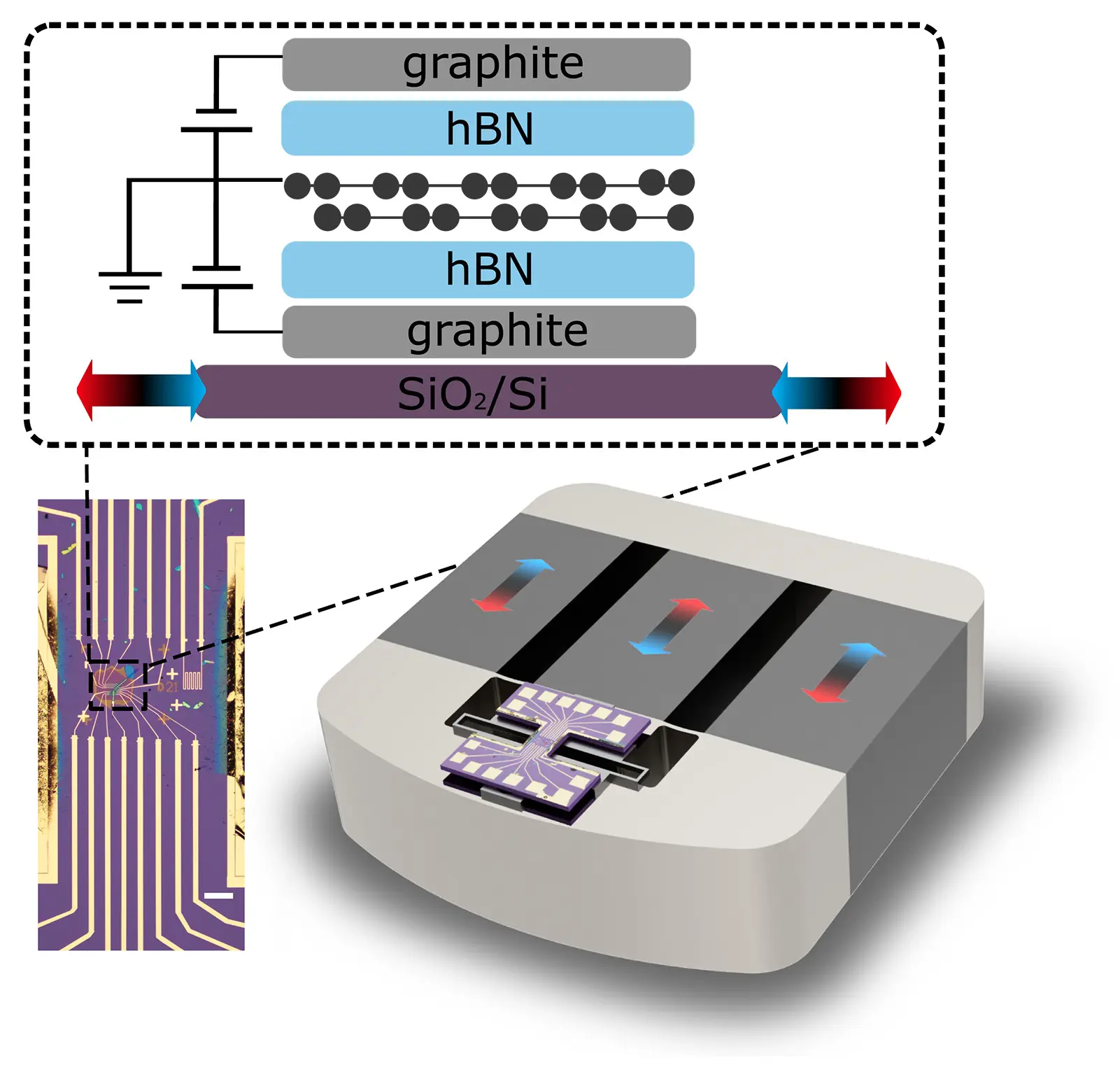
Researchers at the University of Washington have discovered a new method for controlling the properties of graphene by introducing stretching and compressing alongside the traditional twisting technique. Published November 12 in Science, the team’s work demonstrates that applying strain causes significant changes in the material’s electrical resistance, a previously unexplored variable.
This builds on a 2018 MIT study revealing that at a precise 1.1-degree rotation, the “magic angle” and near absolute zero temperatures, these layered graphene materials can become superconducting. “We’ve now added a fundamentally new way to manipulate them, by directly deforming the atomic lattice they live on,” said senior author Matthew Yankowitz, a UW associate professor of physics and materials science and engineering.
Strain Manipulation Amplifies Electrical Response in “Magic Angle” Graphene
Applying compressive or tensile force to layered graphene at the magic angle dramatically alters its electrical behavior, allowing researchers to cycle through multiple material states with predictable precision. This ability to manipulate the material’s properties through strain offers a new avenue for investigating the fundamental physics governing these exotic materials. The team’s work builds on the 2018 discovery that a 1.1-degree rotation between graphene layers, when cooled to near absolute zero, induces superconductivity.
“You can go from a metal, to an insulator, then back to a metal, then to an insulator, then to a superconductor,” Yankowitz said. “This allows us to use one device to stand in for a whole family of materials, so we can see how superconductivity relates to the states around it in a single sample.” This consolidation of material properties into a single, tunable sample streamlines research and accelerates the pace of discovery.
The challenge of working with these atomically thin materials is akin to applying shrink wrap, according to the researchers. “It’s like saying, ‘I’m going to give you two massive sheets of shrink wrap and demand that you place them perfectly flat without any wrinkles,’” Yankowitz stated. Despite this difficulty, the team successfully demonstrated a significant and repeatable response to applied strain. Jiun-Haw Chu, a UW professor of physics, highlighted the broader implications of this finding, noting that the observed response isn’t limited to this specific material system.
“What is remarkable about this large response to strain is that it also appears in other exotic materials, including high-temperature superconductors, one of the great unsolved problems in physics,” Chu said. This commonality across materials suggests a unifying principle at play, bringing scientists closer to understanding the complex phenomena driving superconductivity and related quantum states.
The team’s findings indicate that by “turning these knobs,” researchers can predictably cycle through different states of matter. The research, conducted in collaboration with scientists from institutions including the University of Basel and Clemson University, provides a powerful new tool for exploring quantum materials and potentially unlocking new technological applications. “This common link brings us a step closer to understanding what underlies these fascinating and complex phenomena,” Chu concluded.
What is remarkable about this giant response to strain is that it also appears in other exotic materials, including high-temperature superconductors, one of the great unsolved problems in physics.
Jiun-Haw Chu, UW physics professor
Controlling Lattice Deformation Enables New Exploration of Moiré Material States
Researchers discovered that manipulating strain on layered graphene introduces substantial changes in electrical resistance, expanding control beyond temperature, voltage and magnetic fields. The team detailed in Science how stretching and compressing the material creates “big swings” in resistance, a previously unexplored variable in moiré material research. This new method allows for more precise probing of the material’s quantum states, opening avenues for experiments previously unattainable. The ability to predictably alter material states is rooted in the moiré pattern formed when two atomically thin layers are twisted relative to one another.
Rather than eliminating these distortions, the team harnessed them, attaching the material to a device that expands and contracts with applied voltage to precisely control the degree of strain. The team’s work extends beyond carbon-based materials; researchers are now manipulating a variety of atomically thin substances. They have observed that adjusting variables like voltage, magnetic fields, and temperature can transform these materials from superconductors to insulators.
“Atomically thin materials can host superconductivity, magnetism and other exotic quantum states,” Yankowitz added, highlighting the potential for future applications in efficient computing and power grids. The controlled application of strain provides a new dimension for exploring these quantum phenomena and potentially unlocking new technological advancements.
By turning these knobs, we can cycle through different states of matter in very predictable and repeatable ways.
Matthew Yankowitz, UW associate professor of both physics and materials science and engineering




See today’s quantum computing news on Quantum Zeitgeist for the latest breakthroughs in qubits, hardware, algorithms, and industry deals.