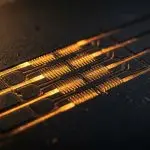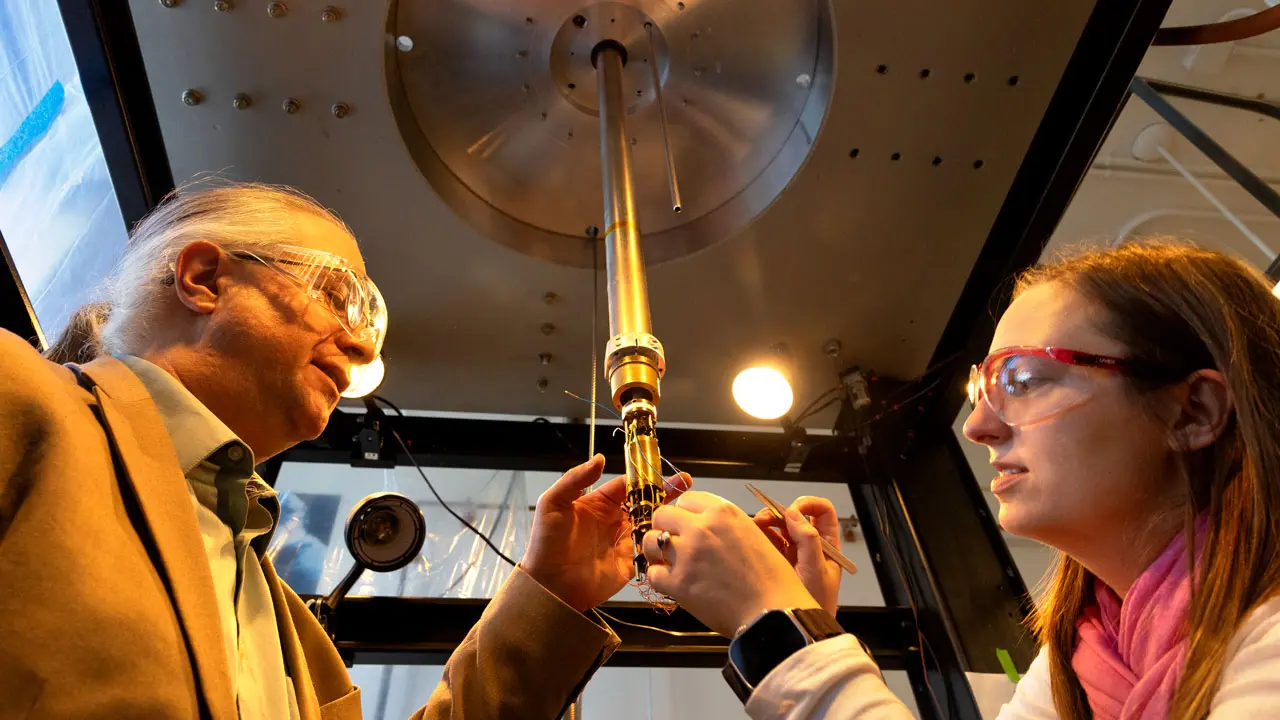
Cornell engineers are now directing the self-assembly of quantum dots, nanoscale clusters of roughly 1,000 atoms, into controlled patterns during liquid evaporation. Published November 14 in Nature Communications, the research details how manipulating concentration and solvent volatility influences the arrangement of these light-absorbing semiconductor particles. The ability to orchestrate these patterns could enable the development of new optical and electronic devices built from nanoscale components, with co-author Anjali Asthagiri ’28 contributing to the work as an undergraduate researcher.
Quantum Dot Cascade Formation During Evaporative Self-Assembly
Anjali Asthagiri ’28, while still an undergraduate student, developed a computational model that accurately predicted the cascade of patterns formed during quantum dot evaporation, matching experimental observations of tile and ribbon formations. The simulations focused on the ordering and packing of the quantum dots, revealing how these nanoscale structures self-assemble under specific conditions; this work built on earlier efforts in Hanrath’s lab pairing quantum dots with microbes for sunlight-driven chemical transformations.
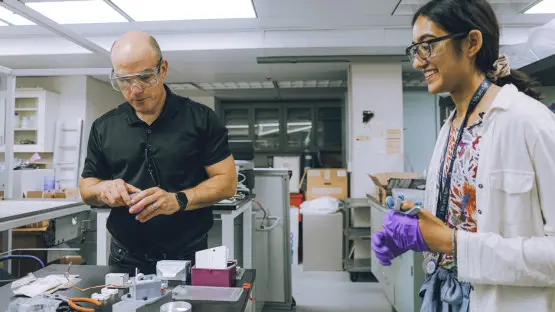
Asthagiri’s model was informed by direct observation. She and Jonathan Palumbo discussed the underlying physics during experiments involving solvent evaporation, convection and diffusion to build intuition for the simulations. The team used a laser confocal microscope to deposit 10 nanoliter droplets of ethylene glycol containing quantum dots, creating a controlled environment for observing the self-assembly process. Each droplet represents roughly 1/100th of a raindrop in volume.
As the droplets evaporated, they left behind a “snail tail of film,” described by Palumbo as demonstrating a sequence of structural changes as the liquid receded. Tobias Hanrath, the Croll Professor in Engineering in the Duffield College of Engineering and the paper’s senior author, said, “One of the beautiful aspects of this paper is that you can have a film that has a lot of disorder and complexity and weird structures that haven’t been seen elsewhere, and most people would look at it and say, ‘Oh, there’s something weird going on there. Let’s make sure we avoid making the film like that.’” Controlling concentration and solvent volatility proved key to replicating the cascade formation, allowing the researchers to move beyond attempts to create perfect, large-scale superlattices.
Previous approaches focused on maximizing crystal size and minimizing grain boundaries, but this work instead explored the potential of smaller, 20-dot clusters to generate diverse patterns. Palumbo explained that the research represents a departure from conventional superlattice design, asking, “What kind of patterns can that make if we grow our super crystal as small as we can, with a cluster of maybe 20 dots? And how do we step between those perfect monolayers and then stranger, smaller systems?”
When people want to take the quantum dot and make a superlattice, they want to make a perfect crystal that’s as big as possible, with no grain boundaries.
Jonathan Palumbo, M.S. ’25, doctoral student in the Hanrath Energy Lab
Controlling Pattern Development via Solvent Evaporation Rate
Researchers have demonstrated precise control over the resulting patterns by manipulating solvent volatility during quantum dot evaporation, and the cascade of morphologies observed is not random. Tobias Hanrath, the Croll Professor in Engineering, explained that embracing complexity, rather than attempting to eliminate it, is key to understanding and controlling these systems.
“I think the interesting conceptual shift is if you embrace the complexity and approach it as ‘Ah, I wonder what’s actually happening there? What gives rise to that?’” The findings, published November 14 in Nature Communications, establish a framework for engineering nanoscale structures with tailored optical and electronic properties.
During the experiments, Jonathan and I would discuss why we may be seeing these cascades and the different underlying physics phenomena at play: solvent evaporation, convection, diffusion.
Asthagiri, who was supported by an Engineering Undergraduate Research Grant for her work on the proj
Source: https://news.cornell.edu/stories/2026/11/tigers-zebras-quantum-dots-nanoparticles-assemble-patterns

See today’s quantum computing news on Quantum Zeitgeist for the latest breakthroughs in qubits, hardware, algorithms, and industry deals.