Ana Belen Sainz and colleagues at University of Gdansk investigate postquantum steering, a phenomenon extending beyond the bounds of quantum theory, and reveal its behaviour in complex scenarios. The study extends the investigation of this effect to systems involving multiple parties, previously limited to single quantum entities. An algorithm for certifying this postquantum behaviour is introduced, alongside a hierarchy of mathematical tools to define the limits of quantum systems. The work demonstrates that postquantum steering is not merely a theoretical possibility but could emerge in broader physical theories, and establishes a key distinction between steering and Bell nonlocality, showing that nonclassical correlations do not automatically guarantee nonclassical steering.
Multi-party certification defines the boundary of postquantum steering
For the first time, certification of postquantum steering, correlations exceeding those permitted by quantum mechanics, extends to scenarios involving multiple characterised quantum parties. Previously, this capability was limited to single-party analyses, hindering a complete understanding of its potential. This development completes the understanding of postquantumness within Einstein-Podolsky-Rosen (EPR) scenarios, resolving a decade-long limitation in quantum information theory. EPR steering, a form of entanglement, assesses whether one party can reliably predict the state of another by performing local measurements. The inability to certify multi-party postquantum steering previously left a gap in our ability to fully explore the limits of quantum correlations in complex systems. A hierarchy of mathematical tools, termed semidefinite programs, was developed to rigorously define the boundary between quantum and postquantum behaviour, enabling a more thorough assessment of nonclassical correlations. These programs provide a systematic way to determine whether observed correlations can be explained by any quantum state and measurement settings, or if they necessitate a more general theory.
This advancement confirms the theoretical possibility of postquantum steering and suggests its potential relevance in broader physical theories beyond standard quantum mechanics, distinguishing it from simple Bell nonlocality. A decade of work established mathematical formalisms and resource theories to quantify this stronger-than-quantum effect, with earlier studies demonstrating its potential activation in quantum networks and its independence from Bell nonlocality. Bell nonlocality, demonstrated through Bell tests, reveals correlations stronger than those allowed by local realism, but does not necessarily imply the ability to steer another party’s state. The team developed a hierarchy of ‘semidefinite programs’, mathematical tools used to define boundaries, to rigorously assess nonclassical correlations. These programs confirm that postquantum steering isn’t merely a mathematical quirk but could arise in broader physical theories beyond standard quantum mechanics, potentially offering insights into alternative frameworks for understanding reality. Furthermore, their algorithm not only certifies postquantum steering but also validates the presence of standard quantum steering in certain instances, providing a benchmark for comparison and ensuring the reliability of their findings. The algorithm’s efficacy relies on efficiently solving these complex semidefinite programs, a computationally intensive task requiring advanced optimisation techniques.
Multi-party postquantum steering certification via semidefinite programming
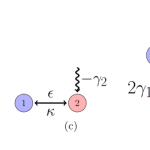
Semidefinite programs, a mathematical technique akin to drawing a precise fence on a map, proved central to extending the understanding of postquantum steering to multi-party scenarios. These programs define boundaries within mathematical spaces, allowing a rigorous determination of whether a given set of correlations originates from quantum mechanics or requires something beyond it. The mathematical formulation involves expressing the constraints imposed by quantum mechanics as a set of linear inequalities, and then checking if the observed correlations satisfy these inequalities. Prior certification of postquantum steering relied on analysing only one party’s quantum behaviour. This new approach uses semidefinite programs to simultaneously constrain the behaviour of multiple parties, creating a more thorough and robust test. By systematically tightening these boundaries, the team could effectively ‘rule out’ quantum explanations for certain observed correlations, thereby confirming the presence of postquantum effects in complex systems. Their work centres on a specific scenario involving one Alice and two Bobs, each with two measurement choices and two possible outcomes, utilising qubits, the fundamental units of quantum information. The choice of two measurement settings and outcomes simplifies the analysis while still capturing the essential features of the steering phenomenon. The use of qubits, rather than continuous variables, allows for a more tractable mathematical treatment.
Multiple-party steering reveals limitations of nonclassical correlation tests
Scientists have steadily mapped the boundaries of quantum mechanics for a decade, seeking to define what lies beyond its established rules. However, the very tools used to achieve this expansion reveal a surprising disconnect. The team’s analysis demonstrates that nonclassical correlations, previously thought to guarantee steering, are not sufficient to confirm it. This finding highlights the subtlety of quantum entanglement and the importance of distinguishing between different types of nonclassical correlations. Despite revealing that standard tests for quantum behaviour are insufficient to guarantee steering, this sharply advances our understanding of quantum correlations. The implication is that observing correlations that violate classical predictions does not automatically imply the presence of steering, a more stringent form of entanglement.
Standard tests for quantum behaviour are insufficient to guarantee this stronger form of entanglement, as their analysis demonstrates. These tests often rely on Bell inequalities, which detect violations of local realism but do not directly assess the ability to steer another party’s state. Extending the analysis of postquantum steering to multiple quantum parties completes a long-standing theoretical challenge within quantum information theory. This articulates the concept for complex systems, previously limited to single-party scenarios, and delivers an algorithm to confirm whether observed correlations exceed quantum limits. The algorithm’s performance is crucial for experimental verification, as it provides a practical method for identifying postquantum steering in real-world systems.
Postquantum steering isn’t simply a mathematical possibility permitted by fundamental principles; it may genuinely arise in physical theories beyond quantum mechanics. This finding establishes a clear distinction between steering and Bell nonlocality, revealing that nonclassical correlations do not automatically imply nonclassical steering, a subtle but important nuance. The ability to distinguish between these phenomena is crucial for developing a more complete understanding of the foundations of quantum mechanics and exploring potential extensions to it. The research was submitted to the arXiv preprint server on 8 Apr 2026, making the findings available to the wider scientific community for scrutiny and further investigation.
The researchers demonstrated postquantum steering in scenarios involving multiple quantum parties, completing a theoretical challenge previously limited to single-party systems. This is important because it clarifies the relationship between different types of nonclassical correlations, showing that simply observing correlations beyond classical predictions does not guarantee the presence of steering. They also developed an algorithm to certify when observed correlations exceed quantum limits, providing a method for experimental verification. The study establishes a clear distinction between steering and Bell nonlocality, enhancing understanding of quantum mechanics and its potential extensions.
👉 More information
🗞 Postquantum steering in scenarios with multiple characterised parties
🧠 ArXiv: https://arxiv.org/abs/2604.07078
See today’s quantum computing news on Quantum Zeitgeist for the latest breakthroughs in qubits, hardware, algorithms, and industry deals.