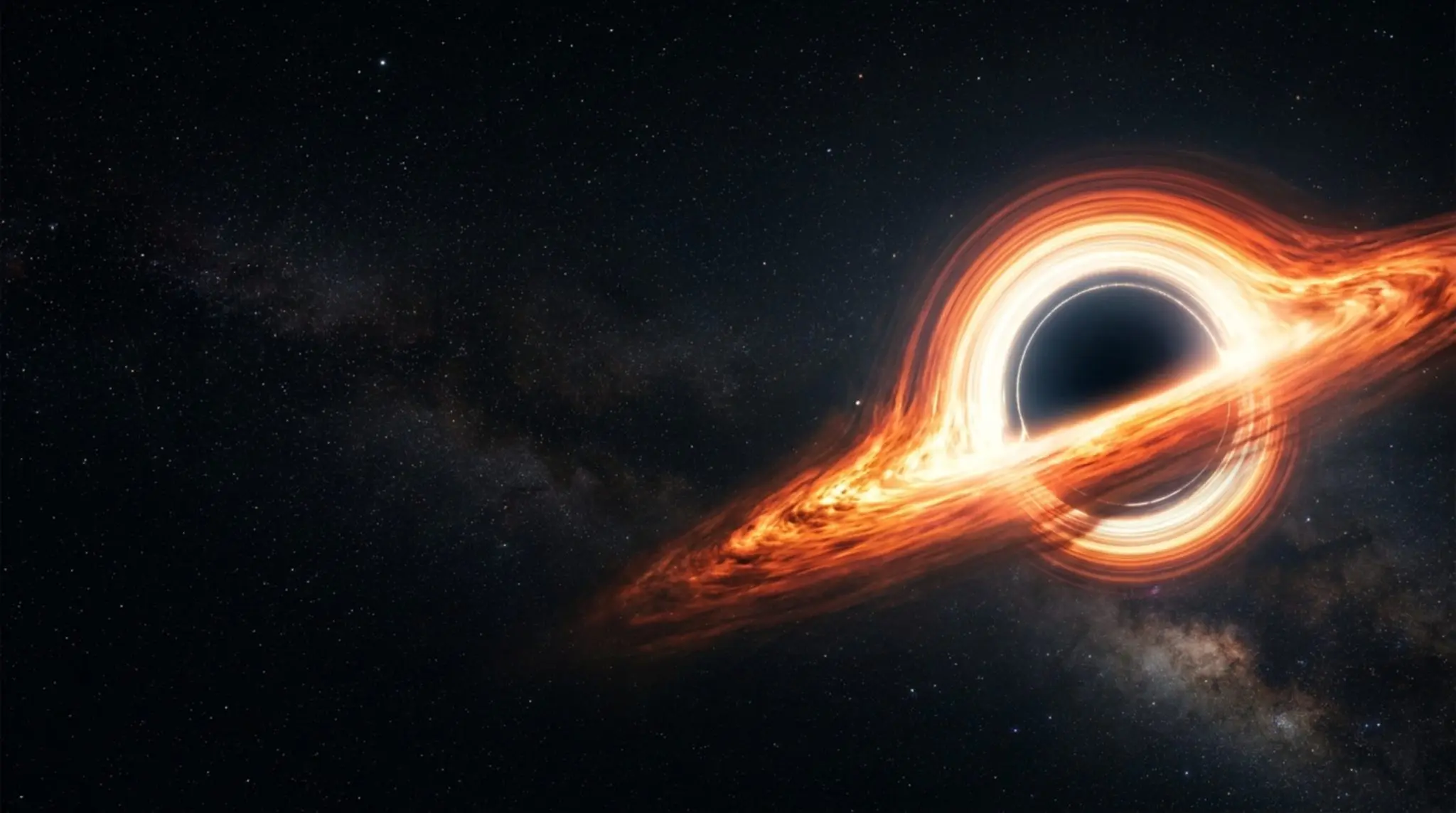
A key quantum property, called imaginarity, changes around a black hole due to Hawking radiation according to new mapping from Hainan Normal University. This detailed analysis reveals behaviours not previously understood regarding local evolution of ‘imaginarity’ within a black hole’s atmosphere; it offers ways to decode information structures surrounding these cosmic objects and understand the fundamental quantum nature of thermal radiation emitted by them. The change in this imaginarity quantifies nonreal coherence within quantum states.
Analysis of these changes shows that different regions surrounding a black hole exhibit contrasting patterns in this property, with some showing increased values while others decrease. Changes to this key quantum property around black holes caused by Hawking radiation have been mapped, where this thermal emission is akin to heat radiating off hot metal but originating from an area beyond which nothing can escape.
This work focuses on ‘imaginarity’, a measure of how much “unreal” or non-classical coherence exists within quantum particles, essentially quantifying potential connections that go beyond normal physical interactions. Analysis of the shift in imaginarity across different regions surrounding a Schwarzschild black hole, a simplified spherical model used as a starting point for more complex simulations, reveals these differing patterns are influenced sharply by the strength of the Hartle, Hawking constant and event horizon radius.
Entanglement degradation and imaginary time around Schwarzschild black holes
A technique rooted in bipartite entanglement analysis dissected quantum behaviour near the black hole; this involved constructing a theoretical scenario where two observers, Alice and Bob, exist just beyond the event horizon of a Schwarzschild black hole, a simplified spherical model used for initial calculations. An initially entangled pair of particles was modelled alongside how Hawking radiation distorts this entanglement from each observer’s perspective; Hawking radiation is akin to heat radiating off hot metal but originating from an area where nothing can escape. This distortion resulted in a more complex four-particle state which then allowed focus solely on accessible information available to Alice and Bob, effectively simulating their local observations.
Quantum imaginarity, quantifying intrinsic nonreal coherence within quantum states, exhibits notable behaviours in curved spacetime environments. The analysis explored Dirac field reduced states near a static Schwarzschild black hole, revealing how Hawking thermal radiation affects three measures of this imaginarity: relative-entropy, geometric, and durability; analyses performed for both accessible and inaccessible regions.
Kruskal modes coupled with a Bogoliubov transform represent particles influenced by gravity, streamlining calculations using parameters such as particle frequency and the event horizon radius, factors impacting information redistribution. Relative-entropy imaginarity follows a valley-shaped radial profile, decreasing from approximately 0.7 for fully accessible states to nearly zero inside the quantum atmosphere.
Quantified decline of quantum coherence near event horizons using multiple imaginarity metrics
They further explored how Hawking thermal radiation impacts nonreal coherence by examining geometric and durability alongside relative-entropy; both accessible and inaccessible states were considered during these investigations. Fully accessible states exhibited a valley-shaped profile radially, decreasing to a local minimum inside the quantum atmosphere, while those deemed inaccessible showed an opposing peak-shaped trend.
Hawking radiation and quantum coherence shifts near black holes reveal clues
The researchers have mapped how quantum imaginarity shifts around black holes due to Hawking radiation; understanding this behaviour is key for tackling the information paradox, the long-standing problem of what happens to data that falls into these cosmic objects. However, their analysis relies on modelling a simplified scenario involving just two entangled particles near a static black hole, limiting its scope. This investigation reveals differing behaviours in nonreal coherence within the surrounding atmosphere depending on whether states are fully accessible or inaccessible. Establishing distinct radial profiles, a valley shape for accessible states contrasted by peaks in those deemed inaccessible, provides new insight into information structuring near such extreme objects as it relates to thermal emission and offers potential avenues for further research exploring more complex scenarios with greater particle interactions.
The study demonstrated that quantum imaginarity, a measure of intrinsic quantum incoherence, decreases radially around a Schwarzschild black hole due to Hawking radiation. The Hartle-Hawking constant strengthened redistribution effects on imaginarity, whereas increasing event horizon radius weakened them. These findings offer a novel perspective on understanding the structure of information within black hole atmospheres and the nature of Hawking radiation itself.
👉 More information
🗞 Evolution of quantum imaginarity in black hole quantum atmosphere
✍️ Ruopu Sun and Xiaofen Huang
🧠 ArXiv: https://arxiv.org/abs/2609.17314

See today’s quantum computing news on Quantum Zeitgeist for the latest breakthroughs in qubits, hardware, algorithms, and industry deals.