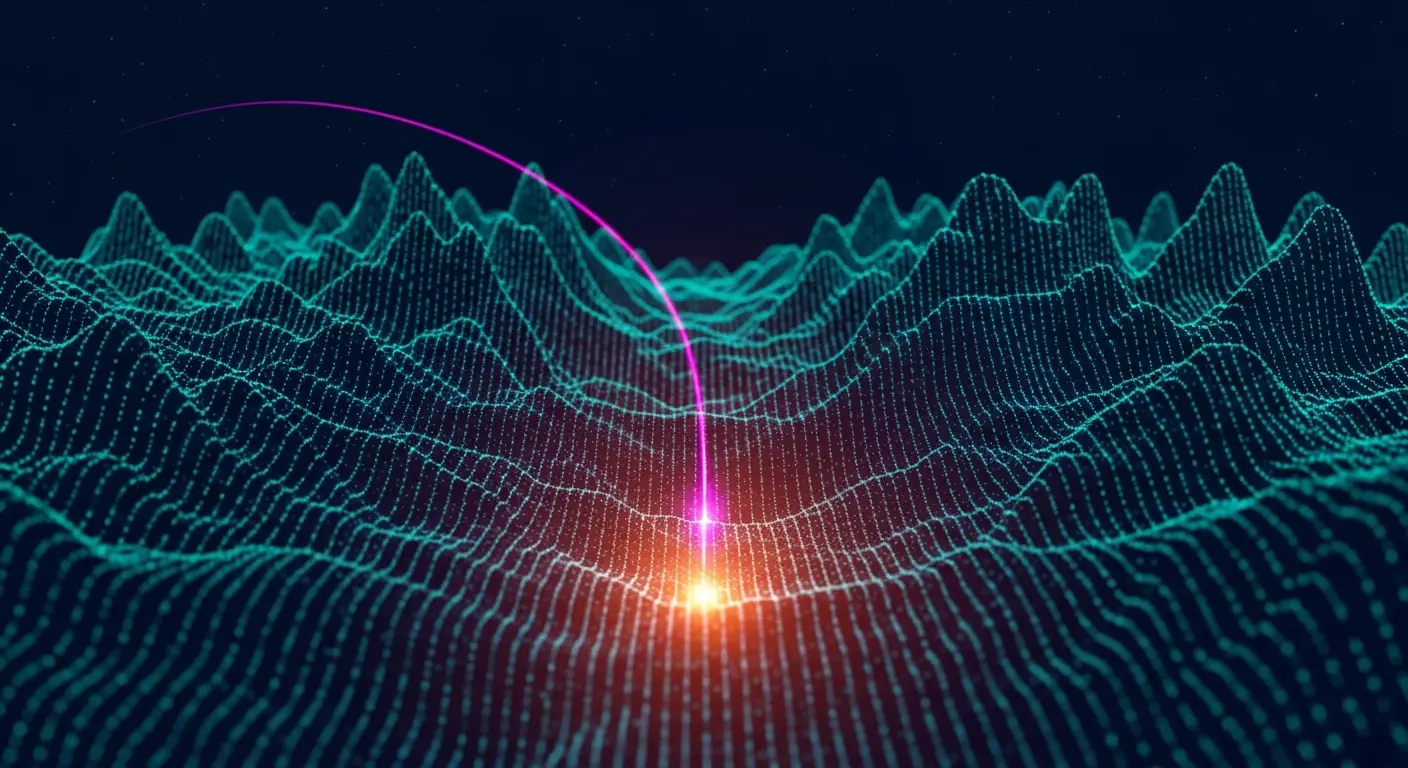
Xiaolong Deng, of the Leibniz Supercomputing Centre, and colleagues have found that gate and readout fidelities in superconducting devices used for variational quantum workloads drift over time, despite current scheduling systems assuming a static backend quality. Their formulation of runtime calibration as a state-trajectory feedback-control problem investigates whether proactive calibration can improve future optimisation. Modelling calibration quality as a drifting state and recovery as a costly reset, the team compared feedback calibration with open-loop baselines across varying latency regimes, from cloud-like (25ms) to tight-loop (4s). The results reveal that feedback control offers benefits in local-millisecond and tight-loop scenarios, particularly when processing numerous calibration targets under capacity pressure.
Millisecond-scale feedback control enables sustained high-throughput superconducting qubit
Superconducting devices now sustain over 74,000 calibration cycles within a six-hour period, a feat previously limited by the time required for traditional, facility-wide recalibration. This represents a significant advancement, as conventional calibration procedures often necessitate lengthy downtime, hindering sustained quantum computation. The ability to perform such a high volume of calibrations is crucial for mitigating the effects of decoherence and control errors inherent in superconducting qubits. A positive-gain region for calibration now exists in local-millisecond and tight-loop latency regimes, demonstrating that actively monitoring and adjusting device performance during computation demonstrably outweighs the associated computational costs. This is a departure from traditional approaches where calibration was considered a periodic overhead, and instead positions it as an integral part of the computational process. By formulating runtime calibration as a feedback-control problem, the team revealed that allocating processing time to calibration improves future optimisation trajectories, especially when managing numerous calibration targets under capacity pressure. This formulation leverages principles from control theory, treating the qubit’s performance characteristics as a dynamic system that can be actively steered towards optimal operation.
Improvements in optimisation trajectories were observed when managing multiple calibration targets simultaneously, exceeding the performance of existing methods which assume static backend quality. Variational quantum algorithms, such as the Variational Quantum Eigensolver (VQE) and Quantum Approximate Optimisation Algorithm (QAOA), are particularly susceptible to fluctuations in qubit performance, as their iterative optimisation procedures rely on accurate gradient estimation. The team modelled calibration quality as a ‘drifting equivalent-age state’, effectively tracking the rate of device performance degradation over time. This ‘equivalent-age’ concept provides a quantifiable metric for the accumulated effects of drift, allowing the calibration system to prioritise qubits that have deviated furthest from their optimal operating point. Demonstrating that actively resetting this state through calibration could offset future performance losses, they benchmarked calibration performance across three latency levels, including a cloud-like system with 25ms latency and a tight-loop system operating at 4 microseconds. This revealed that the benefits of calibration grew with the workload’s sensitivity to quality and the initial calibration age of the device, establishing a clear link between calibration frequency, system latency, and overall quantum processor throughput. The sensitivity of the workload refers to how much the optimisation process is affected by small errors in qubit control and measurement.
The research highlights the importance of considering the temporal dynamics of qubit performance, moving beyond the assumption of a static backend. The 4-microsecond tight-loop system represents a highly integrated setup where calibration and computation are tightly interleaved, allowing for rapid correction of performance drifts. In contrast, the 25ms cloud-like system introduces significant communication overhead, limiting the effectiveness of real-time calibration. The team’s findings suggest that the optimal calibration strategy depends heavily on the specific hardware architecture and network conditions. Furthermore, the ability to calibrate numerous qubits in parallel is crucial for scaling up this approach to larger quantum processors. This requires efficient scheduling algorithms that can distribute calibration tasks across the available qubits without introducing excessive contention or delays. The observed 74,000 calibration cycles demonstrate the potential for continuous monitoring and adjustment of qubit parameters, paving the way for more robust and reliable quantum computations.
Calibration efficacy diminishes with network latency in remote quantum processors
Increasing attention is focused on mitigating the effects of ‘qubit drift’, the gradual degradation of performance in superconducting quantum devices, to enable longer and more complex calculations. This drift is caused by a variety of factors, including temperature fluctuations, electromagnetic interference, and imperfections in the fabrication process. A clear benefit from proactive calibration is evident in low-latency systems, but calibration proved largely ineffective in cloud-based architectures, presenting a key limitation. The inherent delays associated with remote access and data transfer introduce a significant bottleneck, preventing the calibration system from responding quickly enough to counteract the effects of drift. This raises a fundamental tension; as quantum computing scales towards distributed systems and remote access, the infrastructure designed to broaden access may simultaneously undermine the ability to maintain qubit fidelity. The cloud-based model, while offering accessibility, introduces complexities related to network latency, data security, and resource allocation.
This finding justifies continued investment in tightly integrated hardware and software, even as cloud-based quantum computing expands, pinpointing where performance gains are realistically achievable given current limitations. Developing specialised hardware and software stacks that minimise latency and maximise throughput is essential for realising the full potential of quantum computing. Successfully managing the inevitable drift in superconducting qubit performance requires a shift from static to dynamic calibration strategies. These gains are realised within low-latency systems operating at millisecond or microsecond timescales, becoming particularly important as quantum algorithms become more complex and demand greater fidelity. The capacity to calibrate numerous qubits simultaneously is key to realising performance improvements, highlighting the need for further investigation into techniques for optimising calibration schedules and minimising latency in distributed quantum systems. Future research should focus on developing adaptive calibration algorithms that can dynamically adjust the calibration frequency based on the observed rate of drift and the sensitivity of the workload. Exploring alternative calibration techniques, such as machine learning-based methods, could also lead to further improvements in performance and efficiency. The 25ms latency observed in the cloud-like system represents a significant challenge, requiring innovative solutions to overcome the limitations of remote access.
The research demonstrated that dynamically calibrating superconducting qubits during computation can improve performance, but the benefits depend on system latency. Specifically, calibration was most effective in systems operating at millisecond or microsecond timescales, as opposed to cloud-based systems with 25ms latency. This suggests that maintaining tightly integrated hardware and software is crucial for achieving gains in qubit fidelity as quantum algorithms grow in complexity. The authors intend to focus future work on adaptive calibration algorithms and techniques for optimising calibration schedules.
👉 More information
🗞 Runtime Calibration as State-Trajectory Feedback Control in Quantum-Classical Workflows
🧠 ArXiv: https://arxiv.org/abs/2605.11860


See today’s quantum computing news on Quantum Zeitgeist for the latest breakthroughs in qubits, hardware, algorithms, and industry deals.